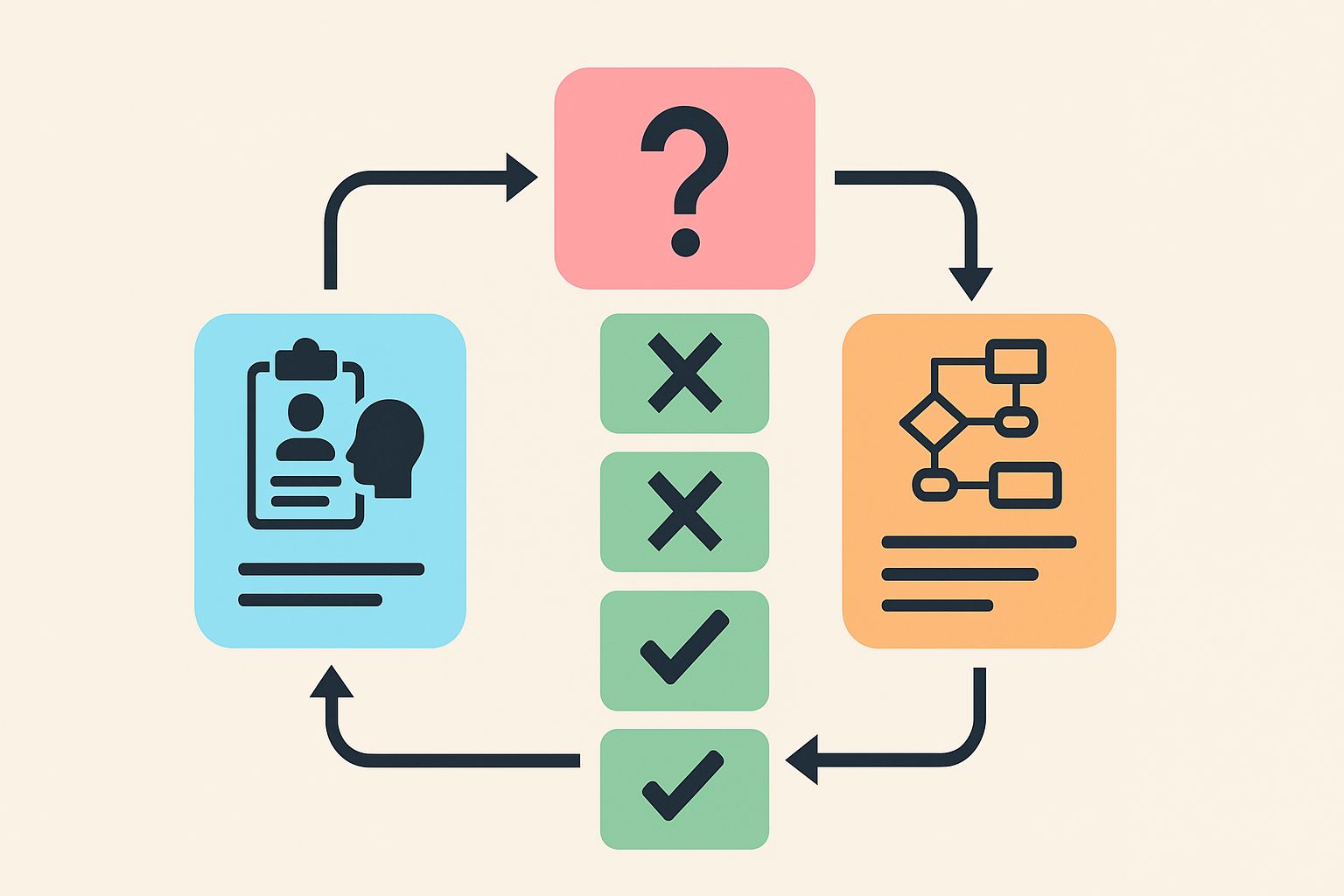
Your Step 1 NBME scores can tell you more than whether you are close to passing. They can show whether your risk is driven by content gaps, unstable reasoning, poor timing, shallow review, or a fragile testing strategy that breaks under NBME pressure. A Step 1 NBME score is not just a number. It is a compressed report of how your knowledge, recognition speed, question interpretation, and test-day judgment behave under exam-like conditions. Two students can both score near the low-pass range and have very different risk profiles. One may know enough medicine but lose points by changing answers, misreading pivots, and choosing familiar distractors. Another may have broad content gaps in physiology, pathology, and pharmacology that make the reasoning problem impossible from the start. The predictive value of NBME practice exams comes from their structure. The Comprehensive Basic Science Self-Assessment is designed for students preparing for Step 1, and NBME describes it as a way to gauge readiness and track progress before the official exam. Current CBSSA reports include an estimated probability of passing Step 1 if the exam is taken within approximately one week. That estimate is helpful, but it is not a guarantee. It must be interpreted beside the score trend, score range, subject breakdown, timing history, and your review quality. For a predictive guide, the most useful question is not, “Was this NBME good?” The better question is, “What does this result predict if I keep studying the same way?” If a student scores 48%, then 52%, then 54%, the trend predicts improvement but not yet stability. If a student scores 63%, then 61%, then 60%, the trend predicts borderline readiness with volatility. If a student scores 68%, then 69%, then 70% under timed conditions, the trend predicts a stronger margin, assuming the exams were taken honestly and not inflated by repeated exposure. Step 1 is reported as pass or fail, but the exam still requires performance above a minimum standard. USMLE currently reports Step 1 as pass/fail for exams administered on or after January 26, 2022, and the official passing standard is reviewed periodically. Because the official report is binary, students often underestimate the importance of margin. A barely passing practice estimate may not protect against sleep loss, unfamiliar stems, anxiety, or a weak content area being overrepresented on test day. A single NBME predicts near-term readiness. A sequence of NBMEs predicts trajectory. Your review notes predict whether the trajectory is likely to continue. This is where the MDSteps Reasoning Method becomes useful. Instead of treating every missed question as “review renal” or “do more immunology,” classify what actually failed. Did you miss the Pivot Clue? Did you understand the topic but fall for a Distractor Trap? Did you pick the right diagnosis but the wrong mechanism? Did you know the fact but apply it to the wrong exam task? These distinctions determine whether your next week should focus on content rebuilding, reasoning drills, timed blocks, or high-yield rule creation. Used correctly, your NBME score pattern becomes a forecast. It tells you whether you are not ready, nearly ready, probably ready, or deceptively ready. The rest of this guide explains how to read that forecast without relying on vague reassurance or panic. The first score tells you your current baseline. The second score tells you whether your study method is working. The third score tells you whether your performance is stable enough to make a test-date decision. This is why one isolated practice exam should rarely drive a final decision. A student can overperform because of favorable topic distribution or underperform because of fatigue, poor pacing, or anxiety. A trend is harder to fake. Start by separating three signals: level, direction, and volatility. Level means your current score band or percent correct. Direction means whether results are rising, flat, or falling. Volatility means how much the scores swing between forms. A rising trend from the 40s to the high 50s predicts that your foundation is improving, but it does not necessarily predict readiness. A flat trend in the low 60s predicts that you may be near the passing range but vulnerable. A stable trend in the high 60s or higher predicts a stronger safety margin, especially if the forms were taken under timed, test-like conditions. Volatility is often ignored. A student who scores 68%, then 58%, then 66% may appear close to ready by average score, but the swing predicts inconsistent reasoning. That inconsistency often appears in long stems, mechanism questions, and two-answer choices. The student can recognize common disease scripts but has trouble when the exam changes one detail. This is a classic Pivot Clue problem. The score is not merely saying “review more.” It is saying, “Your answer changes when the stem changes, but your reasoning system is not detecting the change reliably.” The timing of each NBME also matters. An NBME taken six weeks before the exam is a planning tool. An NBME taken one week before the exam is a readiness tool. NBME’s probability estimate is specifically intended to reflect passing probability if the student tests within about one week, so using an old estimate as a final clearance signal is unsafe. A score that looked acceptable a month ago may no longer reflect current retention, and a score that looked poor early in dedicated may not reflect the benefit of focused repair. A score trend should also be compared with your block behavior. If your timed UWorld blocks are improving but your NBME scores are flat, you may be learning explanation style rather than NBME reasoning style. If your NBME subject breakdown shows repeated weakness in the same domains, content repair is still needed. If the weak domains rotate from form to form, the issue is less likely to be one topic and more likely to be exam-task recognition. A predictive interpretation is not meant to scare you. It is meant to prevent false confidence and false despair. Your trend tells you what is likely to happen if nothing changes. Your review process determines whether that prediction improves. Score bands are useful only when interpreted as risk categories, not identity labels. A student below the passing range is not “bad at Step 1.” That student is receiving a signal that the current knowledge and reasoning system is not yet producing safe performance. A student above the passing range is not automatically safe either. If the margin is thin, the student may pass on a good day and fail on a bad day. When scores are far below passing, the most common problem is not a single weak organ system. It is usually disconnected knowledge. The student may remember isolated facts but cannot connect them to pathophysiology. For example, the stem may describe nephrotic syndrome, but the student cannot connect edema, hyperlipidemia, and loss of antithrombin III to the correct complication. The tempting wrong move is to review only the missed fact. The better move is to rebuild the disease mechanism chain. When scores are near the low-pass range, the problem often shifts from missing content to misusing content. The student knows the general disease but chooses the wrong mechanism, next concept, or associated finding. These students frequently say, “I narrowed it to two.” That phrase usually predicts a Distractor Trap problem. The wrong answer is not random. It is attractive because it belongs to the same topic family, but it does not answer the exact exam task. When scores are consistently above the low-pass range with a reasonable margin, the focus changes again. The goal is not to learn every obscure detail. It is to protect the margin by preventing avoidable misses. That means practicing fatigue-resistant pacing, reviewing incorrects by reasoning type, and converting repeated mistakes into Takeaway Rules. A rule might read, “If a stem asks for the mechanism of edema in minimal change disease, do not answer with immune complex deposition. Ask whether the clue points to podocyte foot process effacement.” Prediction: the student needs foundation repair before test-date decisions. The next NBME should follow targeted content integration, not random question volume. Prediction: the student may be close, but small reasoning errors can decide the result. Miss classification matters more than another passive review cycle. Prediction: readiness is stronger if scores are stable and timed. The goal becomes maintaining accuracy under fatigue and unfamiliar wording. The most dangerous category is the student whose score is barely above passing but whose review is shallow. This student may say, “I passed my last NBME, so I am done.” That may be reasonable if the score was strong, timed, recent, and consistent with prior forms. It is less safe if the score was a one-time jump, an easier-feeling form, or taken under relaxed conditions. For predictive use, do not ask whether the score is “good.” Ask whether it is reproducible. A reproducible score comes from repeated forms, consistent timing, honest conditions, and review notes that show fewer repeated reasoning errors. That is what creates test-day confidence. MDSteps turns practice-exam misses into targeted blocks, pivot-clue review, and miss-pattern tracking so the same NBME-style trap does not keep showing up. A stuck score is not a mystery. It is usually a feedback problem. Many students respond to a plateau by increasing volume. They do more UWorld blocks, reread First Aid, watch more videos, or make more flashcards. Those actions can help if the true problem is exposure. They do not help much if the true problem is that the student keeps making the same type of reasoning error. Imagine a student stuck at 59% to 62% across several NBMEs. Their review spreadsheet lists topics: renal, immunology, cardiology, endocrine. That looks organized, but it may not explain the plateau. If the student missed renal because they confused nephritic and nephrotic patterns, that is a pattern recognition error. If they missed renal because they knew the disease but chose the wrong mechanism, that is an exam-task error. If they missed renal because they ignored a phrase such as “after pharyngitis,” that is a Pivot Clue error. Each requires a different fix. The MDSteps Reasoning Method turns a stuck score into a diagnostic workflow: identify the exam task, find the Pivot Clue, expose the Distractor Trap, classify the miss pattern, convert the miss into a Takeaway Rule, and route the next study action. This matters because a plateau is rarely fixed by reviewing everything equally. It is fixed by finding the bottleneck that repeatedly turns known material into wrong answers. A plateau can also predict inefficient study behavior. If your incorrects are mostly old topics you already reviewed, the problem may be retention. If your incorrects are mostly questions you understood after reading the explanation, the problem may be real-time clue extraction. If your incorrects are mostly questions where you changed from right to wrong, the problem may be confidence calibration. These are not the same problem. This is where a reasoning diagnostic platform can shorten the loop. MDSteps is designed as the reasoning layer above ordinary question volume, helping students classify why misses happen rather than only what topic was missed. For Step 1 students, that means using NBME-style misses to build a Reasoning Profile: which clues are missed, which traps are attractive, and which Takeaway Rules need to become automatic before exam day. The hidden message in a stuck score is usually specific. It may be, “You know enough content to improve, but your review is not changing your decisions.” Once you know that, the next step becomes clearer. The closer you are to test day, the less useful broad study advice becomes. One week out, you need a readiness decision. That decision should combine the most recent NBME probability estimate, the score range, your recent trend, your test conditions, and your error type. No single number should override the whole picture. Start with the official concept: CBSSA reports provide an estimated probability of passing Step 1 if the exam is taken within about one week. That estimate is based on a statistical model and should be considered alongside other results. It is not a guarantee, and it does not know whether you slept poorly, paused the exam, reviewed questions between blocks, or took the form after seeing spoilers. The estimate is most meaningful when the exam was taken under honest, timed conditions that resemble test day. Next, look at the score range or uncertainty. If your likely range overlaps the low-pass area, caution is appropriate even if the point estimate looks acceptable. A borderline score with a wide range predicts that normal day-to-day variation could matter. That does not automatically mean you must postpone, but it means the decision should be made with margin, not hope. Then look at your last two or three assessments. A single recent pass estimate is more convincing when supported by prior improvement or stability. It is less convincing when it appears after several lower scores without a clear explanation for the jump. If the jump followed a targeted repair plan and your review notes show fewer repeated errors, it may be real. If the jump followed random review and easier-feeling questions, treat it cautiously. The last question is the most overlooked. A student can have a reasonable score but dangerous misses. For example, repeated misses in mechanism questions may predict vulnerability because Step 1 heavily tests principles underlying disease and therapy. Repeated misses caused by ignoring “most likely mechanism” or “initial event” may persist on exam day unless actively corrected. In contrast, scattered misses in rare details may be less concerning if the overall reasoning system is stable. One week out, do not try to become a new student. Protect what is working. Your best use of time is to convert your most repeated miss patterns into concise rules. Review incorrects by category: missed clue, wrong task, content gap, trap answer, timing error, and second-guessing. Then rehearse the rule in new questions. The goal is not to memorize your old incorrects. The goal is to prevent the same cognitive move from recurring. A readiness decision should feel evidence-based. The question is not, “Am I scared?” Most students are scared. The question is, “Do my recent data predict a pass with enough margin to absorb normal test-day variability?” If the answer is yes, taper and execute. If the answer is no, postpone only with a precise repair plan. Subject breakdowns are helpful, but they can mislead students when read too literally. A weak bar in cardiovascular does not always mean you need to reread all of cardiology. It may mean you missed physiology graphs, murmurs, shock states, pharmacology mechanisms, or congenital associations. The subject label is a map region, not the street address. To make subject data predictive, attach each weak area to a question task. Step 1 questions may ask for mechanism, diagnosis, risk factor, pathologic finding, adverse effect, microbial feature, inheritance pattern, or experimental interpretation. If your weakest area is endocrine, the next question is whether you missed endocrine because you forgot facts or because you misread the task. A student who cannot distinguish primary from secondary adrenal insufficiency needs a different fix than a student who knows cortisol physiology but chooses the wrong lab pattern under time pressure. Weak subject areas predict risk when they are broad, repeated, and connected to high-yield mechanisms. For example, repeated weakness in renal physiology can spill into acid-base disorders, pharmacology, endocrine regulation, and pathology. Repeated weakness in immunology can affect microbiology, hypersensitivity, autoimmune disease, and transplant concepts. These areas deserve structured repair because they are not isolated. By contrast, a single weak subject bar on one form may reflect sampling. Do not rebuild an entire system because of one bad day. Instead, list the actual missed tasks. Did you miss complement deficiencies, cytokine signaling, antibody structure, or vaccine logic? That list predicts what will happen next more accurately than the label “immunology.” This method also prevents overcorrection. A student sees a low biochemistry bar and spends four days memorizing rare enzyme diseases. But the actual missed questions were about vitamins, rate-limiting steps, and inheritance patterns. The score predicted a targeted biochemistry repair, not a full biochemistry reset. Overcorrection wastes time and creates anxiety. Use weak areas to choose practice, but use missed-question analysis to choose the intervention. Content gaps need concept rebuilding. Task errors need stem interpretation drills. Trap errors need answer-choice comparison. Timing errors need pacing practice. Confidence errors need answer-change rules. A single weak subject can contain all five. For a Step 1 student, the best subject repair is mechanism-centered. Do not ask, “Did I review cardiology?” Ask, “Can I explain why this murmur changes with preload, why this drug causes this adverse effect, why this mutation causes this presentation, and why this distractor is wrong?” That level of review makes the next NBME more predictive of real readiness. A predictive score is only useful if it changes your next action. Many students collect NBMEs like weather reports but do not change their route. After each form, your plan should be based on the NBME Plateau Type that best describes your current pattern. The first plateau type is the Foundation Plateau. Scores are below range and rise slowly because the student lacks integrated knowledge. The fix is not harder blocks. It is rebuilding high-yield mechanisms through organ systems, then testing them in mixed questions. The second type is the Reasoning Plateau. Scores hover near passing because the student has enough knowledge to narrow choices but not enough precision to choose reliably. The fix is missed-question classification. The third type is the Execution Plateau. Scores are acceptable but unstable because timing, fatigue, or answer-changing reduces performance. The fix is timed simulation and rule-based pacing. Your plan should match the plateau type. A Foundation Plateau may need content blocks organized around physiology and pathology. A Reasoning Plateau may need daily NBME-style review that forces you to identify the Pivot Clue before reading explanations. An Execution Plateau may need fewer resources and more full-block stamina practice. A practical weekly plan can be simple. On day 1, review the NBME and classify every miss. On days 2 and 3, repair the top two repeated patterns. On days 4 and 5, test those repairs in mixed timed blocks. On day 6, write Takeaway Rules from persistent misses. On day 7, take or schedule the next assessment only if enough repair has occurred to make the result meaningful. Do not use another NBME too soon after a poor review. If you take a new form before changing the underlying error pattern, you are measuring the same problem again. A better sequence is test, diagnose, repair, rehearse, retest. That sequence turns your scores into feedback rather than punishment. MDSteps can support this workflow through a Step 1 reasoning diagnostic approach, an Adaptive QBank with over 9000 questions, Depth-on-Demand explanations, an exam readiness dashboard, and automatic flashcard decks from missed patterns that can be exported to Anki. The value is not just more questions. The value is routing each miss to the next best action based on why it happened. For Step 1 resources and readiness support, the relevant MDSteps pages are Step 1 preparation, NBME plateau diagnosis, and sample question breakdown. Before you use an NBME score to decide whether to test, verify that the score deserves trust. A practice result is only predictive when it reflects real exam behavior. If you paused repeatedly, looked up answers, took long breaks, or reviewed related material during the exam, the score may still be educational, but it is not a clean readiness signal. Use this checklist after every NBME. First, record the date, form, total score or percent correct, probability estimate if available, timing conditions, and energy level. Second, classify each miss by the primary reason it happened. Third, write a Takeaway Rule for any miss pattern that appears more than once. Fourth, decide whether the next action is content repair, reasoning repair, timing repair, or confidence repair. Fifth, schedule the next assessment only after the repair has been tested in new questions. The most useful final question is this: “What would my score predict if I took Step 1 tomorrow and nothing changed?” If the answer is “I would probably pass with a stable margin,” your goal is execution. If the answer is “I might pass if the form is favorable,” your goal is margin. If the answer is “I do not know why I am missing questions,” your goal is diagnosis. Students often think confidence comes from feeling ready. In reality, confidence comes from interpretable data. A strong NBME trend, a recent probability estimate, stable timed performance, and a clean Reasoning Profile create a better foundation than reassurance. You do not need every topic perfect. You need enough margin, enough stability, and enough control over the errors that used to repeat. Step 1 readiness is not a personality trait. It is a prediction based on evidence. Your NBME scores can tell you whether your current path is safe, fragile, improving, or stalled. The more precisely you read that signal, the less likely you are to waste the final weeks on the wrong fix. Medically reviewed by: Daniel R. Morales, MD, Internal Medicine.Why NBME Scores Predict More Than a Pass or Fail
Predictive principle
How to Read Your NBME Trend Like a Readiness Forecast
NBME pattern
What it predicts
Likely risk
Best next action
Rising but still below low-pass range
Study method is helping, but margin is not ready
Content gaps plus incomplete integration
Rebuild highest-yield systems, then retest
Flat low 60s
Near threshold but fragile
Reasoning misses, weak retention, or timing loss
Classify misses by task, clue, trap, and rule
High variation across forms
Performance depends on question mix
Unstable application under NBME wording
Do mixed timed review with Pivot Clue tracking
Stable high 60s or higher
Better readiness margin
Test-day execution and fatigue
Preserve performance, avoid resource overload
What Different Score Bands Usually Mean
Below range
Borderline range
Comfortable margin
Do not just review your NBME misses. Re-test the pattern that caused them.
Understanding a miss is not the same as repairing it.
The Hidden Message in a Stuck NBME Score
Student symptom
Likely reasoning problem
MDSteps-style fix
NBME score stuck despite more UWorld
Review loop is topic-based, not reasoning-based
Classify misses by Pivot Clue, Distractor Trap, and Takeaway Rule
Always between two answers
Final decision is based on familiarity, not task matching
Name the exact task before reading answer choices
Strong blocks but weak NBMEs
Learning the QBank style rather than NBME wording
Review NBME stems for wording, pivots, and trap patterns
Scores swing widely
Performance depends on topic distribution
Use mixed timed sets and track unstable systems
How to Predict Whether You Are Ready Within One Week
One-week readiness filter
What Your Weakest Subject Areas Really Predict
Which domain appeared weak?
What was the exam asking you to do?
What reasoning step failed?
What will change next time?Turning NBME Predictions Into a Study Plan
NBME Plateau Type
Predictive signal
Tempting wrong move
Correct repair
Foundation Plateau
Low scores with broad subject weakness
Random mixed blocks all day
Mechanism repair, then mixed application
Reasoning Plateau
Borderline scores and frequent two-answer misses
Rereading explanations passively
Pivot Clue, Distractor Trap, Takeaway Rule review
Execution Plateau
Good knowledge but variable timed scores
Adding new resources late
Timed blocks, pacing rules, answer-change control
Rapid-Review Checklist Before You Trust Your Score
Exam-day essentials
References
USMLE Step 1
What Your Step 1 NBME Scores Can Tell You

For NBME score plateaus and review
An NBME score report tells you what dropped. MDSteps helps show why it dropped.
Use MDSteps to sort NBME misses by weak system, reasoning trap, timing issue, distractor pattern, and readiness risk—then practice similar stems before your next assessment.
Full access includes Step 1, Step 2 CK, Step 3, CCS cases, analytics, auto-flashcards, and study planning.
Practice-exam repair
Turn missed NBME concepts into targeted blocks instead of passive note review.
Pivot-clue review
Identify the clue that should have changed your answer before the choices pulled you away.
Readiness tracking
See which weak areas and miss patterns still need work before another assessment.
NBME score stuck?
Practice-exam repair loop
NBME-style practiceMiss-pattern reviewTargeted weak-area blocks
Start with a free reasoning review. Full access includes NBME-style blocks, analytics, flashcards, Step 3 CCS, and study planning.
After NBME review
Still missing the same kinds of questions?
Read why that happens.
1. System
2. Task
3. Error
4. Rule