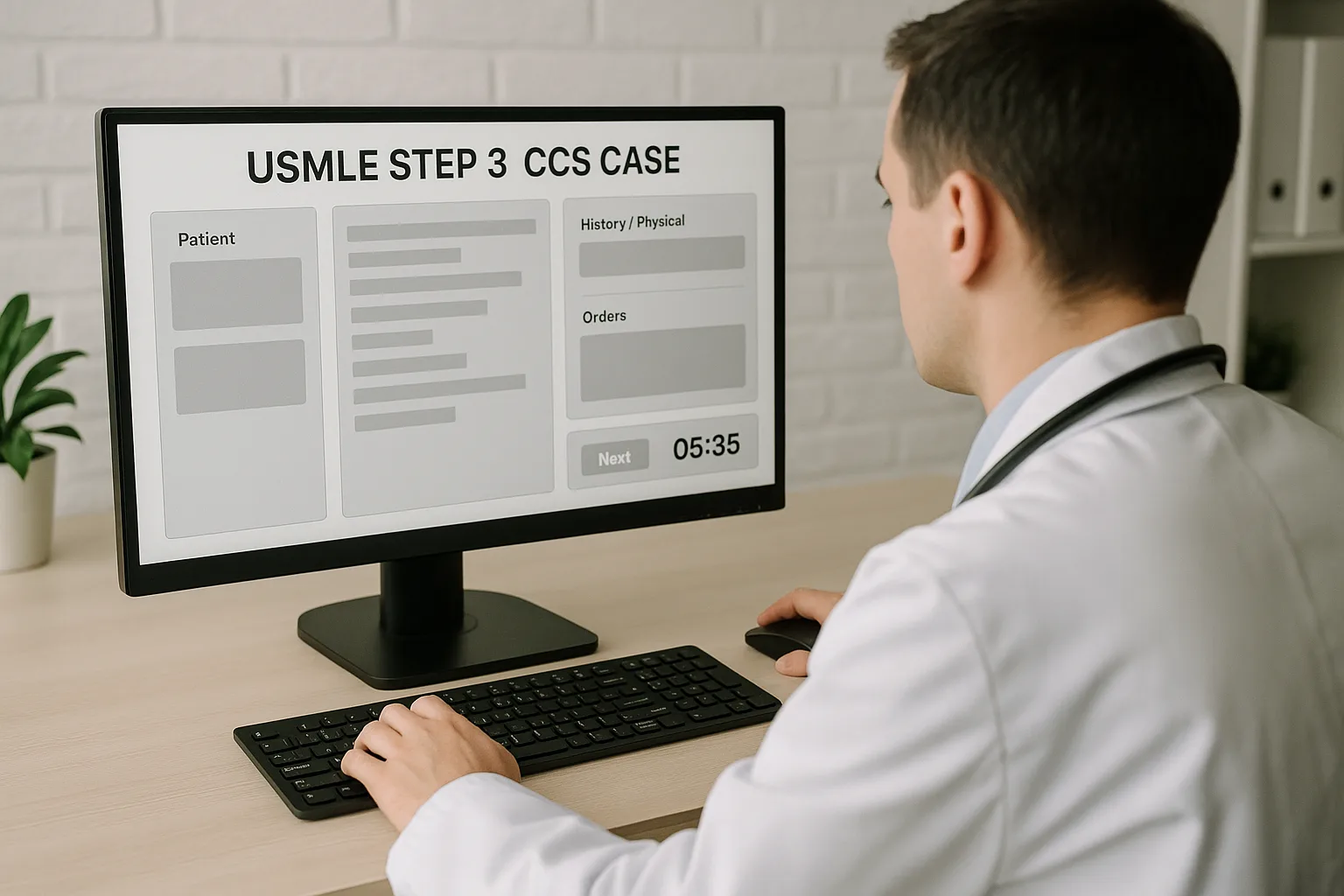
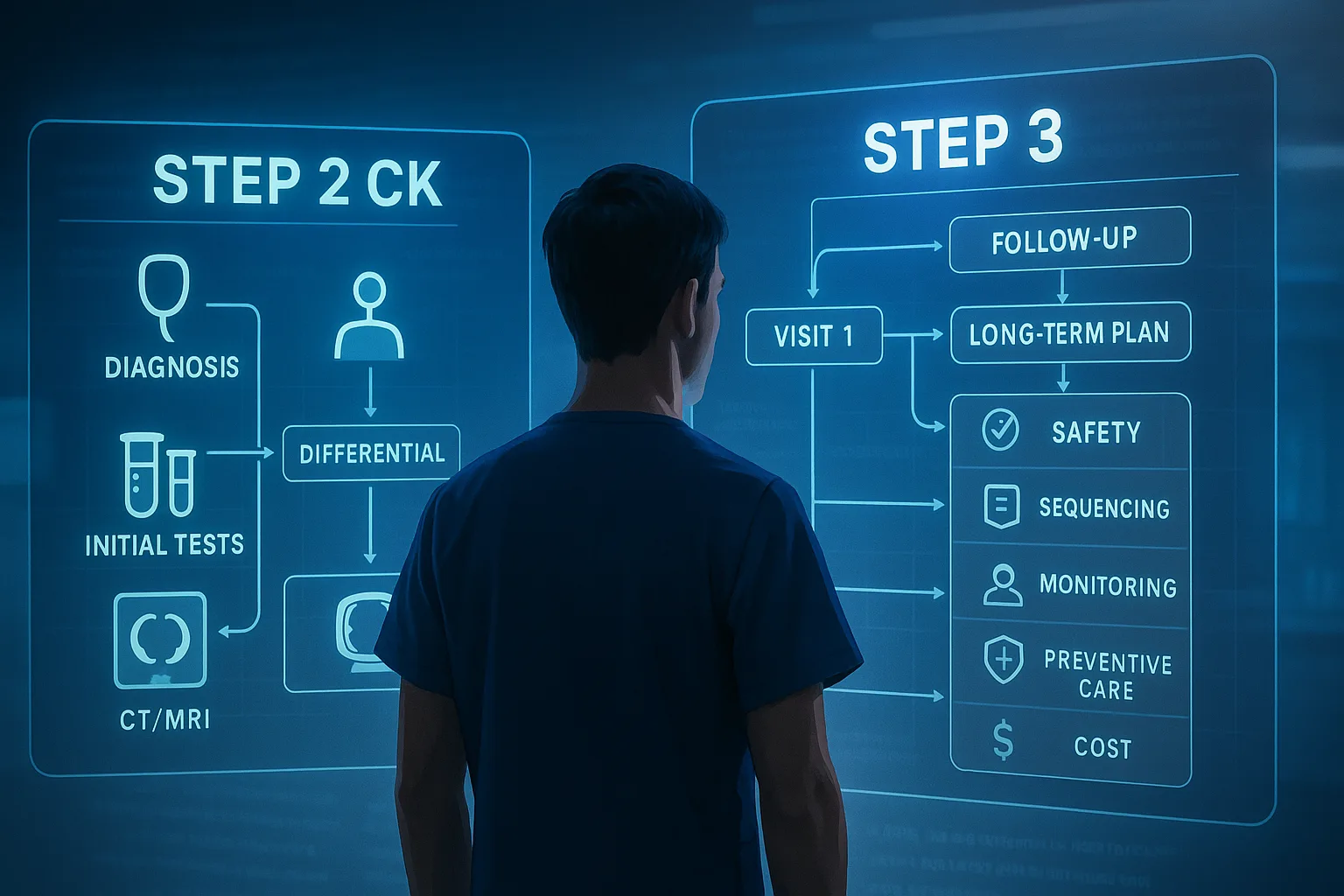
The best Step 3 prep course after failing once is not simply the largest question bank or the most expensive tutoring package. It is the course that identifies why the prior attempt failed, repairs weak decision patterns, forces timed practice, and makes CCS management automatic before the next test date. A Step 3 failure feels urgent because it can affect licensing timelines, residency confidence, and personal momentum. The instinct is to buy a new course immediately. That is understandable, but it is usually the wrong first move. A repeat examinee needs a diagnostic reconstruction before choosing any resource. The question is not, “Which course is popular?” The question is, “Which course fixes the specific pattern that produced a score below the passing standard?” Step 3 is a two-day examination. Day 1 tests foundations of independent practice through multiple-choice blocks, with heavy emphasis on clinical judgment, biostatistics, epidemiology, ethics, patient safety, communication, and foundational biomedical principles. Day 2 combines additional multiple-choice questions with computer-based case simulations. A retake plan must respect that mixed format. A course that only improves passive reading may leave the candidate exposed on timed MCQs. A course that only drills cases may leave Day 1 untouched. A course that only assigns videos may create the illusion of progress without measurable readiness. The first task is to divide the score report into actionable categories. A low overall score can come from several different profiles. One student fails because clinical knowledge is broad but shallow. Another student knows medicine but loses time by overthinking answer choices. Another recognizes diagnoses but cannot choose the next best step. Another performs adequately on MCQs but enters CCS without a reproducible order sequence, reassessment habit, or closure routine. A strong retake course must reveal which of these applies. The passing standard for Step 3 is currently 200 for examinations administered on or after January 1, 2024. That number matters because many repeat examinees were close to passing, sometimes within a narrow band. A close miss does not mean the retake should be casual. It means the margin for error is small and the study plan should target high-yield score leakage. A low score farther from the standard usually requires a deeper rebuild, longer timeline, and more structured accountability. Usually needs test-taking repair, CCS precision, biostatistics cleanup, and timed mixed blocks. Needs a full content pass with daily questions, weekly assessment, and structured case simulation. Needs a rebuilt foundation, supervised schedule, remediation of clinical reasoning, and delayed retesting. The best Step 3 retake course should therefore begin with a baseline assessment. This may include a timed mixed block, a CCS case set, a biostatistics mini-exam, and a review of the prior score report. The course should then convert results into a weekly plan. If a program cannot explain how your missed questions become daily assignments, it is not yet a retake strategy. It is only a library. For repeat examinees, a strong course should include four pillars: adaptive MCQs, CCS simulation, analytics, and a schedule that protects sleep and clinical duties. Residents and graduates often prepare while working unpredictable hours. A generic 10-hour daily schedule is rarely sustainable. The plan must fit the candidate’s real calendar while still creating enough deliberate practice to change performance. That balance is where a retake-focused course earns its value. A retake course should be judged by function, not branding. After one failed attempt, the learner needs a system that produces evidence of readiness. Videos, notes, flashcards, coaching, and question banks can all help, but only if they are connected to a measurable plan. The course should answer five questions every week: what was missed, why it was missed, how it will be fixed, when it will be retested, and whether performance is improving under timed conditions. The first required feature is a large, exam-style QBank with mixed clinical coverage. Step 3 rewards pattern recognition, but it also punishes superficial pattern matching. A patient with chest pain may require immediate stabilization, risk stratification, ECG interpretation, guideline-based therapy, or outpatient follow-up depending on vitals and vignette details. A course should force that decision-making across internal medicine, pediatrics, obstetrics and gynecology, surgery, psychiatry, emergency care, ethics, and prevention. It should not let a repeat test-taker hide inside favorite subjects. The second feature is timed practice. Untimed review has a place early in remediation, especially when rebuilding weak topics. However, the exam is timed and fatigue is real. A repeat plan should gradually shift from tutor mode to timed random blocks. The learner should practice reading the lead-in first, identifying the task, eliminating distractors, and committing to an answer without reopening every option. Many failed attempts are not caused by total ignorance. They are caused by slow decisions, second-guessing, and poor recovery after difficult questions. The third feature is CCS practice that behaves like the exam environment. A static checklist is not enough. CCS requires initial orders, reassessment, time advancement, interpretation of new results, treatment adjustment, consultation when appropriate, counseling, preventive care, and case closure. The candidate must learn to manage patient trajectory, not just select labs. For Step 3, a course with realistic CCS software is usually more valuable than another passive video playlist. The fourth feature is analytics. A repeat candidate should know whether the weakness is diagnosis, next step, treatment, prognosis, ethics, biostatistics, preventive care, or case management. Percent correct by subject is too crude. A good system identifies repeated traps: ordering the definitive test before stabilizing, treating before confirming, missing contraindications, misreading confidence intervals, or choosing inpatient management when outpatient follow-up is correct. The fifth feature is spaced retrieval. Failed attempts often reflect a forgetting problem as much as a learning problem. Reading explanations once does not build reliable recall. A course should convert missed concepts into flashcards, short review prompts, or scheduled reattempts. The candidate should see weak material again before it decays. This is where automation can help when it is used with discipline. MDSteps can fit this retake model when used deliberately. Its Adaptive QBank with more than 9000 questions, automatic study plan generator, AI tutor, missed-question flashcard decks exportable to Anki, analytics dashboard, and Step 3 readiness tools allow a repeat test-taker to connect daily practice to measurable weaknesses. For Step 3 specifically, the live vitals CCS cases are most useful when the learner practices timed orders, advances the clock, reassesses physiology, and reviews every case as a clinical management exercise. The phrase “failed Step 3 once” describes an outcome, not a diagnosis. The best course depends on the failure type. A resident who scored poorly in biostatistics and drug ads needs a different plan from a graduate who never practiced CCS in the exam interface. A candidate who ran out of time needs a different intervention from one who finished early but misread management priorities. Course selection should be matched to the error pattern. The content-gap profile is common among examinees who delayed Step 3 for years, trained outside the United States, or work in a narrow specialty. These candidates may remember broad concepts but lack current outpatient management, preventive care, pediatrics, obstetrics, and psychiatry. They often recognize a disease but miss the next best step because they have not practiced current board-style workflows. The right course for this profile must have broad clinical coverage, explanations that teach decision logic, and spaced review of missed material. The test-taking profile looks different. These examinees often say, “I knew it after reading the explanation.” That statement can be true, but it does not guarantee readiness. The exam rewards retrieval under pressure. A test-taking course should emphasize lead-in analysis, option comparison, distractor recognition, and timing. The learner should practice converting a long vignette into a one-sentence task: stable or unstable, diagnosis or management, initial test or definitive test, inpatient or outpatient, urgent therapy or preventive counseling. The CCS-deficit profile is especially important because many candidates underestimate computer-based cases. They may study MCQs for weeks and leave cases for the final days. This is risky. CCS performance can influence the Step 3 score and may affect pass or fail status. A course for this profile should include timed interactive cases, order sets, reassessment prompts, and debriefing. The candidate should learn what to do in the first two minutes of a case, how to respond to worsening vitals, how to avoid unnecessary invasive testing, and how to close with counseling and follow-up. The fatigue profile is common among interns and residents. The candidate may have adequate knowledge but cannot maintain concentration across two long testing days. This profile needs endurance training, not simply more content. A course should schedule full-length or near full-length practice blocks, break planning, sleep protection, and recovery strategies. It should also teach emotional reset after difficult blocks. The test-taker who carries one bad block into the next block can lose points that were otherwise available. The anxiety profile requires a careful approach. Step 3 retakers often study more than they did for the first attempt, yet feel less confident because the prior failure becomes a mental anchor. The right course should reduce ambiguity. A transparent dashboard, weekly targets, and clear evidence of improvement can help. The learner should not rely on mood to judge readiness. Mood fluctuates. Timed block performance, case execution, and weak-topic closure are more reliable. Most repeat examinees are mixed profiles. That is why a one-dimensional course can fail. A video course may help content but not timing. A QBank may help recognition but not CCS. A tutor may provide accountability but not enough independent practice. The best approach is often an integrated platform plus a disciplined weekly schedule. Tutoring can be added for persistent reasoning errors, but it should not replace daily exam-style work. If you keep narrowing stems to two answers and picking the distractor, the problem may not be your medical knowledge. MDSteps shows the pivot clue, the trap answer, and the reasoning pattern behind the miss—then turns it into targeted practice. A common mistake after failing Step 3 is scheduling the retake too quickly to “get it over with.” Another mistake is delaying indefinitely because the failure created fear. Neither approach is strategic. A retake date should be chosen after estimating how much remediation is required and how many protected study hours are realistic. The plan should be firm enough to create urgency but flexible enough to prevent another underprepared attempt. For a close miss, four to six weeks may be reasonable if the candidate can study consistently and the weakness is narrow. Examples include biostatistics, timing, or incomplete CCS practice. For a moderate gap, six to ten weeks is often safer, especially if the candidate works full time. For a large gap, the candidate may need a longer rebuild with staged assessments before committing to a test date. The goal is not to study forever. The goal is to prevent repetition of the same failure mechanism. Retake preparation should have phases. The first phase is error diagnosis. This should last several days, not several weeks. The candidate reviews the prior performance profile, completes a baseline MCQ set, runs several CCS cases, and lists recurring weaknesses. The second phase is structured remediation. The candidate completes daily mixed questions, reviews explanations actively, creates or imports flashcards from misses, and practices CCS several times per week. The third phase is exam rehearsal. The candidate uses timed blocks, simulated break timing, mixed content, and full CCS sequencing. The final phase is consolidation. The candidate reviews high-yield misses, biostatistics formulas, ethics frameworks, preventive care tables, and CCS order patterns. The retake calendar must account for residency schedules. A busy intern on nights cannot use the same plan as a research fellow with open mornings. The course should adapt to actual availability. A sustainable schedule is usually better than an heroic schedule that collapses after five days. The minimum effective daily unit is often one timed block or one focused content set plus review. On lighter days, the candidate can add CCS cases and flashcards. On heavy call days, the goal may be maintenance: flashcards, biostatistics drills, or review of a small missed-question set. A retake course should also teach when not to test. Do not test because the eligibility window is ending without reviewing whether extension options or reapplication rules apply. Do not test because a friend passed with two weeks of studying. Do not test because the QBank is “finished” if timed mixed performance remains unstable. Completion is not readiness. Readiness means the candidate can reproduce passing behavior under pressure across more than one day. The final two weeks should not introduce a completely new system. They should refine the system already built. This includes reviewing incorrect questions, repeating missed CCS cases, drilling biostatistics, and practicing fatigue management. The best course should make this easy by showing exactly which errors remain open and which are closed. After a failed Step 3 attempt, QBank review must become more precise. Many candidates read explanations passively and mistake recognition for mastery. A better approach is to treat every missed question as a diagnostic specimen. The goal is to identify the cognitive error, not simply copy the correct answer. Did the candidate miss the diagnosis, misunderstand the next step, ignore vital signs, choose an overly invasive test, forget a contraindication, or fall for an attractive distractor? Step 3 questions often test management under uncertainty. The vignette may include incomplete data, comorbidities, abnormal vitals, patient preferences, or resource constraints. The correct answer is often the safest next action, not the most advanced medical fact. This matters for repeat examinees because they may overcompensate after failure by memorizing more detail. Detail helps, but only if it is organized around decisions. A practical review method uses four sentences per missed question. First, state the task: “This question asks for initial management of suspected pulmonary embolism in a hemodynamically stable patient.” Second, state the clue: “Pleuritic chest pain, tachycardia, risk factors, and stable blood pressure point toward diagnostic imaging rather than immediate thrombolysis.” Third, state the trap: “The distractor was treating an unstable patient pathway when the vignette did not show shock.” Fourth, state the rule: “Match management intensity to stability before choosing definitive therapy.” This style converts a missed item into reusable reasoning. Biostatistics deserves separate attention because it is high-yield and often neglected. A repeat course should include practice with sensitivity, specificity, predictive values, likelihood ratios, confidence intervals, p values, number needed to treat, number needed to harm, study design, bias, intention-to-treat analysis, and drug advertisements. The candidate should practice calculation and interpretation. On the exam, the issue is rarely formula memory alone. It is knowing what the number means in clinical language. Ethics and communication also require active practice. Step 3 expects patient-centered decision-making, informed consent, confidentiality, capacity assessment, surrogate decision-making, error disclosure, professionalism, and systems-based safety. A good course should provide frameworks rather than slogans. For example, capacity questions require the patient to understand relevant information, appreciate consequences, reason about options, and communicate a choice. Error disclosure questions favor honesty, explanation, apology when appropriate, and prevention planning. Patient refusal questions require capacity assessment before persuasion or coercion. QBank pacing should change over the study period. Early blocks can be focused if the candidate has severe content gaps. As the retake approaches, blocks should become timed and random. Step 3 does not announce which subject is next. Random practice improves switching, retrieval, and pattern discrimination. It also reveals whether a learner can recover after seeing an unfamiliar topic. This is also where an adaptive platform can outperform a static resource. When missed questions automatically feed flashcards and analytics, the learner spends less time organizing errors and more time repairing them. Used well, MDSteps can support this by turning misses into decks, showing performance trends, and helping a retake candidate decide whether weak domains are truly improving before exam day. CCS is not a side topic for Step 3. It is a distinct clinical performance task. Many repeat candidates know enough medicine to pass MCQ blocks but lose points because their case management is disorganized. They order broadly but do not reassess. They treat before stabilizing. They advance the clock without checking results. They forget monitoring, counseling, prevention, or disposition. They close a case without confirming response to therapy. A retake course should make CCS execution automatic. The first CCS skill is orientation. At the start of every case, identify the setting, acuity, age, pregnancy status when relevant, vital signs, allergies, medications, and chief concern. Setting matters because management differs in the office, emergency department, inpatient unit, and intensive care unit. Unstable patients need immediate stabilization. Stable patients allow a more deliberate diagnostic sequence. The first minute of the case should establish whether the patient needs airway support, breathing support, circulation support, monitoring, intravenous access, urgent medications, or transfer. The second skill is order grouping. Repeat examinees should develop safe default clusters. For an unstable patient, this may include oxygen when indicated, cardiac monitor, pulse oximetry, intravenous access, fluids when appropriate, ECG, focused labs, imaging when needed, and urgent therapy. For chronic outpatient cases, the cluster may include focused diagnostic tests, medication adjustment, lifestyle counseling, follow-up, screening, and preventive care. The point is not to memorize one universal list. The point is to build flexible patterns that match acuity. The third skill is reassessment. CCS cases reward management over time. After ordering tests or therapy, the candidate must advance the clock appropriately, review results, check vitals, and respond. If the patient improves, narrow therapy, transition to oral medications when appropriate, plan discharge, counsel, and schedule follow-up. If the patient worsens, escalate care, broaden the differential, consult when needed, and treat complications. A course that does not train reassessment is incomplete. The fourth skill is avoiding harmful over-ordering. Step 3 cases are not an invitation to order everything. Unnecessary invasive tests, irrelevant consults, delayed emergency treatment, or excessive testing can weaken performance. The exam logic favors clinically appropriate care. A strong course should teach what is necessary, what is optional, and what may be harmful in common case types. The fifth skill is closure. Many cases require counseling, preventive measures, education, and follow-up. A patient with diabetes may need HbA1c monitoring, foot care counseling, eye examination referral, renal protection, lipid management, and lifestyle counseling depending on context. A patient treated for pneumonia may need response assessment, discharge criteria, smoking cessation counseling when relevant, and follow-up. A patient with depression may need safety assessment, treatment plan, counseling, and close follow-up. Closure points reflect real independent practice. For Step 3 retakers, CCS practice should begin early and continue daily or near daily. Short, frequent practice is better than a final-week cram. The candidate should repeat missed case types until the order sequence feels natural. Live vitals and timed orders are particularly useful because they force the learner to manage physiology rather than memorize a paragraph. This is one reason a Step 3 prep course with interactive CCS cases is often preferable for someone who failed once. A repeat Step 3 attempt should be protected. The candidate has already paid the emotional and financial cost of one failure. Before retesting, look for red flags that suggest readiness is still unstable. The most important red flag is inconsistent timed performance. A candidate who has one strong block followed by several weak blocks should not interpret the best block as the true ability level. The exam will sample broadly across two days. Readiness requires repeatable performance. A second red flag is explanation dependence. If the learner understands every missed question only after reading the explanation, that is not the same as being able to answer correctly under timed conditions. The course should include delayed reattempts. A question or concept missed on Monday should be tested again days later in a new form. If the learner still misses the same rule, the concept is not closed. A third red flag is CCS avoidance. Some examinees postpone CCS because it feels unfamiliar. Others run through cases passively by reading model answers. This is dangerous. The candidate should complete timed cases in software, review order timing, and practice closure. If cases still feel chaotic during the final two weeks, the test date should be reconsidered when possible. A fourth red flag is biostatistics panic. Step 3 often includes statistical interpretation, medical literature, and drug advertisement style questions. The candidate does not need to become a statistician, but must be comfortable with common measures and study design. A course should make these questions routine. Panic usually fades when the learner has a fixed approach: identify the measure, write the formula if needed, plug in numbers carefully, and translate the result into clinical meaning. A fifth red flag is sleep debt. Residents often underestimate the effect of exhaustion. A candidate who studies late after long shifts may accumulate hours but lose retention. The final week should protect sleep, meal planning, travel logistics, identification requirements, test-day breaks, and transportation. Administrative errors and fatigue can erode performance even when knowledge is adequate. The final readiness question is simple: can the candidate reproduce passing behavior without coaching? A course can guide, organize, and measure preparation, but exam day is independent. The learner should be able to complete timed blocks, explain misses, run CCS cases, interpret common biostatistics, and maintain composure after hard items. Confidence is useful, but reproducibility is safer. When comparing courses, avoid exaggerated promises. No ethical prep course can guarantee a pass. A trustworthy program should emphasize disciplined practice, transparent feedback, and evidence-based learning. It should also be honest that a prior failure needs analysis, not shame. Many capable physicians fail an exam when the plan does not match the test. The retake should be built to correct that mismatch. The best Step 3 prep course after a failed attempt is the one that turns uncertainty into a measurable retake plan. It should start with diagnostic review, not motivational slogans. It should separate content gaps from test-taking errors, CCS deficits, fatigue, and anxiety. It should assign daily work that matches the failure pattern. It should provide enough exam-style practice to prove readiness before the retake. Use the checklist below before buying or committing to a course. First, confirm that the resource covers both days of Step 3. If the course focuses mainly on passive videos and does not provide strong timed MCQ practice, it may not be enough. If it provides questions but weak CCS practice, it may leave Day 2 exposed. If it provides cases but no analytics, it may be hard to know whether performance is improving. Second, ask how the course handles missed questions. A strong course should not allow errors to disappear. Misses should become flashcards, reattempts, weak-topic assignments, or tutor discussion points. The learner should know which concepts have been repaired and which remain open. The review process should emphasize clinical reasoning. A pile of annotated screenshots is not a system unless those notes return in spaced review. Third, ask how the course defines readiness. Completion percentage alone is not enough. A candidate can finish a QBank with poor retention. A candidate can watch all videos and remain slow on timed blocks. A candidate can read CCS explanations without being able to manage live cases. Better readiness signals include improving timed mixed performance, lower repeat-miss rates, stable biostatistics accuracy, and clean CCS execution across varied presentations. Fourth, evaluate whether the plan fits your life. A resident on inpatient wards may need shorter daily sessions and longer weekend blocks. A graduate studying full time may need a more intensive schedule with daily simulated testing. A parent, night-float resident, or fellow may need a calendar that protects sleep and avoids unrealistic daily quotas. The right plan is demanding but executable. Fifth, choose accountability deliberately. Some candidates need self-directed analytics. Others need tutoring, weekly check-ins, or a coach to audit reasoning. Tutoring is most useful when it reviews specific errors, not when it becomes another lecture series. The tutor should ask why you chose the wrong answer, identify the flawed decision rule, and give you a replacement strategy. For many retakers, a strong practical choice is an integrated Step 3 platform that combines broad questions, live CCS cases, analytics, adaptive scheduling, and missed-question recall. MDSteps is designed around this workflow, with Step 3 preparation, an adaptive QBank, automated flashcards, a study plan generator, and exam readiness tracking. For candidates whose prior attempt exposed CCS weakness, the CCS cases should be used from the first week, not saved for the end. A failed Step 3 attempt should change the plan, not define the physician. The retake should be more analytical, more timed, more case-based, and more honest about weak points. The best course is the one that makes the next attempt feel familiar before test day arrives. When the learner can manage mixed blocks, interpret statistics, navigate ethics, and run CCS cases with a reproducible routine, the retake becomes a professional task rather than a crisis. Medically reviewed by: Daniel R. Alvarez, MD, FACP.Start With the Failure Pattern, Not the Course Name
Close miss
Moderate gap
Large gap
What a Retake-Focused Step 3 Course Must Include
Course feature
Why it matters after a failure
Warning sign
Adaptive QBank
Targets weak disciplines and forces mixed clinical reasoning.
Only subject-by-subject drills with no mixed testing.
Realistic CCS cases
Builds order timing, reassessment, and case closure habits.
Cases are only written explanations or static lists.
Readiness dashboard
Shows whether retake performance is trending above risk range.
No objective threshold before scheduling.
Missed-question flashcards
Turns errors into spaced recall rather than one-time review.
Misses disappear after explanation review.
Structured plan
Protects consistency for residents with limited study time.
Generic calendar that ignores work schedule.
Choose the Course by Failure Type
Course matching algorithm
Learn the patterns behind your misses. Break the plateau.
Still missing questions you thought you understood?
Build the Retake Timeline Around Objective Readiness
Retake profile
Suggested study window
Primary work
Readiness evidence
Close miss
4 to 6 weeks
Timed mixed blocks, CCS polish, biostatistics, ethics.
Consistent passing-range blocks and clean CCS flow.
Moderate gap
6 to 10 weeks
Systematic QBank pass, weekly weak-topic repair, cases.
Upward trend across multiple mixed assessments.
Large gap
10 or more weeks
Foundational rebuild, supervised calendar, repeated testing.
Stable performance before any date is locked.
Use QBank Review to Change Clinical Reasoning
Missed-question review template
Make CCS a Daily Management Habit
CCS phase
Action
Common retake mistake
Opening
Confirm setting, acuity, vitals, allergies, pregnancy status.
Ordering routine tests before stabilizing an unstable patient.
Initial management
Place targeted labs, imaging, monitoring, and treatment.
Using one memorized order set for every case.
Time advancement
Advance in clinically appropriate intervals.
Advancing too far without reviewing vitals or results.
Reassessment
Respond to improvement, deterioration, or new data.
Failing to narrow therapy or escalate care.
Closure
Counsel, prevent, arrange follow-up, and document disposition.
Ending after diagnosis without preventive or follow-up care.
Recognize Red Flags Before You Retest
Exam-Day Essentials
Rapid-Review Checklist for Choosing Your Step 3 Retake Course
Choose a course that has
Avoid a course that relies on
References
USMLE Step 3
Best Step 3 Prep Course After Failing Once

For students stuck despite doing more questions
UWorld explains the medicine. MDSteps explains the decision.
Traditional review often tells you the correct answer. MDSteps helps isolate the decision error: the missed pivot clue, the tempting distractor, the timing mistake, or the weak rule that failed under pressure.
Full access includes Step 1, Step 2 CK, Step 3, CCS cases, analytics, auto-flashcards, and study planning.
Pivot-clue review
See the exact phrase in the stem that should have changed your decision.
Distractor trap logic
Learn why the answer you almost picked felt right—and why it was wrong for this patient right now.
Miss-pattern analytics
Turn repeated mistakes into targeted blocks, flashcards, and readiness signals.
Review the score report. Identify low domains, CCS concerns, and relative weaknesses.
Run a baseline block and CCS set. Use timed conditions, not casual review.
Classify the failure pattern. Content, timing, CCS, fatigue, anxiety, or mixed.
Select the course features. Match resource type to the dominant weakness.
Retest only after objective readiness. Use repeated timed evidence, not hope.
Score stuck after more questions?
Free reasoning diagnostic
Pivot clue isolatedDistractor trap explainedNext study target identified
No credit card required for the free reasoning review. Full access is $27/month after that. Cancel anytime.
Reasoning diagnostic
Still missing the same kinds of questions?
Read why that happens.