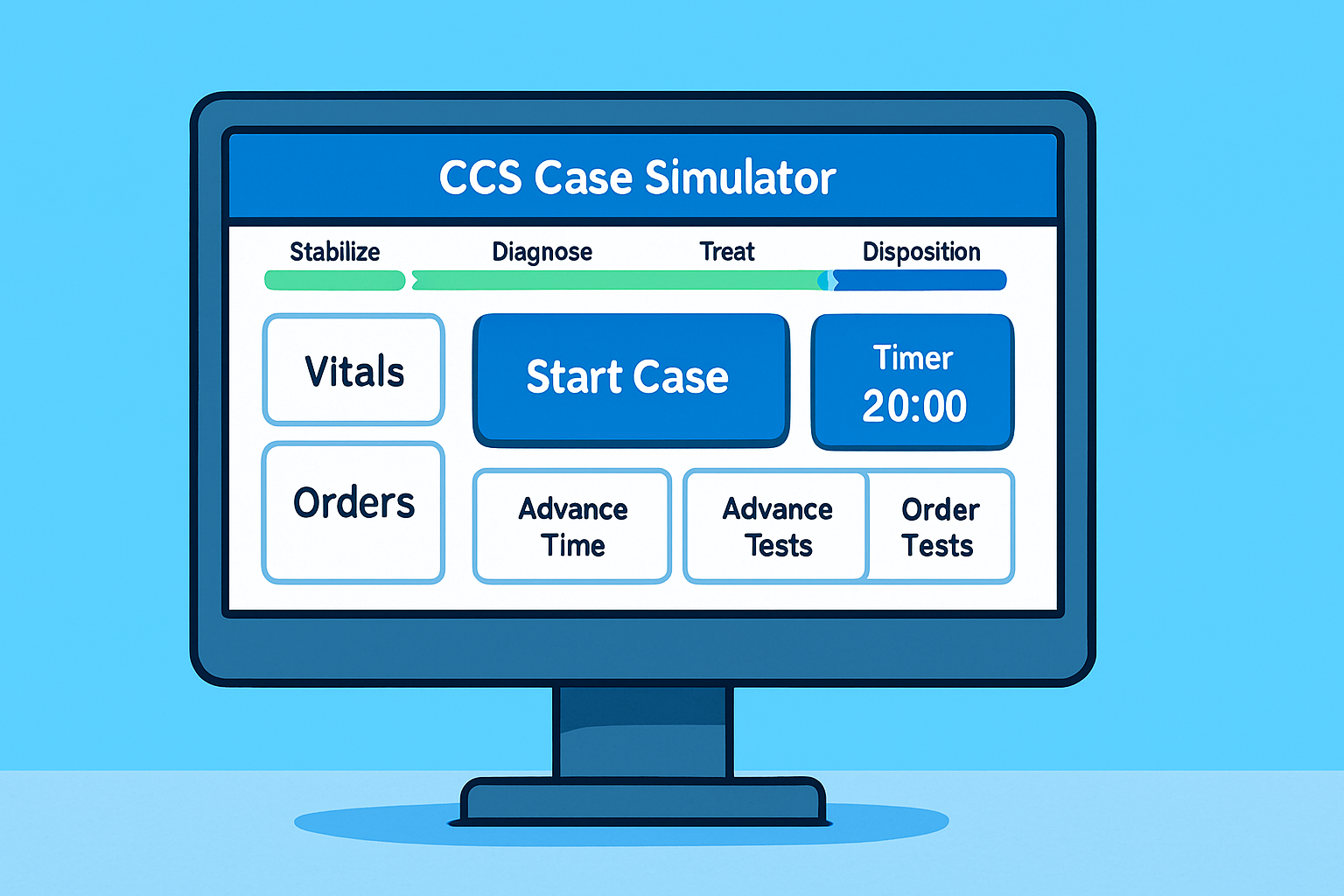
A Step 3 Day 1 vs Day 2 study plan should not treat the two testing days as interchangeable. Day 1 rewards foundations, epidemiology, ethics, mechanisms, and diagnostic reasoning. Day 2 rewards management, prognosis, disease evolution, and CCS execution. Students often prepare for Step 3 as if it were a longer version of Step 2 CK with a few CCS cases attached. That approach misses the core design of the exam. The two days are deliberately different. Day 1, Foundations of Independent Practice, emphasizes whether you can connect clinical decisions to basic medical science, population health, quality, ethics, communication, interpretation of medical literature, and diagnostic reasoning. Day 2, Advanced Clinical Medicine, emphasizes whether you can manage patients over time, choose safe next steps, anticipate complications, and run computer-based case simulations efficiently. This distinction matters because the same disease can be tested with different logic on each day. A patient with heart failure on Day 1 may lead to questions about pathophysiology, drug mechanisms, epidemiologic risk, diagnostic test interpretation, adverse effects, or bias in a clinical study. A similar patient on Day 2 may require medication adjustment, admission decisions, monitoring, discharge planning, prognosis, or urgent intervention in a CCS setting. The content overlaps, but the mental task changes. Day 1 contains approximately 232 multiple-choice questions divided into six 60-minute blocks. There are no CCS cases on Day 1. The day is demanding because many examinees are several years removed from Step 1-style mechanisms and because biostatistics, epidemiology, ethics, and abstract interpretation can feel less predictable than clinical algorithms. Day 1 is not pure basic science. It is basic science and evidence interpretation as applied to clinical practice. Day 2 contains approximately 180 multiple-choice questions divided into six 45-minute blocks, followed by 13 to 14 CCS cases. Each case is allotted either 10 or 20 minutes of real time. The MCQ portion is shorter per block, but the day is longer overall because CCS adds a distinct performance component. You must know what to order, when to change location, when to treat empirically, what monitoring to add, and when preventive care is appropriate. The best preparation plan separates your tasks. For Day 1, prioritize biostatistics, drug mechanisms, microbiology patterns, immunology principles, ethics, patient safety, screening logic, and diagnostic reasoning. For Day 2, prioritize management algorithms, emergency stabilization, outpatient follow-up, prognosis, complications, preventive care, and repeated CCS practice. A single mixed QBank block helps general endurance, but it cannot replace targeted practice for the two exam days. Mechanisms, diagnosis, literature interpretation, epidemiology, ethics, foundational science, safety, and communication. Management, prognosis, treatment sequencing, evolving disease, CCS orders, monitoring, and transitions of care. A useful rule is simple: Day 1 asks, “Why is this happening, how do we know, and how should evidence be interpreted?” Day 2 asks, “What should be done now, what happens next, and how should this patient be managed safely over time?” That rule prevents scattered review. It also helps you decide whether a missed question belongs in a mechanism list, a biostats list, a management list, or a CCS checklist. Day 1 preparation should begin with the areas that are most distinct from routine clinical work. Interns and residents often feel comfortable with common management, but Day 1 can expose gaps in mechanisms, epidemiology, ethics, and abstract interpretation. The goal is not to repeat all of Step 1. The goal is to recover the foundational concepts that still change clinical decisions. Start with biostatistics and epidemiology. You should be able to calculate and interpret sensitivity, specificity, positive predictive value, negative predictive value, likelihood ratios, absolute risk reduction, relative risk reduction, number needed to treat, number needed to harm, confidence intervals, p values, hazard ratios, odds ratios, relative risk, attributable risk, and common study designs. More importantly, you need to translate those values into clinical meaning. If prevalence decreases, positive predictive value falls. If a confidence interval crosses the null value, the result is not statistically significant. If allocation is not concealed, selection bias becomes a threat. These questions are common because they test physician judgment rather than memorized disease facts. Next, review mechanisms that connect directly to diagnosis or treatment. Focus on pharmacology, microbiology, immunology, renal physiology, endocrine feedback loops, acid-base physiology, cardiac physiology, and genetic or molecular mechanisms that explain a presentation. Drug mechanism questions are usually clinically anchored. You may not be asked to recite a pathway in isolation. Instead, you may see an adverse effect, a contraindication, a resistance pattern, or a medication choice that depends on understanding the mechanism. Ethics, communication, and patient safety deserve a separate review block. Do not reduce these questions to vague instincts. Learn a repeatable hierarchy: assess decision-making capacity, respect autonomy, use substituted judgment when appropriate, protect confidentiality unless an accepted exception applies, disclose errors honestly, avoid abandoning the patient, use interpreters rather than family members for medical interpretation, and address impaired colleagues through patient-safety channels. Patient safety questions often reward systems thinking rather than blame. Root-cause analysis, handoff errors, medication reconciliation, closed-loop communication, and quality improvement vocabulary can appear in clinically realistic stems. For diagnostic reasoning, Day 1 often tests the quality of your thinking. Ask what finding would increase or decrease the probability of a diagnosis. Separate screening tests from confirmatory tests. Distinguish disease association from causation. Watch for distractors that are true facts but do not answer the question asked. Sequential item sets can punish premature closure because information may evolve. Generate your answer before reading the options when possible. Use retrieval practice rather than passive rereading. A strong Day 1 session might include 40 timed MCQs, review of every missed biostats or ethics concept, 20 minutes of mechanism flashcards, and a short abstract interpretation drill. MDSteps can support this workflow with an Adaptive QBank, automated study plan generation, an AI tutor for missed-question reasoning, and flashcard decks built from misses that are exportable to Anki. Use those tools to categorize errors quickly, not to create another passive reading pile. Day 1 timing looks familiar because the blocks are 60 minutes, but the cognitive load is different. Biostatistics items, abstracts, drug mechanisms, and ethics stems can consume time if you do not use a structured approach. The best strategy is to protect time for interpretation-heavy questions while avoiding unnecessary overthinking on straightforward clinical items. Begin each question by identifying the task. Is it asking for diagnosis, mechanism, next step, study flaw, interpretation of a statistic, adverse effect, ethical response, or prevention? Many wrong answers come from answering a nearby question rather than the actual one. For example, a vignette may describe a classic disease presentation, but the final line may ask which enzyme is inhibited by therapy or which study design best evaluates an exposure. The final line controls the question. For biostatistics, write formulas during tutorial time only if you can do so from memory and without stress. Useful formulas include sensitivity, specificity, predictive values, relative risk, odds ratio, absolute risk reduction, and number needed to treat. But formulas alone are not enough. Train interpretation. A drug that reduces event rate from 10% to 5% has an absolute risk reduction of 5 percentage points and a number needed to treat of 20. A relative reduction may sound impressive while the absolute reduction is small. Abstract questions often test whether you can resist exaggerated conclusions. For ethics and communication, avoid dramatic answers. The correct answer is usually patient-centered, truthful, nonjudgmental, and safe. Do not choose an answer that dismisses concerns, threatens the patient, violates confidentiality without justification, asks a family member to interpret, or skips assessment of capacity. When a colleague is impaired or a system error is discovered, prioritize patient safety and appropriate reporting channels. When an error reaches a patient, disclose it clearly and explain the clinical implications. For mechanism questions, anchor the mechanism to the vignette. If the question involves an antibiotic, ask whether the stem is testing coverage, resistance, adverse effects, or mechanism of action. If it involves endocrine disease, draw the feedback loop mentally. If it involves renal or acid-base physiology, identify the primary disorder before calculating compensation. If it involves immunology, decide whether the problem is antibody, complement, neutrophil function, T-cell function, hypersensitivity, or immune complex disease. Use an error log that separates knowledge gaps from reasoning errors. A knowledge gap means you did not know the mechanism, formula, association, or guideline concept. A reasoning error means you knew the topic but misread the question, ignored the final line, overruled the vignette, or selected a true statement that did not answer the task. Day 1 improvement comes from fixing both categories. Reading more pages only fixes one. During the final week, Day 1 review should become narrower. Do not attempt a full textbook pass. Review formulas, ethics rules, drug mechanisms, common micro patterns, screening principles, and your own missed-question deck. The purpose is to make high-frequency concepts easy to retrieve under time pressure. If you keep narrowing stems to two answers and picking the distractor, the problem may not be your medical knowledge. MDSteps shows the pivot clue, the trap answer, and the reasoning pattern behind the miss—then turns it into targeted practice. Day 2 MCQs reward clinical management. The questions often feel closer to the work of residency because they ask what should happen next, how a disease changes over time, which treatment is safest, what complication is most likely, or what follow-up is needed. The content may resemble Step 2 CK, but Step 3 often places greater emphasis on unsupervised decision-making, ambulatory care, continuity, prognosis, and patient safety. For Day 2, study management algorithms by clinical setting. In the emergency department, learn stabilization first: airway, breathing, circulation, mental status, hemodynamic instability, oxygenation, access, monitoring, fluids, empiric therapy when delay is dangerous, and urgent procedures when indicated. In inpatient questions, focus on escalation, monitoring, complications, anticoagulation decisions, antibiotic narrowing, discharge readiness, and prevention of hospital-acquired harm. In outpatient questions, focus on screening, chronic disease targets, medication adjustment, counseling, vaccination, and follow-up timing. Many Day 2 items test disease evolution. A patient may present early, worsen, partially respond, develop an adverse effect, or return after discharge. This is where prognosis and complications matter. For myocardial infarction, know mechanical complications, arrhythmias, heart failure, and secondary prevention. For pneumonia, know when to broaden coverage, when to evaluate for empyema, and when outpatient therapy is unsafe. For diabetes, know acute emergencies, chronic complications, medication contraindications, and preventive care. For obstetrics, know how management changes by gestational age and maternal stability. Day 2 also rewards practical treatment sequencing. Do not jump to definitive therapy before stabilization. Do not delay empiric treatment in meningitis, sepsis, ectopic pregnancy with instability, testicular torsion, stroke within treatment windows, or other time-sensitive conditions. Conversely, do not overtreat stable patients when diagnostic confirmation is required. The exam often tests the difference between “best next step” and “best treatment after confirmation.” Preventive care belongs on Day 2 because patient management includes keeping patients well. Review adult immunizations, cancer screening, prenatal screening, osteoporosis prevention, cardiovascular risk reduction, smoking cessation, alcohol use disorder treatment, fall prevention, and post-hospital follow-up. Screening questions often include age, risk factors, prior results, and life expectancy. Learn the logic rather than isolated tables. Screening is useful when disease burden is meaningful, the test is acceptable, and early intervention improves outcomes. A strong Day 2 MCQ session uses timed blocks plus algorithm reconstruction. After each missed management question, write a one-line rule: “Unstable patient with suspected ruptured ectopic pregnancy needs immediate surgical management,” or “Stable patient with suspected pulmonary embolism needs risk-stratified testing before treatment unless clinical concern is high.” These rules become fast retrieval cues during the exam. CCS is the most distinctive part of Step 3. It is not enough to know the diagnosis. You must manage the patient in a simulated clinical environment, place appropriate orders, monitor response, change location when needed, counsel at the right time, and avoid harmful or unnecessary actions. CCS rewards organized clinical behavior. Every CCS case should begin with stabilization and setting. Ask whether the patient belongs in the office, emergency department, inpatient floor, intensive care unit, operating room, or labor and delivery. A stable outpatient with fatigue does not need the same opening orders as an unstable patient with septic shock. Location determines urgency, monitoring, and treatment options. For unstable patients, order vital signs, pulse oximetry, cardiac monitoring when appropriate, IV access, oxygen when indicated, fluids when indicated, and immediate tests or treatments that should not wait. Use a repeatable order structure. First, monitor and stabilize. Second, diagnose with focused labs and imaging. Third, treat empirically when delay is dangerous. Fourth, reassess after results and response. Fifth, add prevention, counseling, and follow-up before the case ends. This structure prevents the two most common CCS errors: forgetting supportive care and forgetting closure care. Many examinees remember antibiotics but forget blood cultures, pregnancy testing, analgesia, isolation, glucose checks, counseling, or outpatient follow-up. CCS also tests restraint. Ordering everything for every patient is not safe clinical reasoning. A stable outpatient with uncomplicated hypertension does not need a broad inpatient workup. A patient with clear bacterial meningitis should not wait for every confirmatory result before empiric therapy. A pregnant patient should not receive contraindicated medications or imaging without appropriate consideration. A child requires weight-based thinking, age-appropriate differentials, and caregiver counseling. The simulator rewards timely, relevant care rather than maximal ordering. Practice cases in real time. Reading CCS explanations is useful, but it does not build the muscle memory needed for order entry, sequencing, interval advancement, and reassessment. You need to practice typing orders, correcting mistakes, and watching how cases evolve. For Step 3 candidates, MDSteps Live Vitals CCS cases can be especially useful because they include timed orders and real physiology, which helps learners connect management choices to patient response. Use practice sessions to develop a personal order template, then adjust it to the clinical scenario. Create CCS checklists by complaint. For chest pain, think ECG, cardiac monitoring, oxygen if hypoxemic, aspirin when appropriate, troponins, chest radiograph, nitrates if appropriate, anticoagulation or reperfusion pathways when indicated, and secondary prevention. For abdominal pain, think pregnancy test when relevant, pain control, focused labs, imaging based on location and stability, surgical consultation when indicated, and NPO status for potential surgery. For sepsis, think cultures, lactate, broad antibiotics, fluids, vasopressors if shock persists, source control, and ICU location when needed. The checklist should support clinical reasoning, not replace it. Your schedule should depend on how far you are from the exam and how much clinical time you have. A busy intern with four weeks cannot study the same way as a student with eight protected weeks. The principle is to divide preparation into two tracks: a Day 1 track for foundations and interpretation, and a Day 2 track for management and CCS. Both tracks should run each week, but the emphasis should shift as the exam approaches. In the early phase, identify baseline weaknesses. Complete mixed timed blocks to measure broad clinical readiness. Then add targeted Day 1 sets for biostats, ethics, drug mechanisms, and foundational science. At the same time, begin CCS practice early enough to avoid last-week panic. Even two cases per day can build familiarity if you review them carefully. The mistake is to postpone CCS until after finishing the QBank. CCS is not just content; it is a workflow skill. In the middle phase, increase exam simulation. Use timed blocks for both days. On some days, pair a Day 1-style block with a biostats drill. On other days, pair a Day 2-style management block with CCS cases. Review missed questions by creating short rules, not long notes. Each missed question should produce a retrievable correction. For example: “Wide confidence interval means imprecision,” or “Treat unstable supraventricular tachycardia with synchronized cardioversion.” In the final phase, reduce new resources and increase recall. Review your missed-question deck, formulas, ethics principles, screening tables, emergency algorithms, and CCS order templates. Avoid opening a new giant resource during the last several days. It creates anxiety and dilutes high-yield recall. The final week should feel like sharpening, not rebuilding. For students starting below their target score, the schedule should be more diagnostic. Do not simply increase question volume. Use analytics to identify whether the problem is knowledge, timing, interpretation, or careless reading. The MDSteps analytics and exam readiness dashboard can help convert performance into a study plan by showing repeated misses, weak categories, and readiness trends. This matters because a student missing biostats for formula reasons needs different work than a student missing medicine questions because of unstable-versus-stable management errors. Plan rest around the two-day format. If your testing days are consecutive, do not schedule intense new learning after Day 1. After the first day, eat, hydrate, take a short walk, review only a light CCS checklist if needed, and sleep. If there is a gap between days, use it for brief CCS order review and management algorithms, not a major content overhaul. The most common Step 3 trap is studying everything in the same way. Day 1 and Day 2 require different retrieval cues. If you review only management algorithms, Day 1 biostats and mechanisms may feel unfamiliar. If you review only foundations, Day 2 CCS may expose poor workflow. The solution is not more anxiety. It is better classification. For Day 1, the first trap is ignoring biostatistics until the final week. Biostats improves with repeated short practice. It does not improve reliably with one long cram session. Spend 15 to 20 minutes most days on calculations, interpretation, study design, and bias. Abstract-style questions should be practiced under time pressure because the challenge is reading efficiently while preserving accuracy. The second Day 1 trap is treating ethics as opinion. USMLE ethics questions usually follow consistent professional principles. The best answer tends to preserve autonomy, truthfulness, confidentiality, safety, and respect. When the patient has capacity, the patient decides. When capacity is uncertain, assess it. When a surrogate is needed, use the legally or ethically appropriate surrogate and substituted judgment when possible. When the patient is endangered, act to protect safety within accepted professional limits. The third Day 1 trap is overstudying rare mechanisms while missing common ones. Prioritize mechanisms that explain frequently tested clinical decisions: autonomic drugs, antimicrobials, anticoagulants, antiepileptics, diabetes medications, renal physiology, acid-base disorders, shock, respiratory failure, immunodeficiency, hypersensitivity, and endocrine feedback. The exam is more likely to ask a clinically meaningful mechanism than an obscure isolated fact. For Day 2, the first trap is choosing diagnostic testing when the patient needs stabilization. If the patient is unstable, treat the instability. This applies to airway compromise, shock, altered mental status, severe hypoxemia, anaphylaxis, status epilepticus, cardiac arrest, unstable arrhythmia, ruptured ectopic pregnancy, and other emergencies. Diagnostic certainty is important, but it cannot come before immediate life-saving care. The second Day 2 trap is forgetting outpatient and preventive medicine. Step 3 reflects general practice, not only ICU emergencies. Screening, vaccination, medication adherence, lifestyle counseling, occupational risk, reproductive counseling, chronic disease follow-up, and geriatric safety can be tested. These questions are often easier points if you study them directly. The third Day 2 trap is practicing CCS passively. Watching someone else manage cases is not enough. You must enter orders yourself, advance time, respond to changes, and close the case. Build a shortlist of orders you commonly forget: pregnancy test when relevant, pain control, NPO status before surgery, cultures before antibiotics when this does not delay care, telemetry, pulse oximetry, DVT prophylaxis for admitted patients, counseling, vaccines, smoking cessation, and follow-up. Reading explanations without converting misses into retrievable rules. Write one-line rules that can be reviewed in spaced intervals. Better recall under timed conditions and fewer repeated misses. Finally, avoid changing your entire strategy after one bad block. Step 3 performance fluctuates by topic mix. Use patterns across blocks, not single-block emotions. If repeated misses cluster in one domain, target it. If misses are random and timing is poor, adjust pacing. If CCS cases feel chaotic, simplify your opening structure and practice more cases in real time. The final review should be concrete. You do not need a perfect memory of every guideline to perform well. You need a reliable framework for the most common exam tasks. Use the following checklist during the final week and again the night before each exam day. On Day 1, your exam-day mindset should be calm and analytical. Expect some questions to feel unfamiliar. That does not mean they are impossible. Identify the task, extract the relevant data, make a prediction, and eliminate distractors. Do not spend excessive time trying to remember a rare fact if the question can be solved through interpretation. Guessing is better than leaving an item unanswered. On Day 2, your mindset should be clinical and sequential. Ask what the patient needs now. Then ask what must be monitored next. In CCS, do not rush the first orders, but do not freeze. Place essential orders, advance time thoughtfully, and respond to new information. If the patient improves, transition to prevention, counseling, and follow-up. If the patient worsens, escalate location, monitoring, diagnosis, and treatment. The highest-yield final action is to review your own misses. Your missed questions reveal your exam, not someone else’s. Sort them into Day 1 and Day 2 categories. A Day 1 miss might become a formula card, mechanism card, or ethics rule. A Day 2 miss might become a management algorithm, emergency sequence, or CCS checklist item. This conversion from error to retrieval cue is the difference between doing more questions and actually improving. Step 3 rewards the physician who can connect evidence, mechanisms, ethics, diagnosis, management, and follow-through. Day 1 and Day 2 simply emphasize different parts of that same professional task. Study them separately, then integrate them through mixed timed practice. That is the most efficient way to prepare without wasting energy on unfocused review. Medically reviewed by: Jonathan M. Reyes, MD, FACPWhy the Two Days Test Different Skills
Foundations of Independent Practice
Advanced Clinical Medicine
What to Study for Day 1
Priority
What to Review
Exam Task
Best Practice Method
Biostats and epidemiology
Risk, diagnostic tests, study design, bias, confidence intervals
Interpret data and judge evidence
Daily calculation drills plus abstract questions
Ethics and safety
Capacity, consent, confidentiality, disclosure, systems errors
Choose the safest professional response
Rule-based review with vignette practice
Mechanisms
Pharmacology, microbiology, physiology, immunology
Explain disease or treatment effects
Missed-question flashcards and mechanism maps
Diagnosis
Key features, test selection, false positives, false negatives
Identify likely diagnosis or next diagnostic step
Mixed timed QBank blocks with error labeling
How to Approach Day 1 Question Blocks
Define task
Biostats, ethics, mechanism, diagnosis
Before options
True but irrelevant choicesLearn the patterns behind your misses. Break the plateau.
Still missing questions you thought you understood?
What to Study for Day 2 MCQs
Clinical Setting
First Question to Ask
Common Trap
Study Focus
Emergency department
Is the patient unstable?
Ordering confirmatory tests before stabilization
ABC approach, empiric treatment, urgent procedures
Inpatient ward
Is the patient improving, worsening, or ready for transition?
Missing complications or unsafe discharge
Monitoring, escalation, de-escalation, discharge criteria
Clinic
What care prevents future morbidity?
Ignoring screening, vaccination, counseling, or adherence
Prevention, chronic disease adjustment, follow-up
Longitudinal care
How does the disease change over time?
Treating a late complication as an initial presentation
Prognosis, recurrence, complications, surveillance
What to Study for Day 2 CCS Cases
Vitals, ABCs, monitoring, access
Focused labs, imaging, cultures
Empiric or definitive therapy
Advance time, review response
Counsel, prevention, follow-upA Practical Study Schedule by Exam Window
Time Before Exam
Day 1 Focus
Day 2 Focus
CCS Target
Review Output
6 to 8 weeks
Baseline blocks, biostats, ethics, mechanisms
Broad management review
2 to 3 cases weekly
Error categories and weak systems
3 to 5 weeks
Timed blocks plus abstracts and formulas
Timed management blocks and prognosis review
1 to 2 cases most days
One-line rules from misses
1 to 2 weeks
High-yield formulas, ethics, mechanisms, missed concepts
Emergency algorithms, outpatient prevention, transitions
2 to 4 cases daily if schedule allows
Final checklist and order templates
Final 48 hours
Light formula and ethics review
Management mnemonics and common complications
Selected familiar cases only
Sleep, logistics, confidence
Common Traps and How to Avoid Them
Trap
Correction
Result
Rapid-Review Checklist for Each Day
Suggested MDSteps workflow
References
USMLE Step 3
Step 3 Day 1 vs Day 2: what to study for each day

For students stuck despite doing more questions
UWorld explains the medicine. MDSteps explains the decision.
Traditional review often tells you the correct answer. MDSteps helps isolate the decision error: the missed pivot clue, the tempting distractor, the timing mistake, or the weak rule that failed under pressure.
Full access includes Step 1, Step 2 CK, Step 3, CCS cases, analytics, auto-flashcards, and study planning.
Pivot-clue review
See the exact phrase in the stem that should have changed your decision.
Distractor trap logic
Learn why the answer you almost picked felt right—and why it was wrong for this patient right now.
Miss-pattern analytics
Turn repeated mistakes into targeted blocks, flashcards, and readiness signals.
Day 1
Day 2
Read final line
→
Label domain
→
Predict answer
→
Eliminate traps
Score stuck after more questions?
Free reasoning diagnostic
Pivot clue isolatedDistractor trap explainedNext study target identified
No credit card required for the free reasoning review. Full access is $27/month after that. Cancel anytime.
Reasoning diagnostic
Still missing the same kinds of questions?
Read why that happens.
Stabilize
Diagnose
Treat
Reassess
Close
Day 1 Essentials
Day 2 Essentials