On Step 2 CK, where every second matters, strategic elimination can outperform even the most detailed recall.
Instead of chasing the “right” answer immediately, elite test-takers focus on what’s wrong—and let logic isolate what survives.
Step 2 CK answer elimination strategies convert uncertainty into probability management:
the process of ruling out flawed choices using hierarchy, pattern recognition, and contextual reasoning.
High performers approach each question like a clinical consultation. They dissect distractors as though they were
differential diagnoses—asking, “Does this fit the data?” rather than “Do I remember this fact?”
By actively disproving each option, the remaining answer often becomes self-evident.
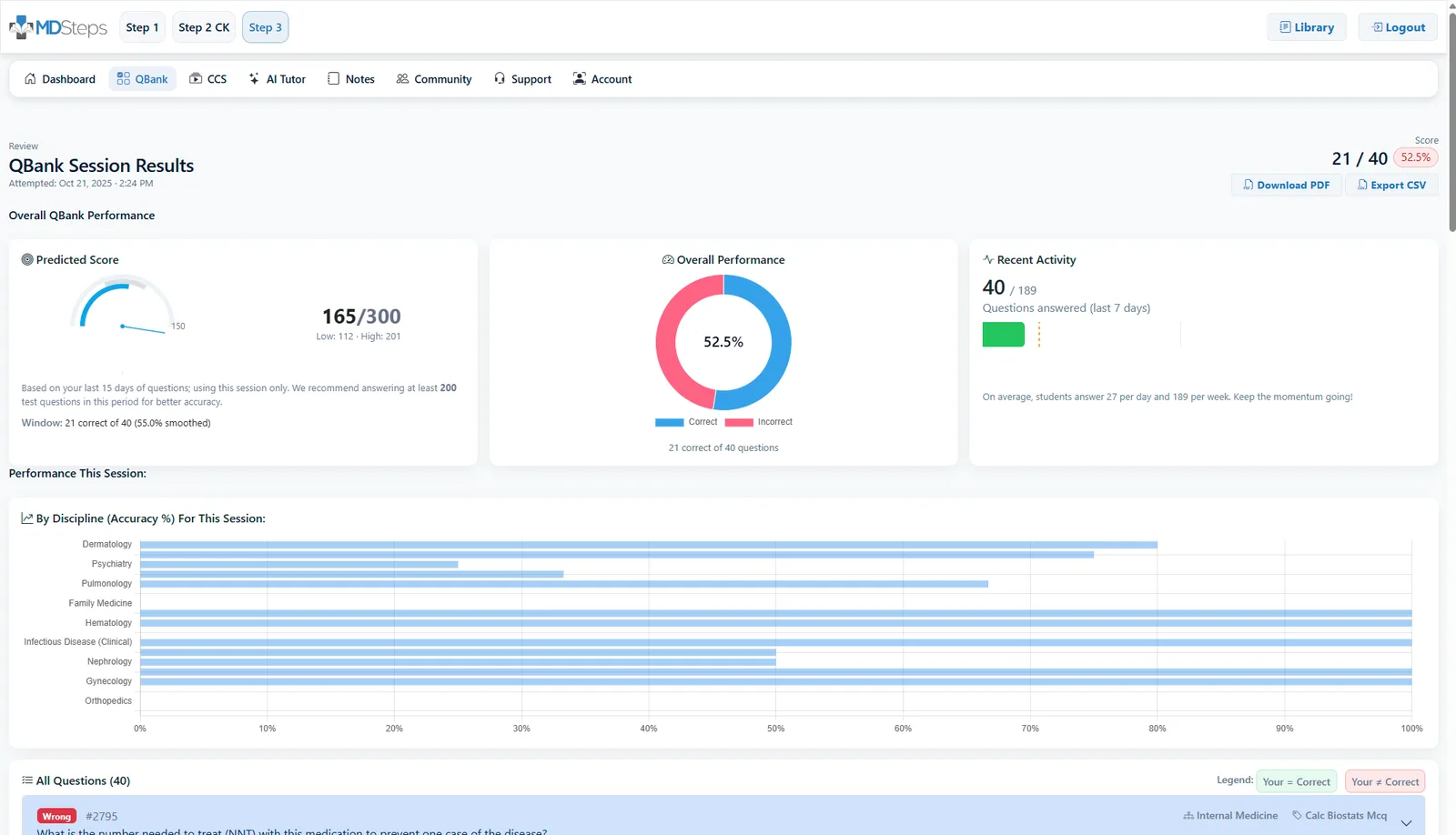
MDSteps’ Adaptive QBank reinforces this habit with instant rationales that color-code reasoning errors, training
your elimination reflex long before exam day.
Every NBME question includes at least two intentionally attractive wrong answers.
Understanding how and why these distractors are built is crucial. Step 2 CK distractors typically exploit one of three weaknesses:
premature closure (jumping to conclusions), overconfidence in partial clues, or neglect of context.
Once you can name the distractor type, you neutralize its power.
Repeated exposure in practice blocks—especially through MDSteps’ adaptive review analytics—builds subconscious immunity to these patterns.
Before reading the stem, glance at the last sentence to identify the task verb—diagnose, manage, test, or counsel.
This single step prevents you from analyzing irrelevant data and reframes how you read the vignette.
Knowing whether the item tests next-step management or diagnostic reasoning alters how you weigh evidence.
The MDSteps QBank trains this sequence automatically:
every item begins with a “task preview,” encouraging readers to classify question type in under five seconds.
Practicing this habit conditions your brain to separate must-know facts from background noise.
Train next-best-step reasoning with adaptive clinical blocks, 50/50 trap analysis, and targeted review recommendations.
As you process the vignette, propose two or three possible diagnoses before viewing options.
This primes a cognitive framework for elimination.
When you later see answer choices, discard any that fail to align with your pre-hypothesized cluster.
This mimics the real-life clinician workflow and limits over-interpretation.
During timed MDSteps blocks, use the “quick-mark” feature to flag uncertain items for re-review.
The platform’s analytics dashboard will reveal whether you tend to change right answers to wrong ones—a key insight
for behavioral optimization before test day.
When two or more options seem plausible, rely on clinical hierarchy logic—Urgency > Accuracy > Efficiency.
Choose the answer that addresses the most urgent issue first, even if another option feels more “textbook.”
Step 2 CK heavily rewards prioritization, mirroring inpatient triage thinking.
For instance, a patient with septic shock and mild electrolyte abnormalities:
immediate IV fluids (urgent) outrank correcting the potassium (accurate but delayed).
Practice comparing answers on this urgency scale until it becomes reflexive.
After hierarchy reasoning, re-read the stem to confirm that your tentative choice aligns with every detail.
Ask: “Does this answer explain the fever, rash, and lab result simultaneously?”
One unmatched clue often signals a trap.
Eliminating options that fail a full-pattern check ensures internal consistency—one of the most reliable Step 2 CK elimination tactics.
MDSteps’ QBank analytics can cluster your past misses by “pattern inconsistency,” highlighting exactly which organ systems
or time-course clues you tend to overlook.
Fatigue and emotional bias erode logical elimination.
Implement the 90-Second Rule: if you haven’t narrowed to two options in 90 seconds, mark and move.
Spending excessive time on one stem costs later questions.
Step 2 CK scoring is linear—each question counts equally—so time lost early reduces total correct answers.
The MDSteps platform’s timed-block simulator mimics exact NBME pacing with visual countdowns and recovery intervals,
conditioning your rhythm for the real test environment.
Mastering Step 2 CK answer elimination strategies transforms randomness into controlled reasoning.
Every ruled-out option improves your odds, sharpens focus, and conserves energy for tougher items.
The final phase of mastering elimination involves deliberate integration.
Dedicate one weekly block solely to “elimination practice”—skip memorization and emphasize reasoning.
Afterward, log missed items into your MDSteps auto-flashcard deck.
Each card should record: task type, distractor category, and why your elimination failed.
Over time, these micro-reviews reinforce cognitive economy, letting you triage with precision even under fatigue.
Pairing this reflective process with MDSteps’ analytics dashboard—tracking timing, confidence, and reasoning category—creates
a closed feedback loop identical to clinical decision training.
The goal: approach each Step 2 CK item not as a trivia quiz, but as a structured reasoning challenge.
References:Why Answer Elimination Outperforms Guessing
The Psychology Behind Distractors
Distractor Type Common Trap Elimination Cue Plausible Fits part of the vignette but ignores a key modifier Cross-check demographics, time course Implausible Fails to match disease mechanism or context Ask: “Would any physician actually do this next?” Trap Appeals to memorized fact rather than reasoning Re-read the question task (diagnosis vs next step) Step 1: Identify the Question Task Early
Turn this into Step 2 decision practice
Stop picking between two good-sounding answers.
See how it works
Step 2: Rapid Hypothesis Generation
Step 3: Apply Hierarchy Logic
Step 4: Pattern Confirmation and Rejection
Step 5: Manage Time and Emotional Bias
Rapid-Review Checklist: Elimination Mastery Essentials
Integrating Elimination Training into Your Study Plan
• NBME. “Comprehensive Clinical Science Self-Assessment (CCSSA) Guide.”
• Ericsson KA et al. Deliberate Practice in Expert Performance. Psychol Rev 1993.
• MDSteps Adaptive QBank & Analytics Dashboard.
• American Medical Association. “Exam Performance and Fatigue Management in Standardized Testing.” AMA Ed 2024.
USMLE Step 2 CK
The Art of Elimination: How Top Scorers Triage Step 2 CK Answer Choices

Full access: $27/mo
Lifetime: $299
Clinical decision blocks50/50 trap analysisWeak-area review
Monthly access. Cancel anytime. No free trial required.
Step 2 reasoning