Key Points
- Bladder carcinoma is common and strongly linked to smoking and occupational exposures; painless gross hematuria is the classic presenting symptom and always warrants evaluation.
- Cystoscopy with complete transurethral resection is essential for diagnosis and staging; adequate sampling of detrusor muscle and repeat resection in high risk cases are critical for accurate staging.
- Non muscle invasive disease is managed with risk adapted intravesical therapy and close cystoscopic surveillance, with early radical cystectomy considered in very high risk or BCG unresponsive settings.
- Muscle invasive bladder cancer is best treated with neoadjuvant cisplatin based chemotherapy followed by radical cystectomy and pelvic lymph node dissection for fit patients, or bladder preservation chemoradiation in selected cases.
- Systemic therapy for advanced and metastatic disease integrates platinum based chemotherapy, immune checkpoint inhibitors, and antibody drug conjugates, chosen according to prior therapy, comorbidities, and patient preferences.
- Long term survivorship care focuses on surveillance for recurrence, management of urinary and sexual function, stoma care when applicable, and modification of cardiovascular and lifestyle risk factors.
- Bladder carcinoma, most commonly urothelial carcinoma, classically presents with painless gross or microscopic hematuria and is stratified into non muscle invasive and muscle invasive disease based on depth of invasion.
- Evaluation centers on cystoscopy with transurethral resection and pathologic staging, with intravesical therapy for non muscle invasive tumors and radical cystectomy or bladder preservation chemoradiation plus systemic immunotherapy or chemotherapy for muscle invasive or metastatic disease.
Algorithm
- Evaluate patients with gross or persistent microscopic hematuria or unexplained irritative urinary symptoms with urinalysis, urine culture, and risk stratified imaging, and refer for cystoscopy.
- Perform office cystoscopy; if a lesion is identified, schedule transurethral resection of bladder tumor with intent to completely resect all visible tumors and obtain adequate muscularis propria.
- Assign stage and grade based on pathology, confirming presence of detrusor muscle and assessing for carcinoma in situ, lymphovascular invasion, and variant histology; repeat TURBT when recommended for high grade T1 tumors or when muscle is absent in high risk resections.
- Classify non muscle invasive tumors by risk group using recognized criteria that incorporate tumor stage, grade, size, multiplicity, presence of carcinoma in situ, and recurrence pattern.
- For low risk non muscle invasive disease, perform complete TURBT followed by immediate single dose intravesical chemotherapy, then cystoscopic surveillance without prolonged intravesical therapy.
- For intermediate and high risk non muscle invasive disease, initiate intravesical therapy, typically BCG induction and maintenance for eligible patients, or intravesical chemotherapy or other approved agents when BCG is contraindicated or unavailable; counsel very high risk patients regarding early radical cystectomy.
- For muscle invasive bladder cancer, obtain staging CT or MRI of abdomen and pelvis and chest imaging; assess performance status, comorbidities, renal function, and cisplatin eligibility.
- Offer cisplatin based neoadjuvant combination chemotherapy followed by radical cystectomy with pelvic lymph node dissection to cisplatin eligible patients; for those who are cisplatin ineligible or decline surgery, discuss bladder preservation chemoradiation using maximal TURBT plus concurrent radiosensitizing chemotherapy.
Clinical Synopsis & Reasoning
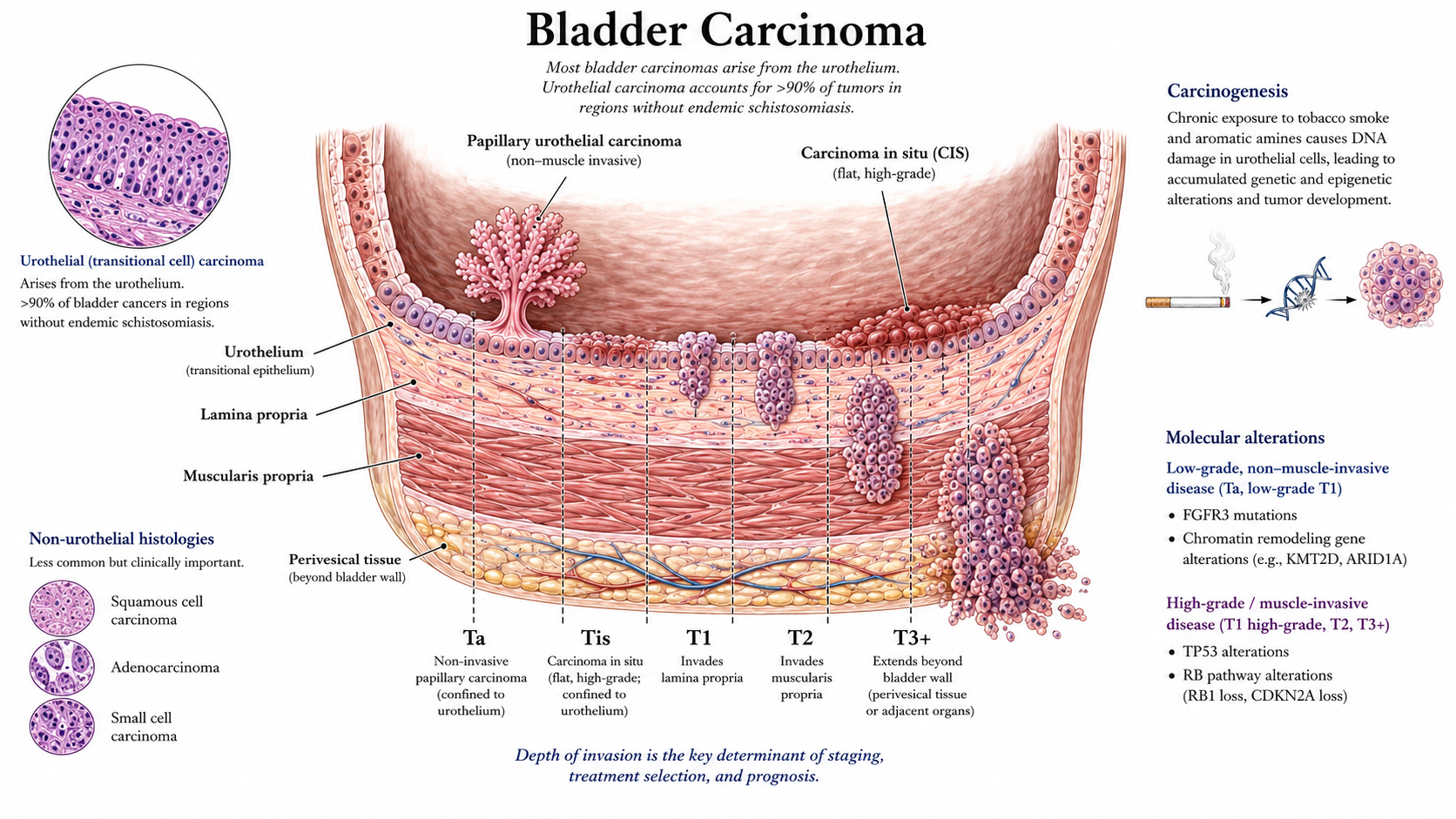
Bladder carcinoma is a malignant epithelial tumor that arises from the urothelium in the majority of cases, with urothelial carcinoma accounting for over 90 percent of tumors in regions without endemic schistosomiasis. Non urothelial histologies such as squamous cell carcinoma, adenocarcinoma, and small cell carcinoma are less common but clinically important due to different behaviors and treatment approaches. Carcinogenesis is driven by accumulated genetic and epigenetic alterations, with frequent mutations in FGFR3 and chromatin remodeling genes in low grade non muscle invasive disease, and TP53 and RB pathway alterations in high grade and muscle invasive disease. Chronic exposure to carcinogens such as tobacco smoke and aromatic amines leads to DNA damage in urothelial cells and promotes tumor development. Tumors may arise as papillary lesions that grow into the lumen or as flat carcinoma in situ with high grade cytology and high risk of progression. Depth of invasion into the lamina propria, muscularis propria, and beyond the bladder wall is the key determinant of staging and guides treatment selection and prognosis.
Cancer evaluation should define histology, local extent, nodal and metastatic stage, performance status, organ function, and molecular or pathologic features that change therapy. Incidental imaging findings should be characterized before biopsy or treatment is chosen.
Escalation findings include major bleeding, obstruction, sepsis, renal failure, spinal cord compression, rapidly progressive metastatic symptoms, or treatment toxicity requiring urgent intervention.
For Bladder Carcinoma — Diagnosis, Staging & Management, the differential should remain mechanistic and deliberately short. The clinician should identify the one or two alternatives that would change immediate management, then choose tests that discriminate among those possibilities. A familiar diagnosis should not be allowed to explain a new objective abnormality automatically. If the time course, severity, examination, or measured physiology does not fit the presumed process, reopen the differential before simply adding treatment.
Testing should be question-driven. High-yield studies in the source article include Urinalysis and urine culture, Urine cytology, Office cystoscopy, Transurethral resection of bladder tumor (TURBT) with mapping biopsies, CT urography or MR urography. Each study should confirm the syndrome, identify etiology, quantify severity, detect a complication, or establish a safe baseline for treatment. Serial data are most useful when the trajectory changes management; broad low-yield testing can create incidental findings that distract from the decision at hand.
Interpret diagnostic results in the context of pretest probability and the limitations of the test. A negative result is reassuring only when the modality can exclude the suspected process at that stage, and a positive result matters only when it fits the phenotype. The working diagnosis should explain the symptoms, objective abnormalities, and time course together. Document the finding that most strongly supports the leading diagnosis, the dangerous alternative that remains, and the result or change that would cause the plan to pivot.
Separate diagnosis from severity. Two patients with Bladder Carcinoma — Diagnosis, Staging & Management may require different care because of age, pregnancy, organ reserve, immune status, anatomy, comorbidity, or a complication. The practical goal is to place the patient on the correct risk and management branch while preserving the option to reassess as new data arrive. Topic-specific branches in the source material include Low risk non muscle invasive disease: Solitary, small, low grade Ta tumor without carcinoma in situ and without high risk factors; Intermediate risk non muscle invasive disease: Multifocal or recurrent low grade Ta tumors or selected low volume high grade Ta lesions without other high risk features; High risk non muscle invasive disease: High grade T1 tumors, carcinoma in situ, large or multifocal high grade Ta tumors, or any tumors with associated high risk features; Muscle invasive bladder cancer: Tumors invading detrusor muscle (T2) or beyond, with or without regional nodal involvement. A high-yield implementation point is: Visible hematuria warrants cystoscopic evaluation and upper-tract imaging as indicated. Management is stage and risk based: TURBT with risk-adapted intravesical therapy for NMIBC, while muscle-invasive disease generally requires cisplatin-eligible neoadjuvant chemotherapy plus radical cystectomy or a selected bladder-preserving trimodality approach.
A useful decision architecture is to separate four questions: Is there an immediate threat that must be treated before the diagnosis is complete? What single finding most strongly establishes the working diagnosis? What finding measures severity or predicts deterioration? What intervention actually changes the underlying mechanism rather than only improving a symptom or number? Keeping those questions separate prevents common errors such as ordering a definitive test before stabilization, treating a laboratory value without treating its cause, or continuing empiric therapy after the data point elsewhere.
Monitoring should be chosen for the complication most likely to change the next decision in Bladder Carcinoma — Diagnosis, Staging & Management. Vital signs, mental status, urine output, oxygen requirement, pain pattern, ECG, laboratory trajectory, or focused repeat examination may be more informative than repeating a broad panel. The reassessment interval should shorten when the disease can deteriorate rapidly or when treatment itself can produce important toxicity. A stable patient can tolerate staged evaluation; an unstable patient needs parallel evaluation and treatment with explicit handoff of what remains unresolved.
Special populations can change both presentation and treatment thresholds. Pregnancy, advanced age, childhood, frailty, immunosuppression, kidney or liver dysfunction, anticoagulation, and major cardiovascular or pulmonary disease may alter symptoms, drug choice, dosing, imaging strategy, procedural risk, and disposition. Medication reconciliation should specifically look for agents that can precipitate the syndrome, mask its severity, interact with treatment, or require temporary interruption.
Communication is part of diagnostic safety. When transferring care, state the leading diagnosis, the evidence supporting it, the dangerous alternative that is not fully excluded, the treatment already given, the response observed, and the next trigger for escalation. This is especially important when a patient moves from the emergency department to a ward, ICU, procedure area, operating room, or outside referral center, because time-sensitive decisions are often lost at transitions rather than during the initial assessment.
Treatment Strategy & Disposition
The hallmark presenting symptom of bladder carcinoma is painless gross hematuria, although many patients have only microscopic hematuria detected on urinalysis. Irritative voiding symptoms such as urinary urgency, frequency, dysuria, and nocturia may reflect carcinoma in situ or high grade tumors, and are often initially misattributed to infection, particularly in women. Recurrent presumed urinary tract infections without a clear pathogen should prompt evaluation for underlying urothelial carcinoma. Advanced or muscle invasive disease may cause pelvic pain, suprapubic mass, obstructive urinary symptoms due to ureteral involvement and hydronephrosis, or lower extremity edema from lymphatic or venous obstruction. Metastatic disease most commonly involves lymph nodes, bone, lung, liver, and peritoneum and may manifest as bone pain, pathologic fractures, cough, dyspnea, weight loss, or constitutional symptoms. Many patients have significant comorbidities related to shared risk factors such as smoking and occupational exposure, which influence treatment choices and tolerance of therapy.
Local surgery, ablation, radiation, intravesical therapy, systemic therapy, or surveillance should be selected by stage, recurrence risk, histology, comorbidity, kidney function, and patient priorities. Multidisciplinary review is particularly important when several evidence-supported pathways trade oncologic control against organ preservation or toxicity.
Relevant therapeutic tools in this article include Intravesical Bacillus Calmette Guerin (BCG), Intravesical chemotherapy (mitomycin C, gemcitabine, epirubicin), Cisplatin based combination chemotherapy, Immune checkpoint inhibitors (PD 1 or PD L1 inhibitors), Antibody drug conjugates and targeted agents. Their presence in a table does not mean every patient should receive every option. Match treatment to the indication, contraindications, organ function, interaction profile, and the clinical endpoint that will define success.
After the first meaningful intervention, reassess the physiologic or functional target rather than assuming that treatment should continue automatically. If the response is poorer than expected, revisit diagnosis, treatment delivery, adherence or access, procedural success when relevant, and the possibility of a complication. Escalation should be tied to predefined failure criteria such as worsening hemodynamics, progressive organ dysfunction, persistent severe symptoms, new neurologic findings, or inability to achieve source control.
Disposition for Bladder Carcinoma — Diagnosis, Staging & Management should reflect instability, monitoring needs, treatment intensity, and the likelihood of sudden deterioration. ICU or specialty-unit care is appropriate when continuous organ support, invasive monitoring, frequent rescue treatment, or an urgent procedure is required. Stable patients still need a clear follow-up interval, explicit return precautions, and a plan for unresolved diagnostic uncertainty.
Prevention and recurrence reduction belong in the treatment plan. Review precipitating medications and exposures, chronic disease control, adherence barriers, vaccination or infection-prevention needs when relevant, rehabilitation, nutrition, and the patient’s ability to obtain follow-up care. The discharge plan should state what is complete, what remains pending, and exactly which new symptom or objective change warrants urgent reassessment.
Therapeutic sequencing matters. Stabilization, definitive therapy, and prevention are related but not interchangeable phases. A rescue intervention may buy time without correcting the cause; a definitive procedure may be ineffective if the patient is not physiologically prepared; and long-term prevention should not distract from an unresolved acute threat. The record should therefore identify which phase the patient is in and the endpoint required before moving to the next one.
Medication and procedure safety should be revisited after every major change in physiology. Renal or hepatic dysfunction, electrolyte shifts, bleeding risk, pregnancy, drug interactions, QT effects, sedation, airway risk, and changes in perfusion can convert an initially reasonable option into a poor one. When multiple therapies are possible, prefer the option that addresses the mechanism with the lowest foreseeable burden for that patient and that can be monitored reliably in the available care setting.
Treatment failure should be defined before it occurs. Persistent instability, progression of organ dysfunction, failure of a key laboratory or clinical marker to improve, worsening imaging, recurrent symptoms after a temporary response, or inability to achieve source control should trigger a new branch rather than indefinite repetition of the same therapy. That branch may be a second-line drug, invasive procedure, surgery, transfer, or reconsideration of the diagnosis.
Management Notes
Use the structured sections above as a clinical reference, not as a rigid protocol. Individual management for Bladder Carcinoma — Diagnosis, Staging & Management depends on age, pregnancy status when relevant, organ function, comorbidity, anatomy, contraindications, local resources, and patient preferences. Topic-specific source anchors include: Low risk non muscle invasive disease: Solitary, small, low grade Ta tumor without carcinoma in situ and without high risk factors; Intermediate risk non muscle invasive disease: Multifocal or recurrent low grade Ta tumors or selected low volume high grade Ta lesions without other high risk features; High risk non muscle invasive disease: High grade T1 tumors, carcinoma in situ, large or multifocal high grade Ta tumors, or any tumors with associated high risk features; Muscle invasive bladder cancer: Tumors invading detrusor muscle (T2) or beyond, with or without regional nodal involvement; Metastatic or unresectable disease: Distant organ metastases or locally advanced tumors not amenable to curative local therapy. A high-yield implementation point is: Visible hematuria warrants cystoscopic evaluation and upper-tract imaging as indicated. Management is stage and risk based: TURBT with risk-adapted intravesical therapy for NMIBC, while muscle-invasive disease generally requires cisplatin-eligible neoadjuvant chemotherapy plus radical cystectomy or a selected bladder-preserving trimodality approach. If the symptoms, examination, testing, and expected treatment response do not align, reopen the diagnosis before simply escalating the same therapy.
Epidemiology / Risk Factors
- Bladder cancer is one of the ten most common cancers worldwide, with an estimated several hundred thousand new cases and over two hundred thousand deaths annually.
- Incidence is higher in industrialized countries and in men, who have approximately three to four times the risk of women, although women often present with more advanced disease and have worse outcomes.
- The median age at diagnosis is in the early seventies, and most cases occur in older adults; pediatric and young adult bladder carcinoma is rare and often associated with distinct biology.
- Cigarette smoking is the single most important modifiable risk factor, roughly doubling to tripling risk and accounting for a substantial proportion of cases.
- Occupational exposures to aromatic amines and other carcinogens in industries such as dye, rubber, leather, metal, and petroleum refining remain relevant in some regions.
Investigations
| Test | Role or Rationale | Typical Findings | Notes |
|---|---|---|---|
| Urinalysis and urine culture | Initial evaluation of hematuria and irritative urinary symptoms; excludes infection and assesses for microscopic hematuria | Red blood cells on microscopy; sterile pyuria can be seen in urothelial carcinoma | Hematuria that persists after treatment of presumed infection requires urologic workup including cystoscopy and upper tract imaging |
| Urine cytology | Noninvasive assessment for high grade urothelial carcinoma and carcinoma in situ | High grade malignant urothelial cells in positive specimens; low grade tumors often yield negative or atypical results | High specificity for high grade disease and carcinoma in situ; limited sensitivity for low grade papillary tumors; best used as adjunct to endoscopic evaluation |
| Office cystoscopy | Primary diagnostic test for visualization of bladder mucosa and identification of lesions | Papillary tumors, sessile masses, erythematous plaques, or velvety changes consistent with carcinoma in situ | Performed using flexible or rigid cystoscope under local anesthesia; guides planning for formal transurethral resection of bladder tumor |
| Transurethral resection of bladder tumor (TURBT) with mapping biopsies | Definitive diagnosis and staging through complete macroscopic resection and pathologic assessment | Histology, grade, presence or absence of detrusor muscle, depth of invasion, and associated carcinoma in situ | Adequate inclusion of muscularis propria in the specimen is critical for accurate staging; repeat resection is recommended for high grade T1 tumors and when muscle is absent in initial high risk resections |
| CT urography or MR urography | Evaluation of upper urinary tract and cross sectional imaging of abdomen and pelvis for staging | Filling defects in the renal pelvis or ureter suggest synchronous upper tract urothelial carcinoma; assessment of extravesical extension and regional lymph nodes | Preferred modality for high risk non muscle invasive disease, muscle invasive tumors, and gross hematuria workup; adjust contrast use based on renal function |
| Cross sectional chest imaging | Staging and detection of pulmonary metastases in muscle invasive or high risk disease | Pulmonary nodules, lymphadenopathy, pleural lesions | Chest CT is recommended for muscle invasive or high risk tumors; chest radiograph may suffice for low risk non muscle invasive disease |
| Laboratory tests | Baseline renal function, liver tests, complete blood count, and metabolic panel for risk stratification and treatment planning | Anemia, elevated creatinine, abnormal liver tests, or electrolyte abnormalities depending on disease extent and comorbidities | Renal function strongly influences cisplatin eligibility and selection of systemic therapy and urinary diversion options |
Clinical Categories and Risk Stratification Overview
| Category | Typical Features | Clinical Implications |
|---|---|---|
| Low risk non muscle invasive disease | Solitary, small, low grade Ta tumor without carcinoma in situ and without high risk factors | Managed with complete TURBT and single immediate postoperative intravesical chemotherapy instillation; surveillance cystoscopy at regular intervals |
| Intermediate risk non muscle invasive disease | Multifocal or recurrent low grade Ta tumors or selected low volume high grade Ta lesions without other high risk features | Requires induction and often maintenance intravesical therapy with risk adapted follow up to reduce recurrence |
| High risk non muscle invasive disease | High grade T1 tumors, carcinoma in situ, large or multifocal high grade Ta tumors, or any tumors with associated high risk features | Induction and maintenance intravesical BCG is standard when feasible; early consideration of radical cystectomy in very high risk settings |
| Muscle invasive bladder cancer | Tumors invading detrusor muscle (T2) or beyond, with or without regional nodal involvement | Radical cystectomy with pelvic lymph node dissection after neoadjuvant cisplatin based chemotherapy is standard for fit patients; bladder preservation chemoradiation is an alternative for selected patients |
| Metastatic or unresectable disease | Distant organ metastases or locally advanced tumors not amenable to curative local therapy | Systemic therapy with platinum based chemotherapy, immune checkpoint inhibitors, and antibody drug conjugates, often in sequence; palliative radiotherapy and symptom management are important |
Pharmacology
| Medication or Regimen | Mechanism | Role | Key Limitations |
|---|---|---|---|
| Intravesical Bacillus Calmette Guerin (BCG) | Live attenuated mycobacterial immunotherapy that stimulates local immune response in bladder mucosa | Standard of care for high risk non muscle invasive disease including carcinoma in situ and high grade T1 tumors, given as induction and maintenance courses | Local cystitis symptoms are common; systemic BCG infection is rare but serious; supply shortages and contraindications in immunocompromised or severely frail patients limit use |
| Intravesical chemotherapy (mitomycin C, gemcitabine, epirubicin) | Direct cytotoxic effects on urothelial cells with minimal systemic absorption | Single postoperative instillation for low risk tumors and induction or maintenance schedules for low and intermediate risk disease or for patients who cannot receive BCG | Chemical cystitis, rash, and rare bladder contracture; careful handling is required to avoid extravasation |
| Cisplatin based combination chemotherapy | Platinum compound forming DNA cross links, combined with other cytotoxics such as gemcitabine, methotrexate, vinblastine, and doxorubicin | Neoadjuvant therapy for muscle invasive disease and first line systemic therapy for metastatic urothelial carcinoma in eligible patients | Nephrotoxicity, ototoxicity, neuropathy, and nausea; requires adequate renal function, performance status, and hydration; many patients are ineligible due to comorbidities |
| Immune checkpoint inhibitors (PD 1 or PD L1 inhibitors) | Blockade of inhibitory pathways in T cells to enhance antitumor immune response | Used in BCG unresponsive high risk non muscle invasive disease, in metastatic disease after platinum therapy, and in selected patients as first line or maintenance therapy depending on biomarkers and regulatory indications | Immune related adverse events including dermatitis, colitis, hepatitis, endocrinopathies, and pneumonitis; require early recognition and management with immunosuppression |
| Antibody drug conjugates and targeted agents | Monoclonal antibodies directed at urothelial surface antigens linked to cytotoxic payloads or targeted inhibitors against specific molecular pathways | Treatment for metastatic disease that has progressed after chemotherapy and immunotherapy in selected patients, based on agent approval and biomarker status | Myelosuppression, neuropathy, ocular toxicity, and risk of severe skin reactions for some agents; long term safety and optimal sequencing continue to evolve |
Prognosis / Complications
- Prognosis is primarily driven by tumor stage, grade, presence of carcinoma in situ, and completeness of resection, as well as patient age, comorbidities, and performance status.
- Low risk non muscle invasive tumors have excellent disease specific survival but a meaningful risk of recurrence, necessitating long term cystoscopic surveillance.
- High risk non muscle invasive disease carries a substantial risk of progression to muscle invasive cancer over time, particularly in the presence of poorly controlled carcinoma in situ or recurrent high grade T1 tumors.
- With contemporary multimodality treatment, a significant proportion of patients with organ confined muscle invasive bladder cancer achieve long term disease control or cure after neoadjuvant chemotherapy and radical cystectomy or trimodality bladder preservation.
- Metastatic urothelial carcinoma remains associated with limited median survival, but modern systemic therapies including immunotherapy and antibody drug conjugates have improved outcomes and offer durable responses for a subset of patients.
Patient Education / Counseling
- Explain the diagnosis in clear language, including tumor type, stage, grade, and risk group, and describe how these features influence treatment options and prognosis.
- Discuss the importance of smoking cessation, avoidance of occupational carcinogens, and optimization of cardiovascular and metabolic health as part of cancer care and survivorship.
- Review the benefits, risks, and long term functional implications of radical cystectomy and different urinary diversions, including impact on continence, body image, sexual function, and daily activities.
- For patients pursuing bladder preservation, emphasize the need for close surveillance, the possibility of requiring salvage cystectomy if disease recurs or progresses, and the small risk of undertreatment compared with primary cystectomy in selected settings.
- Address fertility, sexual health, and psychosocial concerns proactively, and involve multidisciplinary support including stoma therapists, nutrition specialists, physical therapists, and mental health professionals.
Exhibits
References
- EAU Guidelines on Non-Muscle-Invasive Bladder Cancer — Link
- EAU Guidelines on Muscle-Invasive and Metastatic Bladder Cancer — Link
Practice the decision pattern next.
Most students do not plateau because they refuse to study. They plateau because their review does not show the exact reasoning error behind repeated misses. MDSteps turns topic review into targeted blocks, explanations, flashcards, and readiness signals.
- Full access to 1,100+ medical reference articles linked directly to relevant QBank concepts
- 16,000+ USMLE-style questions across Step 1, Step 2 CK, and Step 3
- Depth-on-Demand™ explanations that isolate the pivot clue, distractor trap, and decision point
- CCS cases with live vitals, order timing, reassessment, and after-action feedback