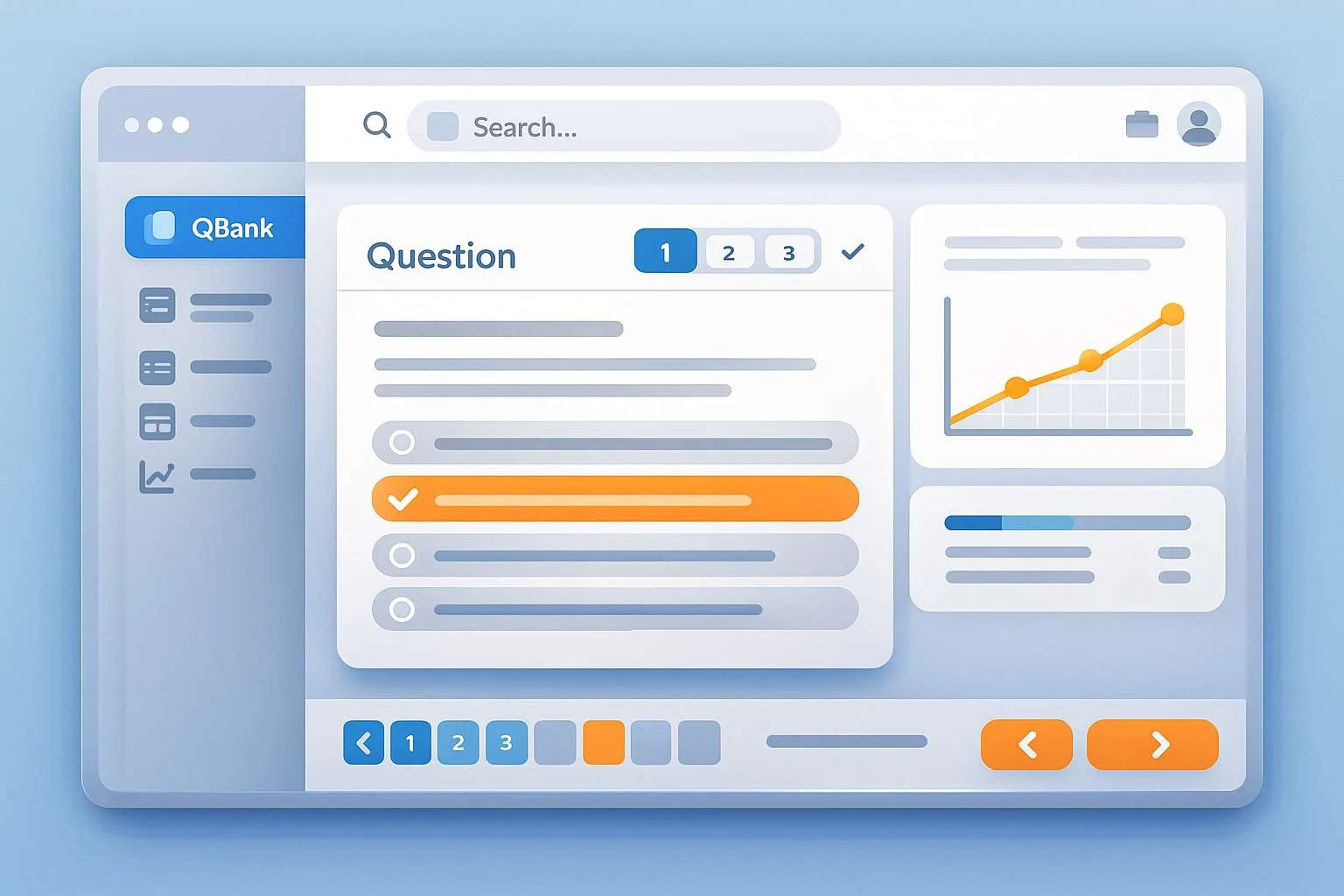
Study Step 1, Step 2 CK, Step 3, and CCS for $27/month.
Get 16,000+ USMLE-style questions, 135 CCS cases, stem decoding, visual rationales, analytics, flashcards, and reasoning-focused review in one subscription.
Get 16,000+ USMLE-style questions, 135 CCS cases, stem decoding, visual rationales, analytics, flashcards, and reasoning-focused review in one subscription.
Cancel anytime. First month protected by our 7-day good-faith refund guarantee after 100 questions or 5 CCS cases.
Best UWorld Alternatives for Step 1 & Step 2: Why MDSteps’ Adaptive QBank Outperforms
Why Students Are Seeking UWorld Alternatives for Step 1 & Step 2 CK
The search for the best UWorld alternatives for Step 1 and Step 2 CK has intensified as students look for tools that keep pace with modern testing.
The search for the best UWorld alternatives for Step 1 and Step 2 CK has intensified as students look for tools that keep pace with modern testing. UWorld remains widely used, but its static question difficulty, fixed routing, and limited personalization are increasingly outmatched by adaptive learning systems. Many examinees report “pattern fatigue,” plateauing scores, and the sense that the interface now over-teaches certain distractors while underexposing others.
AMBOSS, another major platform, offers valuable medical libraries and structured articles. However, AMBOSS questions are often rated by students as “academic” rather than “exam-native,” with stems that feel more like textbook review than true NBME-style vignettes. More importantly, AMBOSS—like UWorld—offers no adaptive difficulty progression. Every learner receives the same questions, regardless of mastery gaps.
Modern evidence-based learning emphasizes adaptive spacing, dynamic difficulty, and high-precision feedback loops. MDSteps was designed around these principles, offering a fresh option for students who want:
- Exam-realistic question phrasing and length
- An adaptive QBank that increases difficulty in real time
- Analytics that automatically build targeted study plans
- Automatic flashcard decks exportable to Anki
- Over 9,000 questions with integrated USMLE pattern logic
The demand for alternatives is less about abandoning UWorld and more about strategic diversification—exposing the brain to new variants of patterns, distractors, and framing. Students preparing for Step 1 and Step 2 CK increasingly want a QBank that adjusts to them—not one-size-fits-all content.
How MDSteps’ Adaptive QBank Works, and Why Adaptivity Matters
One of the core differentiators between MDSteps and legacy banks like UWorld or AMBOSS is adaptive difficulty progression.
One of the core differentiators between MDSteps and legacy banks like UWorld or AMBOSS is adaptive difficulty progression. In MDSteps, every question influences the next. When a student repeatedly misses endocrine physiology, the question engine routes additional endocrine items with variations in tone, distractor sophistication, and case severity. This mirrors the behavior of computerized adaptive tests used in multiple medical licensing systems globally.
UWorld, while comprehensive, does not personalize the sequence at all. Students often report that they must manually “hunt through the bank” to find their weak topics, which increases friction and burns valuable study time. AMBOSS is similar—users manually select subject blocks, and the bank provides little insight into mastery trajectories without heavy spreadsheet work.
MDSteps removes this cognitive load by integrating:
- Adaptive routing that corrects blind spots automatically
- Live performance vitals showing day-to-day mastery curves
- Automatic flashcard generation from incorrect and flagged items
- Study-plan auto-generation based on past 72 hours of data
This creates a feedback loop that mirrors high-fidelity test rehearsal—making every session both diagnostic and corrective.
UWorld vs. AMBOSS vs. MDSteps: Feature-by-Feature Comparison
AMBOSS excels in fast reference lookup but struggles to replicate NBME pacing—its question stem style is widely regarded as more academic than clinical.
| Feature | UWorld | AMBOSS | MDSteps |
|---|---|---|---|
| Adaptive Question Routing | No | No | Yes |
| Analytics Depth | Moderate | Moderate | High (real-time mastery curves) |
| Question Style | Classic but repetitive | Academic/lecture-like | NBME-pattern optimized |
| Auto-Flashcard Decks | No | No | Yes (Anki export supported) |
| Integrated Study Plan | No | No | Yes (AI-driven) |
| Question Count | ~4,500–5,000 | ~3,000–4,000 | 9,000+ |
AMBOSS excels in fast reference lookup but struggles to replicate NBME pacing—its question stem style is widely regarded as more academic than clinical. UWorld has strong explanations, but has changed little in structure for years. MDSteps combines adaptive delivery, thorough analytics, and expanded question volume, positioning it as a comprehensive alternative rather than a supplementary bank.
Why Adaptive Learning Boosts Step 1 & Step 2 CK Performance
High-stakes exams like Step 1 and Step 2 CK test not just knowledge but rapid pattern recognition under pressure.
High-stakes exams like Step 1 and Step 2 CK test not just knowledge but rapid pattern recognition under pressure. Research in cognitive load theory shows that productive struggle—encountering problems at the edge of difficulty—promotes durable learning. Static QBanks cannot guarantee this. UWorld may be too easy for some students and too punishing for others. AMBOSS often produces “reading mode”—students feel the need to skim long library articles instead of actively reasoning.
MDSteps’ algorithmic sequencing ensures:
- Questions remain challenging enough to promote neuroplasticity
- Weaknesses receive increased exposure
- Strengths are periodically stress-tested
- The student never “coasts” through predictable patterns
Adaptivity also accelerates the time-to-mastery curve. By targeting deficits early and repeatedly, students spend less time inefficiently reviewing topics they’ve already mastered. This produces fewer hours wasted and a more consistent score trajectory.
Building a Multi-QBank Strategy With MDSteps as the Core
Many students benefit from using more than one QBank, but a structured approach is essential.
Many students benefit from using more than one QBank, but a structured approach is essential. The following strategy leverages MDSteps’ adaptivity to anchor the learning process:
- Primary Bank (MDSteps) — daily adaptive blocks (40–80 questions)
- Secondary Bank (UWorld or AMBOSS) — 20–40 questions 3–4× per week for variation
- Daily Review — MDSteps auto-generated Anki deck from misses
- Systemic Reinforcement — MDSteps analytics dashboard to track underperforming systems
This hybrid model prevents the “UWorld plateau” many students experience around 55–60% correct. Adding MDSteps’ adaptive system reintroduces difficulty gradients and novel distractor shapes, which keeps pattern recognition sharp.
Common Pitfalls Students Face When Relying Only on UWorld or AMBOSS
Students often report the following issues when using UWorld or AMBOSS alone:
Students often report the following issues when using UWorld or AMBOSS alone:
- Pattern Overfamiliarity: Stems and distractors become predictable.
- No adaptive sequencing: Weaknesses go uncorrected for days.
- Overreading: AMBOSS users spend excessive time in giant library articles.
- Plateauing scores: Gains slow after the first 1–2 passes.
- Difficulty spike before exam day: NBME exams feel “foreign.”
MDSteps counters each pitfall with adaptive routing, tighter NBME-aligned stem construction, and a system that rewards—not punishes—incremental learning.
Rapid-Review Checklist: Choosing the Best UWorld Alternative
Students searching for the best UWorld alternatives for Step 1 and Step 2 CK consistently benefit from tools that reduce friction and increase personalized exposure.
- Does the QBank adapt to my performance? — MDSteps: Yes
- Does it produce targeted flashcards automatically? — MDSteps: Yes
- Does it track mastery with actionable analytics? — MDSteps: Yes
- Does it mimic NBME-style stems precisely? — Highly optimized
- Does it avoid academic over-explanation? — Yes, concise teaching points
Students searching for the best UWorld alternatives for Step 1 and Step 2 CK consistently benefit from tools that reduce friction and increase personalized exposure. MDSteps delivers both.
Further Resources & How to Integrate MDSteps Into Your Study Plan
For students beginning their dedicated prep, MDSteps provides:
- MDSteps Adaptive QBank
- An AI-driven study plan generator
- 16,000+ USMLE-style questions
- Performance dashboards for system-level and discipline-level mastery
- Auto-generated flashcard decks exportable to Anki
When combined with MDSteps’ built-in analytics and spaced-repetition tools, this provides a streamlined, modern, and exam-aligned alternative to UWorld and AMBOSS for both Step 1 and Step 2 CK.
UWorld explains the medicine. MDSteps explains the decision.
Traditional review often tells you the correct answer. MDSteps helps isolate the decision error: the missed pivot clue, the tempting distractor, the timing mistake, or the weak rule that failed under pressure.
Full access includes Step 1, Step 2 CK, Step 3, CCS cases, analytics, auto-flashcards, and study planning.