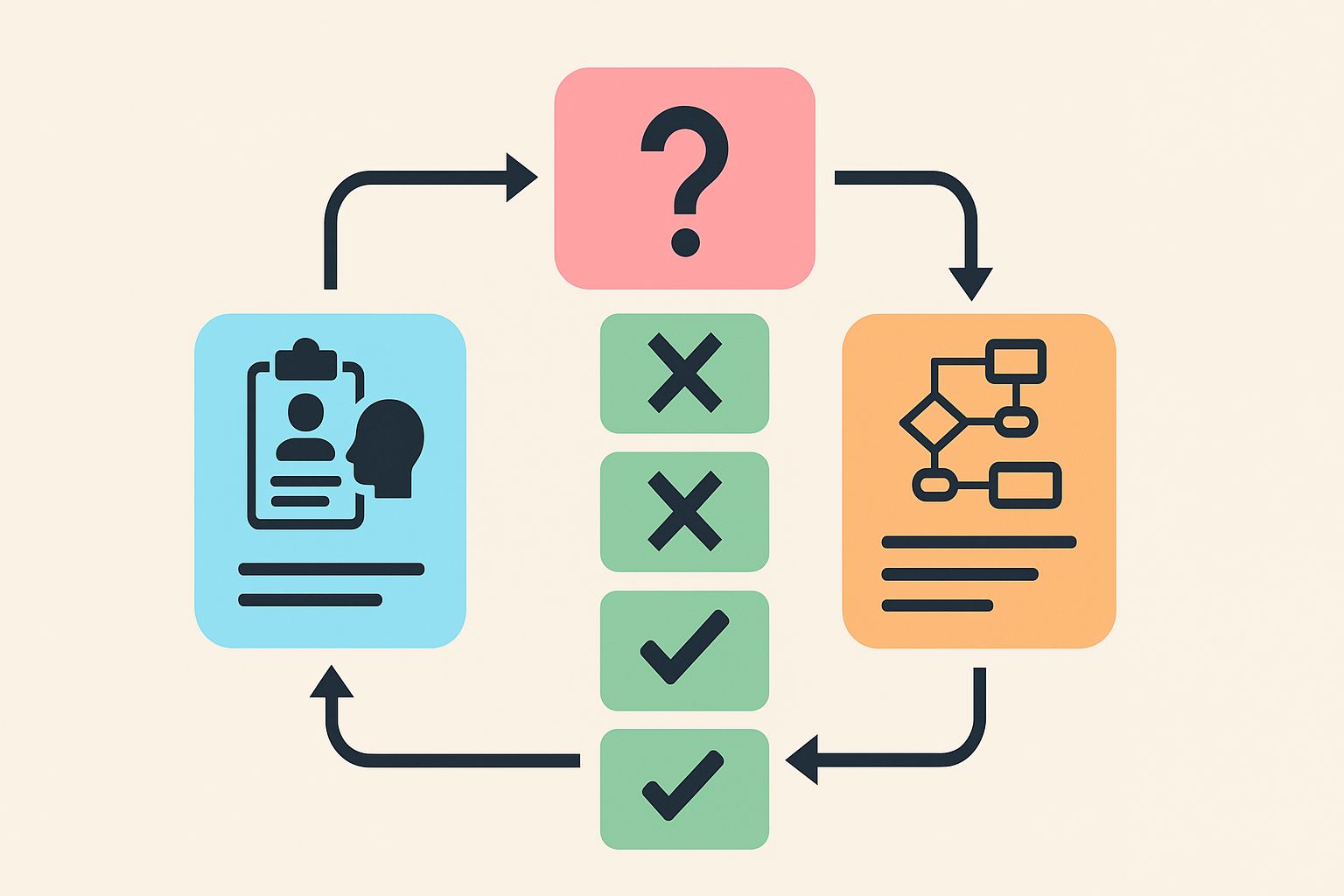
A plateau means your practice scores stop trending upward despite continued effort. For Step 1, that most often
reflects a mismatch between what you study and how the exam demands you use it—clinical reasoning,
not encyclopedic recall. The NBME-style stem is designed to push you through three moves: (1) extract signals from
noise, (2) generate a short differential, and (3) commit to the best next inference or mechanism. If any of those
moves is fuzzy, you can “know the fact” and still miss the item.
Learning science supports a plateau-break strategy that increases “desirable difficulty”—retrieval practice,
spacing, and interleaving—because those methods train flexible recall and transfer to new stems better than passive
review. Your goal is to create effortful retrieval under mild stress, then correct your mental model
immediately after. That is exactly what Step 1 is testing: can you retrieve and apply under pressure?
Before rebuilding anything, confirm you’re treating the right problem. Step 1 scores and percent-correct can
fluctuate. Use three data checks so you don’t overreact to normal variability.
Compare 2–3 recent self-assessments/blocks under similar conditions. If your “best day” and “worst day” are
within a narrow band, you’re likely plateaued.
Tally misses into: knowledge (never learned), retrieval (knew later),
reasoning (misapplied), test strategy (timing, changing answers).
Mark questions that took >90 seconds and why. Most plateaus have a predictable bottleneck
(over-reading, differential sprawl, lab interpretation, or “two-good-answers” paralysis).
Next, identify which of these plateau phenotypes matches you. Each has a different fix:
Most students are a blend, but one phenotype is usually dominant. Your plan should emphasize the dominant leak,
then maintain the others with smaller doses.
Step 1 reasoning isn’t “clinical experience.” It’s pattern recognition + mechanism checking. A practical model is
dual-process thinking: a fast pattern system generates candidates, and a slower analytic system verifies mechanism
and eliminates traps. When you plateau, your fast system is either noisy (too many candidates) or biased (anchored
on the wrong one), and your slow system can’t rescue you quickly enough.
The key is comparison. If you only study “disease A,” the exam will beat you with “disease A vs B” distractors.
Build scripts in pairs and triplets: DKA vs HHS, restrictive vs obstructive, SIADH vs cerebral salt wasting,
Wernicke vs Korsakoff, nephritic vs nephrotic. Comparison forces interleaving, which strengthens discrimination. Turn failures into fuel: the error log that actually changes scores “Review your incorrects” is vague, so most students do the easiest version: read the explanation, nod, move on.
That’s comforting—and it preserves the exact mental model that produced the miss. You need an error log designed
to change future decisions. Think like a clinician: when a patient fails therapy, you don’t just read about the
drug—you identify the failure mode and prevent recurrence. MDSteps helps isolate the missed pivot clue, tempting distractor, overthinking loop, or 50/50 differentiator that made the question fall apart under pressure.
Stem: alcoholic with confusion, ataxia, nystagmus → treated with glucose → worsens.
Now make the log actionable: schedule a “retest loop.” Every 3–4 days, pull 10–20 logged misses and do a
closed-book recall: read only your “trigger + rule,” then restate the mechanism and differentiator out loud.
This uses retrieval practice (testing effect) and spacing—two of the most consistently supported learning methods.
Plateaus break when you change the stimulus. The next two weeks should feel different: fewer total tasks, higher
cognitive intensity, and tighter feedback loops. Below is a sample schedule you can adapt to your dedicated or
pre-dedicated phase. The structure aims to (1) raise reasoning reps, (2) force interleaving, and (3) protect
recovery so you can think sharply.
Notice what’s missing: endless passive reading. Content review exists, but it’s short and immediately tested.
That’s how you convert information into performance.
After a failure or a discouraging self-assessment, many students develop “answer avoidance”: they read, reread,
and hope certainty appears. That behavior quietly drains time and increases random guessing at the end of the
block. A plateau reset must include execution tactics that keep you moving without sacrificing reasoning quality.
Practice these tactics intentionally. During one block per day, track exactly three things: (1) number of flagged
questions, (2) time remaining at question 20 and 30, and (3) how often you changed an answer correctly vs
incorrectly. Many students discover that answer changes are net-negative when driven by anxiety rather than new
evidence.
A failed exam or a disappointing self-assessment can trigger a harsh inner narrative (“I’m not cut out for this”).
That narrative is not just emotional—it changes how you study. You avoid hard questions, you review passively, and
you seek certainty before committing. The fix is a structured recovery plan: stabilize your process, then rebuild
evidence that your process works.
Confidence should come from evidence: you’re making fewer “same mistake” errors, your time checkpoints are
improving, and your retest accuracy rises. Track those, not just the overall percent. When you see progress in
process metrics, practice scores usually follow.
If you need structure, the MDSteps automatic study plan generator can convert your plateau phenotype into a daily
plan with built-in review loops and analytics—so you’re not guessing what to do next.
Use this checklist weekly during your reset, and again in the final 72 hours. The goal is to keep your reasoning
loop clean, your pacing predictable, and your mental model anchored to mechanisms.
Why plateaus happen: it’s usually “processing,” not “content”
Common plateau pattern
Translation: your issue is one of four “reasoning leaks”
A 3-part diagnostic: are you stuck from noise, gaps, or strategy?
Check 1: trend, not a single test
Check 2: error categories
Check 3: where time bleeds
Plateau phenotype
What it looks like
Root cause
Best intervention
Knowledge-limited
Same weak systems repeat; lots of “never saw this”
Coverage gaps, not enough targeted content pass
Short “surgical” content bursts + immediate questions
Retrieval-limited
“I knew it after”; misses are easy in review
Passive study, low-effort recall
Timed retrieval sets, spaced repeats, closed-book summaries
Reasoning-limited
Confidently wrong; baited by distractors
Faulty illness scripts / mechanism links
Script building + compare/contrast drills
Execution-limited
Accuracy OK untimed; collapses timed
Pacing, anxiety loops, decision fatigue
Block strategy, “commit rules,” and stamina training
Clinical reasoning reboot: build illness scripts the NBME rewards
What an “illness script” is (Step 1 version)
How to build scripts quickly (from missed questions)
Clinical reasoning improves when you can see the decision error.
The topic tells you what you missed. The miss pattern tells you why.
The 4-line “reasoning repair” log
Example (vignette-style)
Stop “random grind”: a 14-day plateau reset schedule
Day
AM (high intensity)
Midday (repair)
PM (retention)
1–2
2 timed blocks (mixed) + strict review
Error-log build (top 10 misses) + 30 min weak topic “surgical read”
Spaced recall: 20-min closed-book summaries
3
1 timed block + “slow reasoning set” (10 Q untimed, explain aloud)
Compare/contrast sheet (A vs B vs C)
Light Anki / flashcards from misses
4
Self-assessment or long mixed set (stamina)
Review only: rewrite scripts for repeated misses
Walk + early sleep
5–6
2 timed blocks + 10 “two-best-answer” drills
Retest loop: 15 old misses (closed-book) → then verify
One-page “high-risk traps” list
7
Rest or half-day: 1 light block
Well-being (exercise, meal prep)
Short recall only
8–10
Repeat days 1–3 with new mix; keep same review rigor
Target the top 2 weak systems from your data
Spaced recall + early stop time
11
Self-assessment (or NBME-style form)
Post-test: categorize misses by leak type
Recovery
12–14
Refine: fewer blocks, more decision drills
Retest the error log; rebuild scripts
Exam simulation components (breaks, pacing)
Block tactics that protect accuracy when anxiety spikes
The 3-pass method (simple version)
“Commit rules” that prevent score bleed
Recovering from failure: rebuild confidence without losing rigor
Step 1: stabilize (48 hours)
Step 2: rebuild reps (days 3–10)
Step 3: prove transfer (days 11–14)
Rapid-Review Checklist: plateau-break essentials for test day
Reasoning essentials
Execution & recovery essentials
USMLE Step 1
USMLE Step 1 Score Plateau? How to Improve Clinical Reasoning and Recover From Failure

For clinical reasoning and 50/50 traps
The topic tells you what you missed. The reasoning pattern tells you why it happened.
MDSteps trains the thinking layer: stem decoding, pivot clues, distractor logic, answer elimination, timing mistakes, and repeated miss patterns.
Full access includes Step 1, Step 2 CK, Step 3, CCS cases, analytics, auto-flashcards, and study planning.
Pivot-clue training
Find the stem detail that changes the diagnosis, next step, or answer choice.
Distractor trap logic
See why the wrong answer felt right and why it fails for this patient right now.
Reusable rules
Turn each miss into a rule you can apply to the next similar vignette.
High-yield mindset shift: A plateau is feedback on your thinking loop. Treat it like a
diagnosis. If you “treat” with more of the same, you keep the same disease.
Clinical reasoning trap?
Free reasoning diagnostic
Pivot clue isolatedDistractor trap explainedReusable rule created
No credit card required for the free reasoning review. Full access includes Steps 1–3, CCS, analytics, auto-flashcards, and study planning.
Reasoning diagnostic
Still missing the same kinds of questions?
Read why that happens.
Practical tip: If you use the MDSteps platform, you can automate this loop: our Adaptive QBank
tags the underlying skill error (interpretation vs mechanism vs strategy) and can auto-generate flashcard decks
from your misses that export to Anki—so your error log becomes your spaced repetition pipeline.
NBME trap to expect: an answer that matches a single detail but violates the core mechanism.
Train yourself to prioritize “path process consistency” over keyword matching.
Final thought: Plateaus break when you move from “covering content” to “training decisions.” Build
scripts, retest mistakes, and practice committing under time pressure. That’s what the exam rewards.
References (external)
Medically reviewed by: Priya Shah, MD (Internal Medicine).