Features
Find the reason you keep missing USMLE® questions.
MDSteps is a reasoning-first USMLE® prep platform with an adaptive 16,000+ question QBank, 135 CCS cases, analytics, flashcards, study planning, and a mechanism-first library. It is built to show you why you missed, what pattern caught you, and what to practice next.
What happens after signup
Your first login starts with a 20-question baseline.
Clinical reasoning teaching
See how MDSteps teaches the decision path.
A standard explanation tells you the answer. MDSteps shows the path: signals → distractors → pivot clue → elimination → reusable NBME pattern.
| Sodium | 142 mEq/L |
|---|---|
| Chloride | 104 mEq/L |
| Bicarbonate | 12 mEq/L |
| ABG | pH 7.42 • PaCO2 20 • PaO2 95 |
MDSteps framework
What students see in review
- Signals vs distractors separated so students know what mattered and what was noise.
- Choice-by-choice elimination that explains why each distractor was tempting and why it fails.
- Pivot clue identification so students can recognize the decisive detail faster next time.
- Mechanism-first explanation that connects the stem to physiology, pathology, or management logic.
- Reusable NBME pattern so one missed item becomes a transferable test-day rule.
Broad USMLE® coverage without a premium-platform price.
Step 1, Step 2 CK, Step 3, CCS, analytics, flashcards, visual rationales, and a reference library in one subscription.
Reasoning-first QBank
Adaptive QBank with Depth-on-Demand™
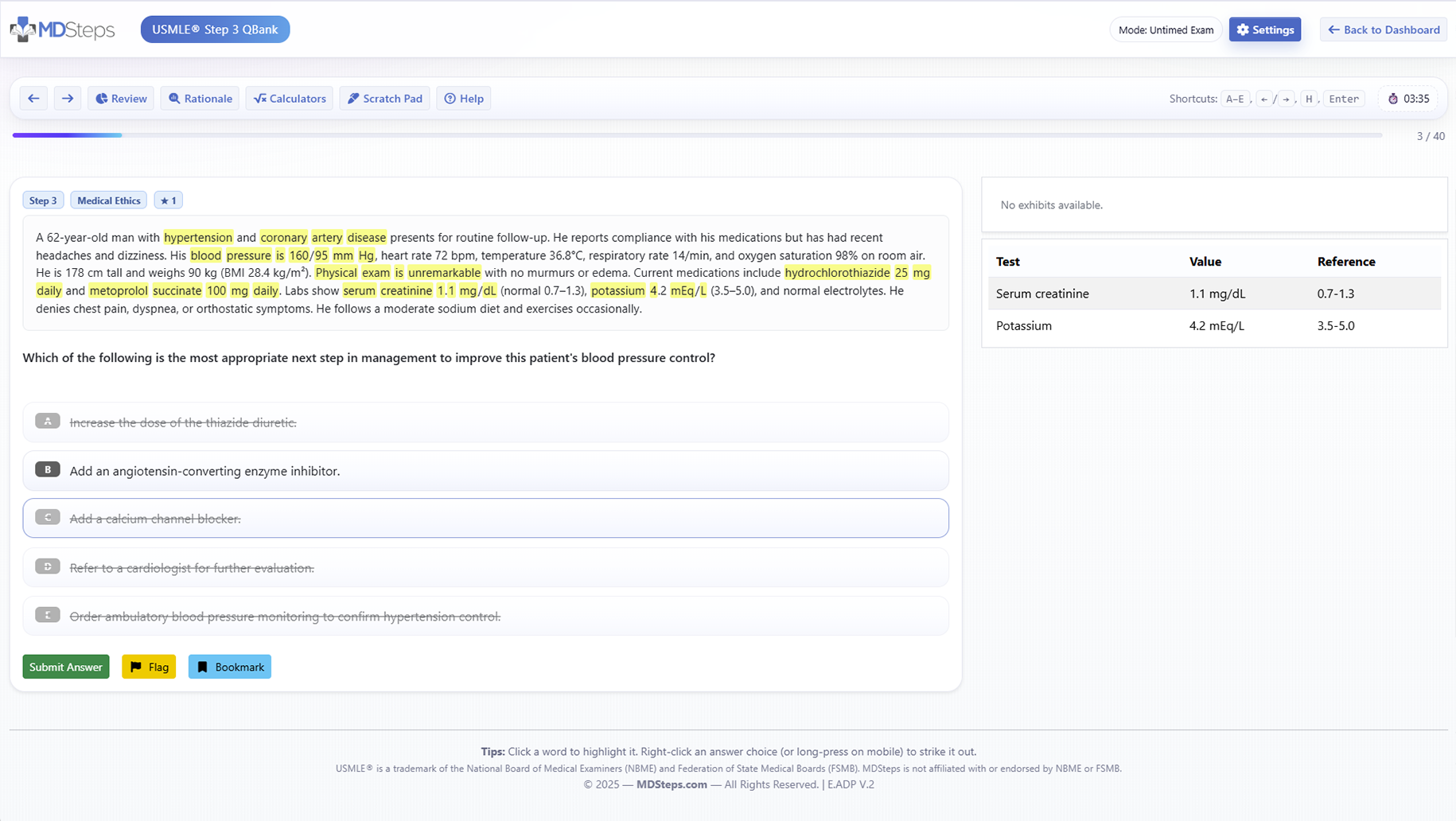
The QBank is where most study hours go, so it should do more than count right and wrong answers. MDSteps tracks difficulty, pacing, weak systems, repeated miss-patterns, and review behavior so every block becomes a feedback loop. If you are doing blocks but still repeating the same mistakes, read why that happens .
- Over 16,000 USMLE-style practice questions across Steps 1–3.
- Personalized sequencing that targets weak systems and recurring miss-patterns.
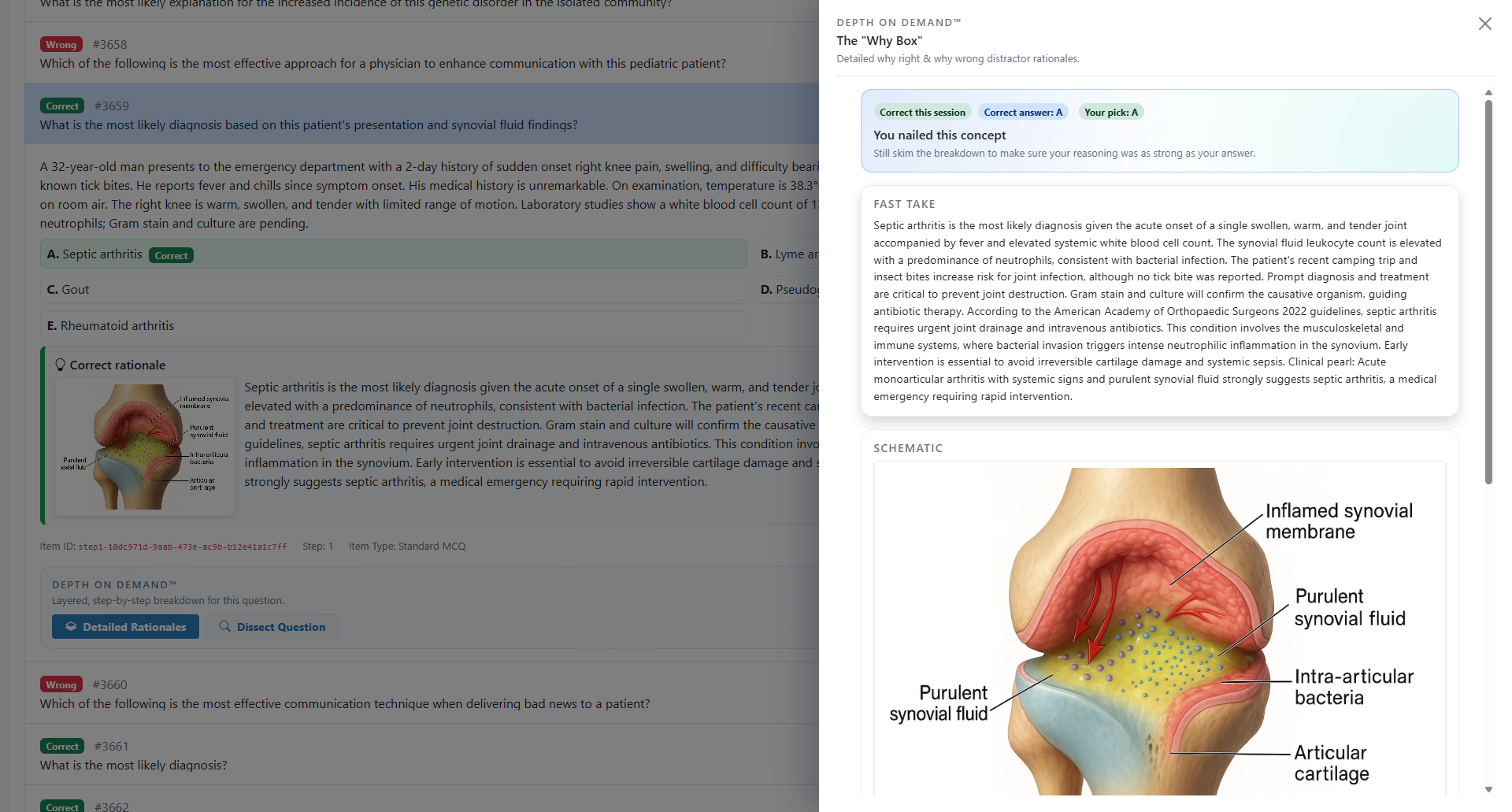
- Depth-on-Demand™ layered review: fast signal → differentiators → full dissection.
- Vignette highlighter and choice strike-through to mirror real test-taking behavior.
- Author names and credentials shown on individual question reviews for added transparency.
- Why-right / why-wrong rationales with explicit pitfall flags.
- Clinically reviewed vignettes with up-to-date references and item-level citations.
- Block Builder for fast mixed sessions aligned to your current exam focus.
How the adaptation logic works
Step 3 CCS included
Computer Case Simulations that train management over time.
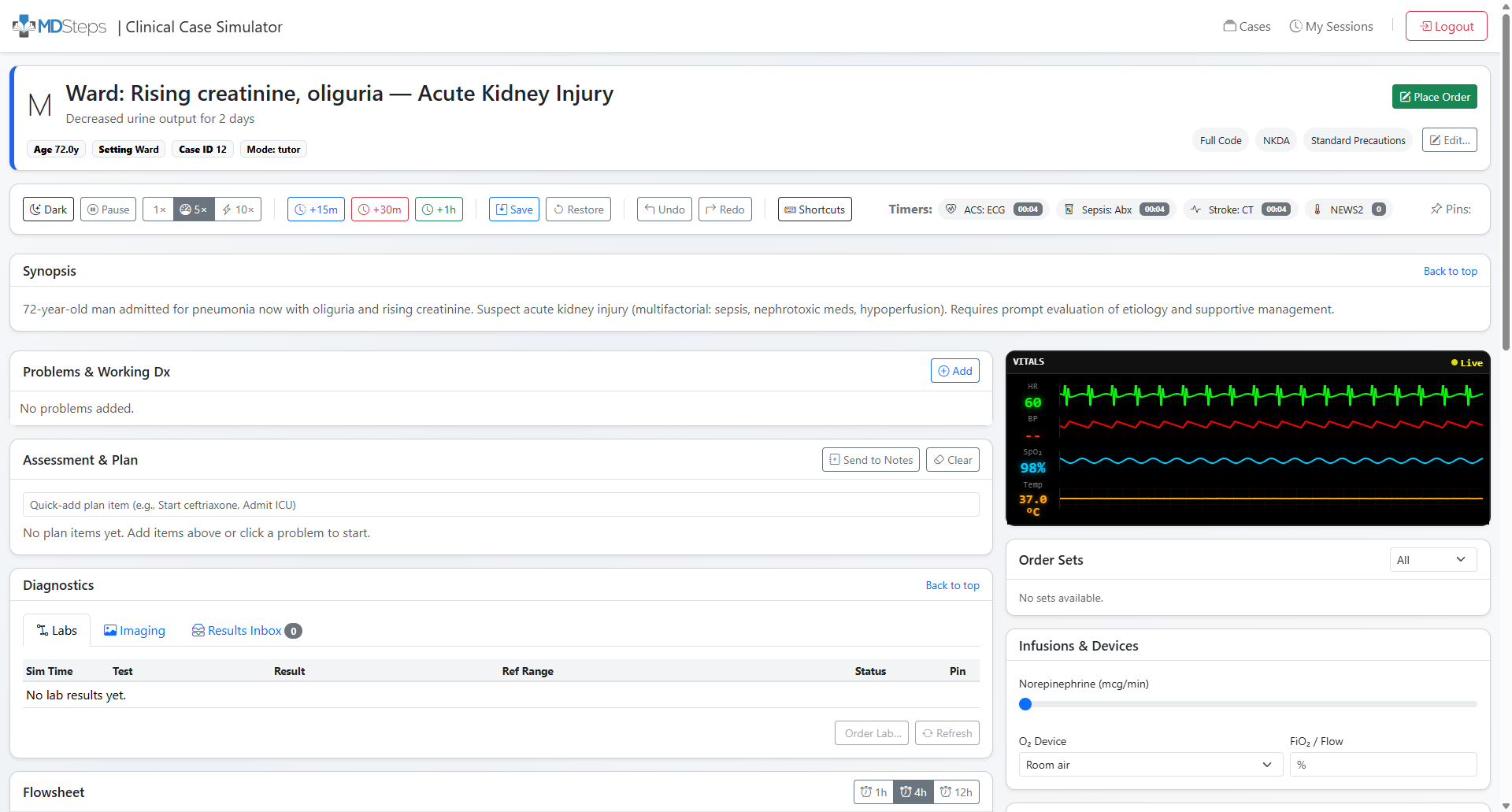
Step 3 CCS tests whether you can stabilize, order, reassess, and close safely. MDSteps’ CCS runner mirrors that workflow with timed orders, evolving vitals, labs, imaging, consults, and post-case scoring.
- 135 CCS cases included with the same $27/month subscription.
- Vitals and labs respond to your orders and timing.
- Critical alerts with safe-order prompts and “don’t forget” cues.
- Post-case review focused on missed management patterns, not just final diagnosis.
Take Some Demo CCS Cases
Analytics & exam readiness
A dashboard that tells you what to do next.
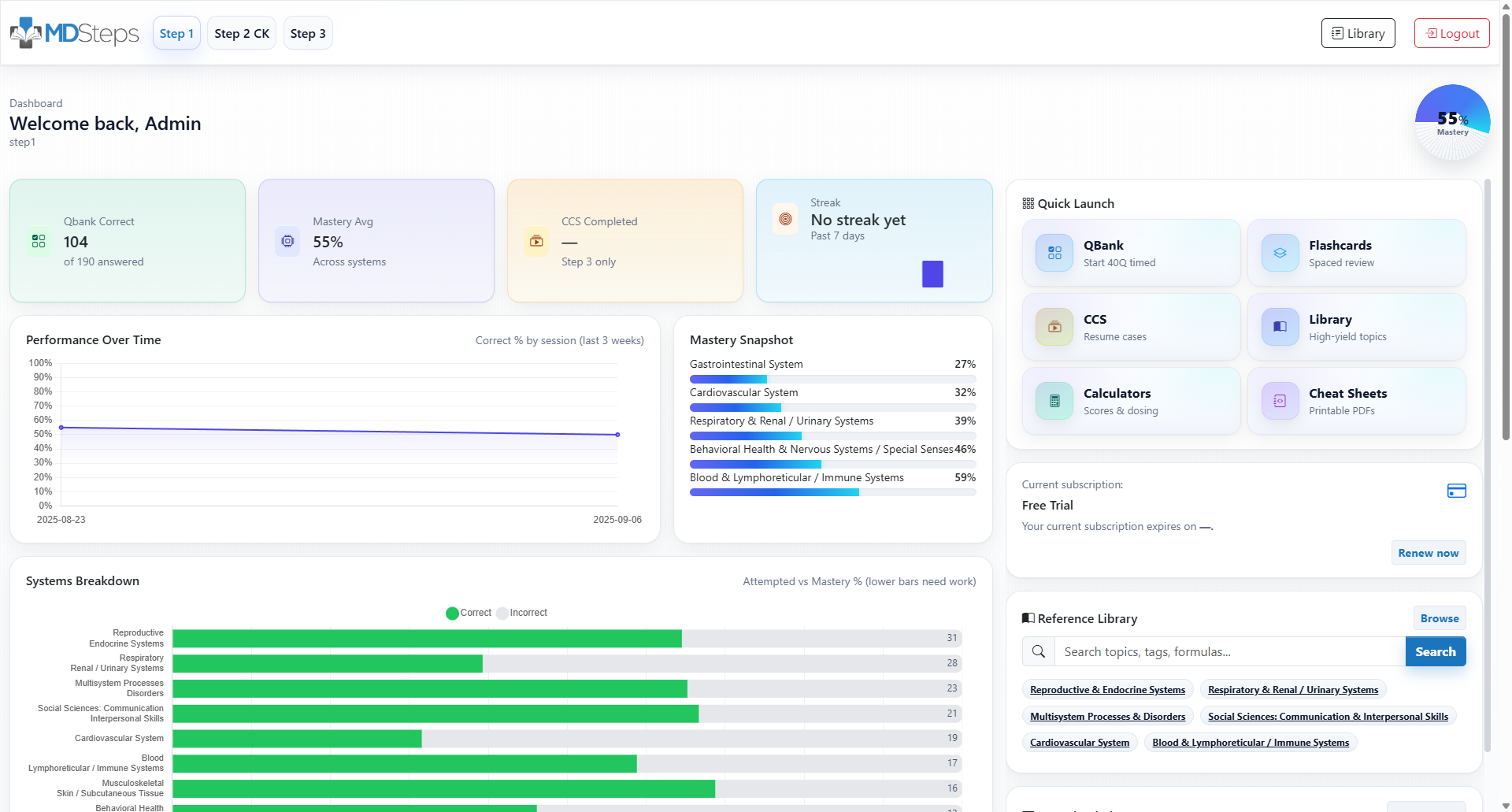
Scores alone do not explain why performance is stuck. The MDSteps dashboard reads your sessions through a reasoning lens: systems, stability, pacing, missed pivots, and next-block recommendations.
- Weakness detection with suggested next blocks tuned to your patterns.
- Session history with deltas, streaks, and stability rather than averages alone.
- Exam-day pacing feedback to curb rushing and overthinking.
- Baseline-informed recommendations after your first 20-question diagnostic block.
Know exactly what to do next
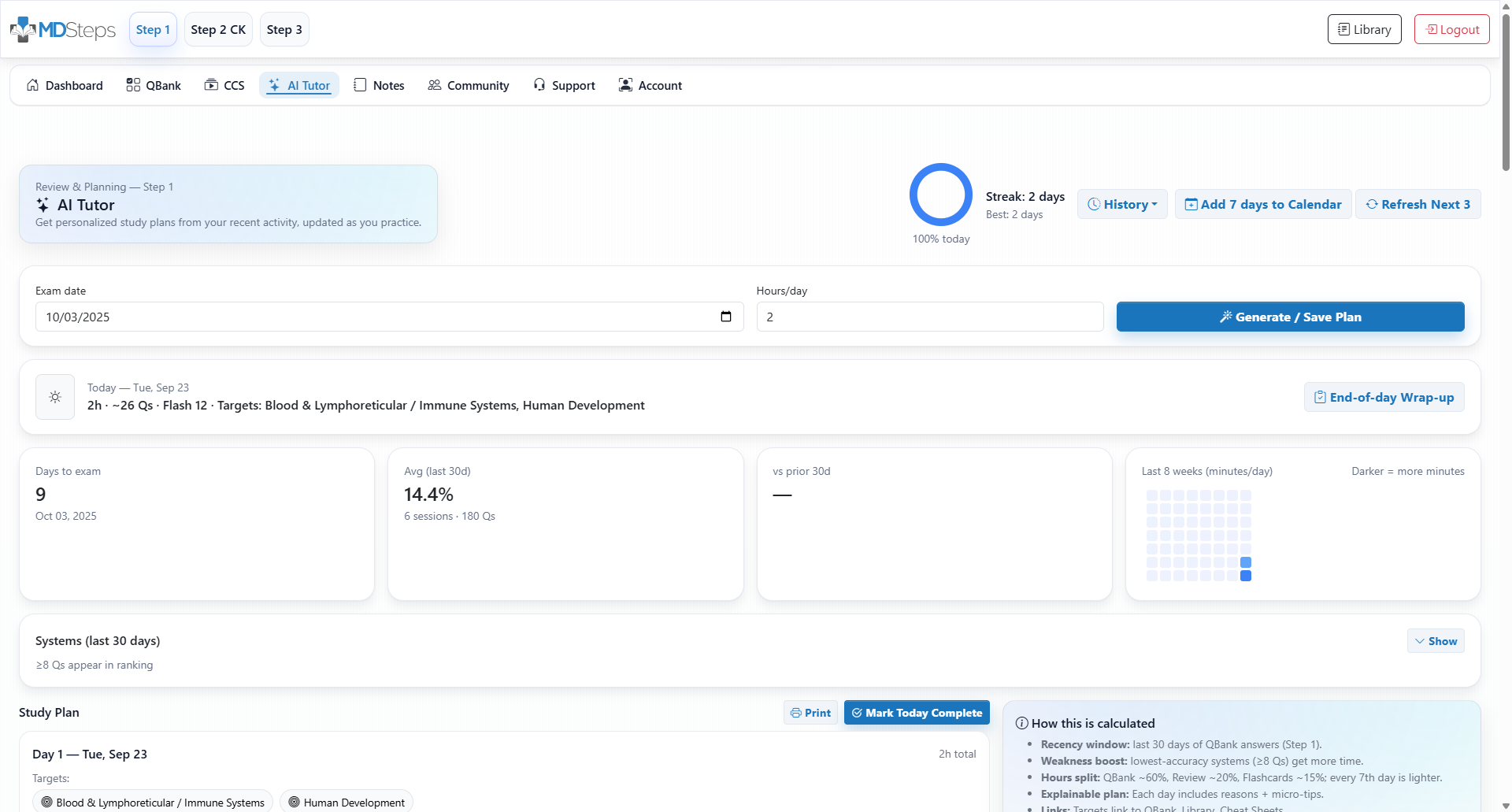
Customized study plans from your actual data.
Tutor Mode turns your exam date, availability, performance history, and miss patterns into a structured sequence. Instead of guessing what today’s block should be, you get a path built around where you are now.
- Uses your past activity and results, not a generic template.
- Set days per week and realistic hours per day to reduce burnout.
- Sync to Google or iOS calendars so prep shows up where your life already lives.
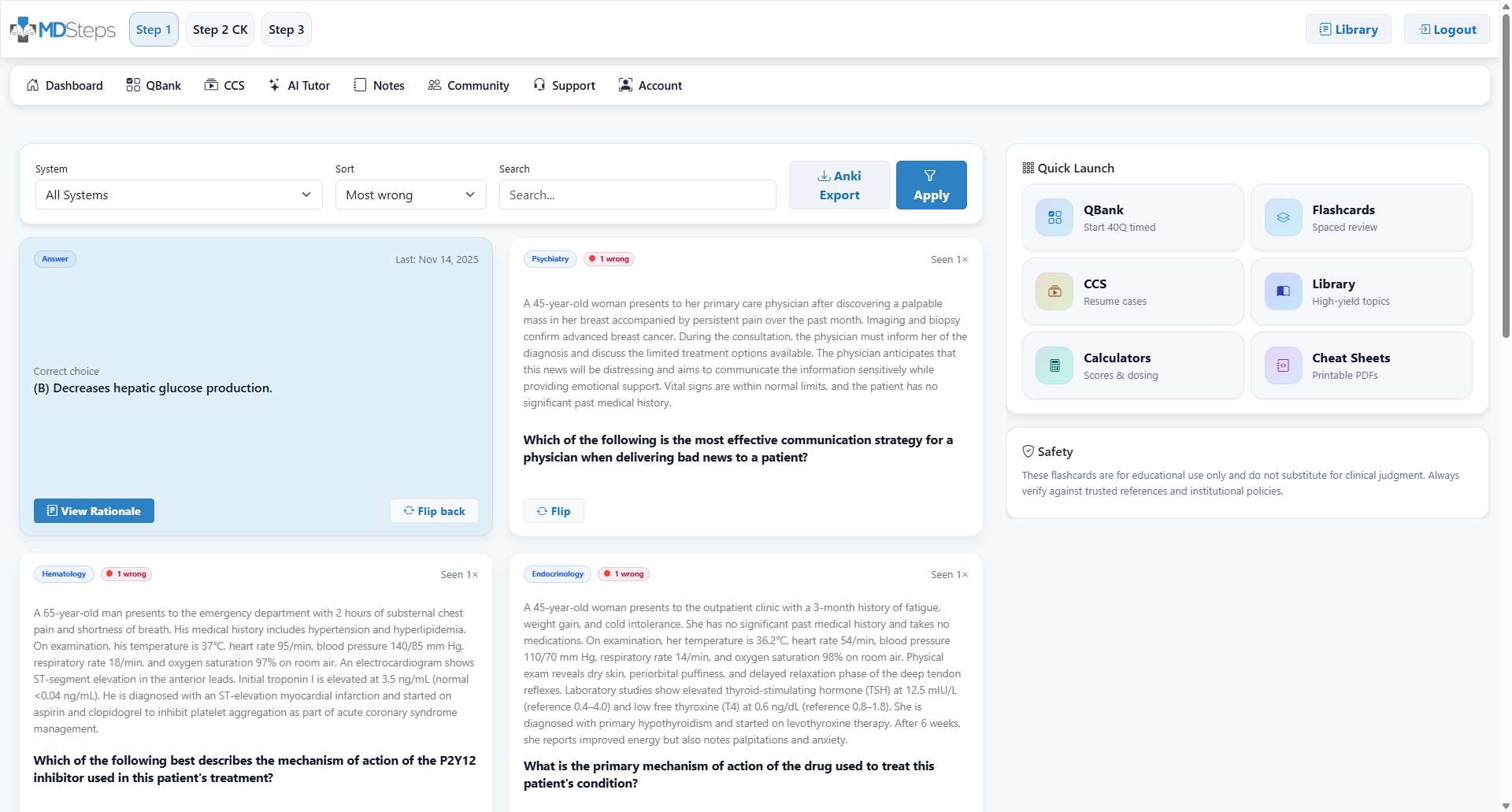
Exportable Anki decks
Turn missed questions into reusable memory.
Every miss is a chance to repair a pattern. MDSteps automatically builds flashcard decks from your incorrects so you can review the right details in the right context and export them to Anki when needed.
- Build decks by frequency, system, discipline, or custom tags.
- One-click Export to Anki via TSV files.
- Review flashcards directly within MDSteps or in your own setup.
Reference library
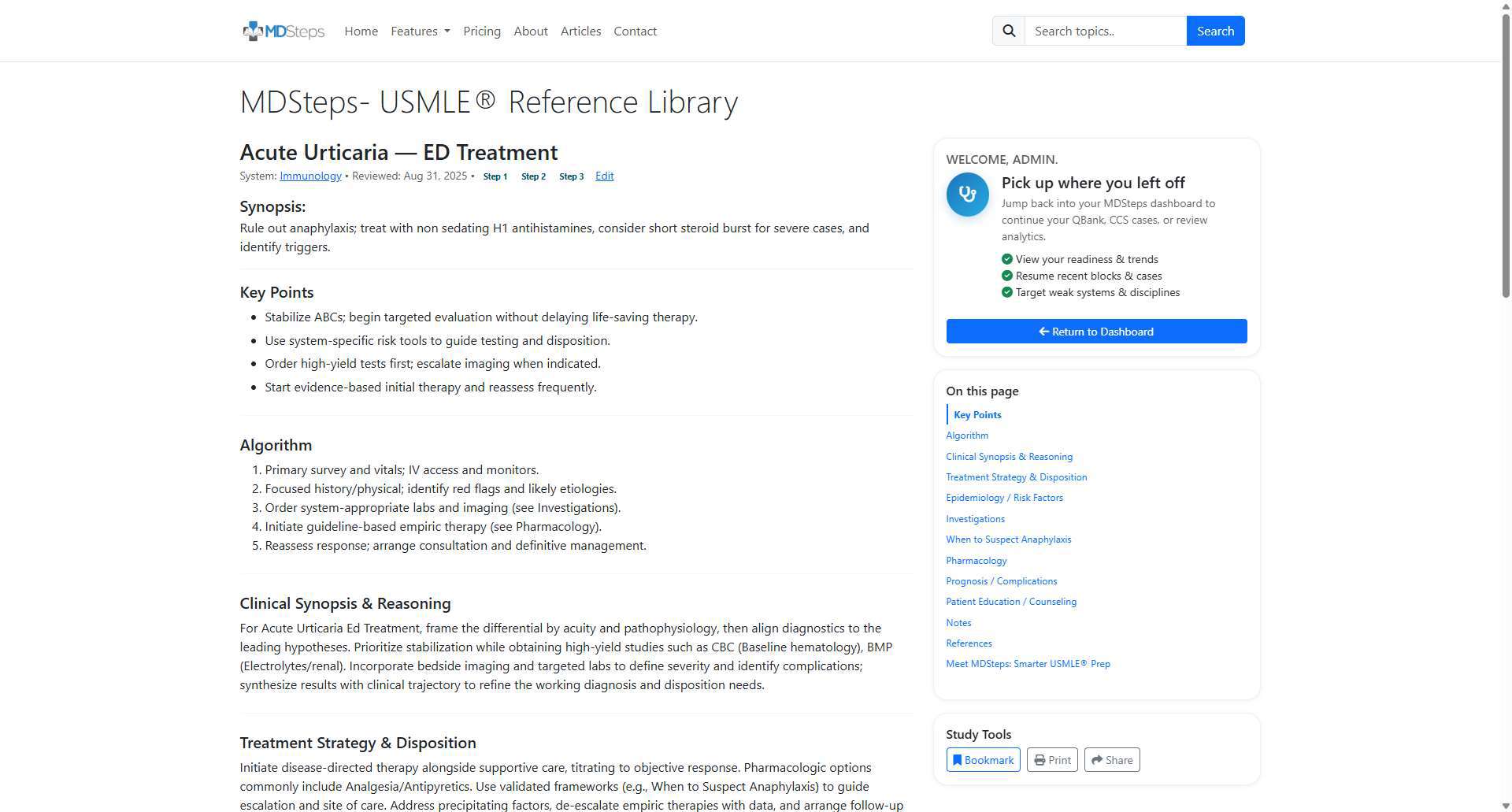
Mechanism-first references linked from review.
When an explanation is not enough, the reference library is one click away. Clinically reviewed entries cover mechanisms, diagnostic steps, management algorithms, pharmacology, and high-yield pathways.
- Over 1,000 concise, clinically reviewed articles and references.
- Algorithms, clinical reasoning frameworks, pharmacology, and diagnostic pathways.
- Jump from a question explanation into the full library article and back again.
USMLE® by Step
Built differently for each USMLE® Step.
Step 1, Step 2 CK, and Step 3 do not test the same logic. MDSteps adjusts the balance of mechanism, diagnosis, management, and CCS so you train the reasoning that your exam is actually scoring.
All Features
Everything you need to train exam-style reasoning without the clutter.
Common Questions
How is this different from a standard QBank?
Standard QBanks track correctness. MDSteps goes further by using item-level adaptation, CCS, and a reasoning-aware dashboard to diagnose blind spots and retrain how you think through stems.
What happens after I pay?
Your first login begins with a 20-question baseline. That block helps MDSteps identify your reasoning patterns, personalize your dashboard, and recommend your first repair path.
Does one subscription include every Step?
Yes. Full access includes Step 1, Step 2 CK, Step 3, and CCS. You can focus your dashboard on your current exam and shift focus as your timeline changes.
Can I review missed questions as flashcards?
Yes. Missed items flow into a deck you can tag, filter, export, and cram. It keeps your highest-yield mistakes in circulation until they become stable.
What is the CCS runner and how does it work?
It is a full simulator with evolving vitals, timed orders, and outcomes. You practice stabilizing, investigating, treating, and stopping, then review annotated reasoning.
How does the adaptive system choose my next questions?
It models item difficulty plus your recent performance and pacing, then chooses questions that are “just hard enough” while resurfacing weak systems and reasoning patterns at smart intervals.
Does every question include citations?
Yes. Each item includes concise references so you can trace the logic back to guidelines or core sources and build trust in the reasoning, not just the answer key.
Do you integrate with flashcard apps?
You can export decks as TSV for import into tools like Anki. Relevant tags and fields are preserved where supported so your cards stay organized.
Can I export my data?
Yes. You can export performance and QBank review data as CSV/JSON to store, analyze, or share with mentors, advisors, or tutors.
How often is content updated?
We release updates aligned with major guideline and exam-trend changes, and continuously refine items and rationales based on student feedback and performance.
Is there a refund policy?
Yes. New monthly subscribers are protected by a 7-day good-faith refund guarantee: complete your baseline plus 100 QBank questions or 5 CCS cases in your first 7 days. If MDSteps is not useful, email support for a first-month refund.
What about privacy?
We store only what is needed to run your account and analytics. You control exports and can request data deletion via support; we do not sell your data to third parties.
Full access from day one
Start MDSteps for $27/month and get your reasoning profile.
Start with a 20-question baseline, then use the adaptive QBank, 135 CCS cases, reasoning-first analytics, auto-flashcards, and reference library with no trial limits.
- 16,000+ USMLE-style questions with explanations that teach decision patterns.
- 135 CCS cases that train orders, timing, reassessment, and safe closure.
- Progress dashboard that turns your data into a clear next step.
- Auto-flashcards, Anki export, calculators, cheat sheets, and library access.