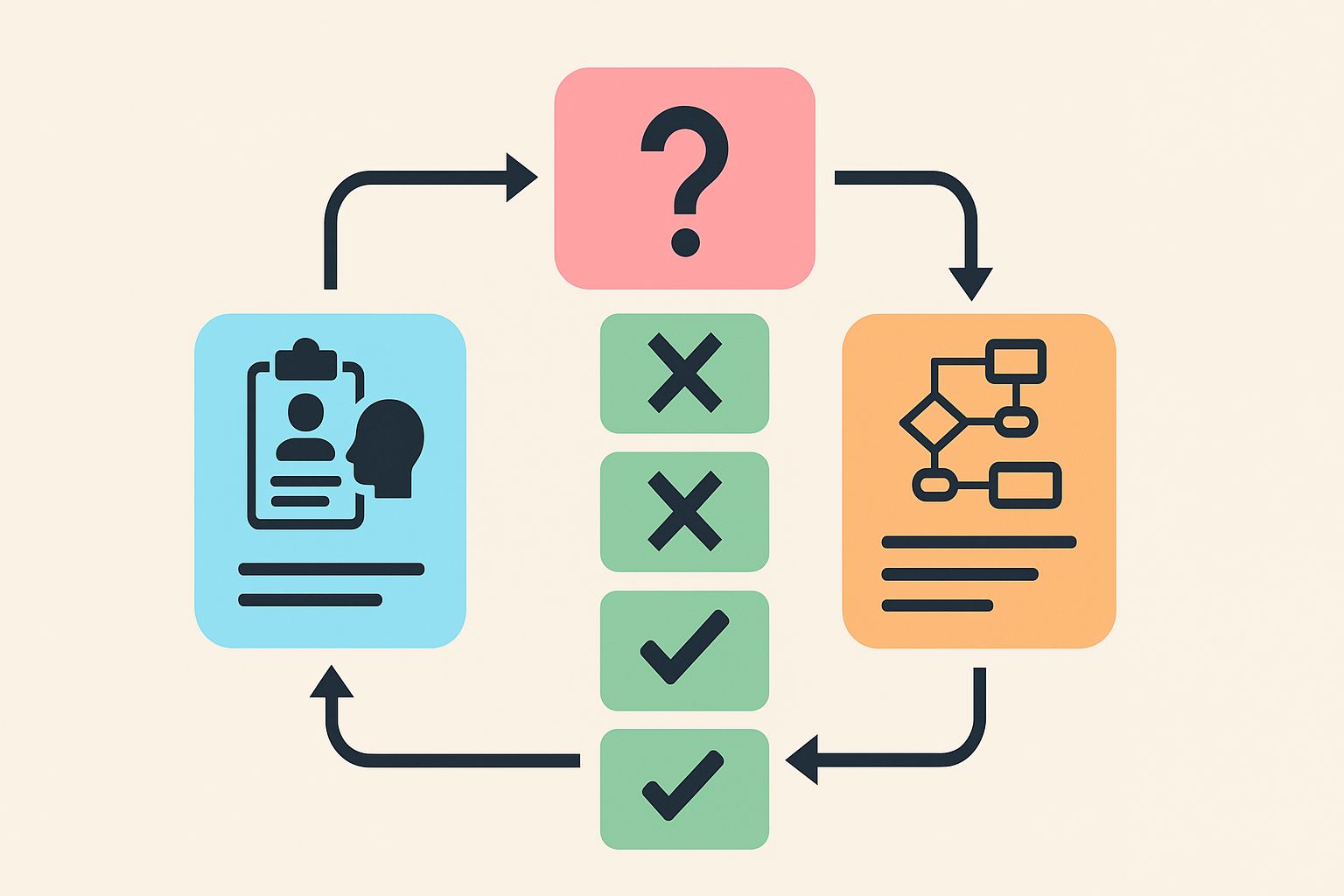
Step 1 readiness diagnostic Knowing whether you are ready to pass Step 1 is not the same as feeling calm, finishing a resource, or recognizing most facts in First Aid. Readiness means your NBME evidence, question timing, and error patterns all point in the same direction. Students usually ask this question when they are close enough to the exam to feel pressure, but not confident enough to trust their preparation. Students usually ask this question when they are close enough to the exam to feel pressure, but not confident enough to trust their preparation. The first rule is to stop treating Step 1 readiness as a mood. Confidence changes by the hour. A safer decision uses objective evidence from recent NBME-style performance, the official sample-question experience, and the type of mistakes you still make under time pressure. Because Step 1 is reported as pass/fail, the practical goal is not to prove that every topic is mastered. The goal is to show that your performance stays above the danger zone even when the test mixes mechanisms, pathology, pharmacology, biostatistics, ethics, and experimental-style wording. A single strong practice block is helpful, but it is not enough. A readiness signal should repeat across more than one assessment, preferably under timed conditions that resemble your actual test date. A useful framework is the three-signal rule. First, your most recent Comprehensive Basic Science Self-Assessment should show a comfortable estimated probability of passing if testing soon. Second, your missed questions should be explainable by fixable reasoning errors rather than broad inability to recognize common disease mechanisms. Third, your timing should be stable enough that you are not guessing because you are rushed during the final third of each block. The NBME Comprehensive Basic Science Self-Assessment is the cleanest readiness anchor because it is designed for students preparing for Step 1 and reports an estimated probability of passing… The NBME Comprehensive Basic Science Self-Assessment is the cleanest readiness anchor because it is designed for students preparing for Step 1 and reports an estimated probability of passing if the exam is taken within a short time window. Treat that probability as a risk estimate, not as a guarantee. A high probability supports taking the exam only when the surrounding evidence also agrees. Look at the trend, the spacing, and the miss composition. A student with two recent strong forms, stable timing, and mostly isolated mistakes is in a different position from a student with one borderline score after memorizing a narrow weak area. The second student may have improved recall without improving transfer. Step 1 punishes that gap because the same concept can be tested through a patient presentation, an experimental graph, an adverse drug effect, or a pathophysiology mechanism. Use your NBME report to separate three states. Green means your estimated pass probability is high, your likely performance range is not brushing the low-pass zone, and your misses have clear Takeaway Rules. Yellow means you are near the line or your results vary form to form. Red means your practice test result depends heavily on topic luck, timing shortcuts, or post-hoc recognition. For students stuck in the yellow zone, MDSteps Step 1 can function as a reasoning diagnostic layer by routing missed questions into a Reasoning Profile, adaptive practice, Depth-on-Demand explanations, an automatic study plan, and flashcard decks exportable to Anki from the misses that actually matter. Not every missed question should delay your exam. Not every missed question should delay your exam. A rare pathway detail missed once is different from repeatedly missing the clue that separates two common diagnoses. The dangerous misses are predictable. They appear when you understand the explanation afterward, but failed to identify what the question was really asking while the clock was running. Use the MDSteps Reasoning Method after every recent NBME or mixed timed block. Identify the exam task, find the Pivot Clue, expose the Distractor Trap, classify the miss pattern, convert it into a Takeaway Rule, then route the next study action. This converts “I need to review renal again” into a sharper diagnosis, such as “I confuse nephritic and nephrotic syndromes when the stem gives edema before urine microscopy.” You are safer when your misses are becoming smaller, cleaner, and less repetitive. You are not ready when the same trap keeps changing costume. Readiness also means you can execute the exam, not just answer questions at home. Readiness also means you can execute the exam, not just answer questions at home. For exams on or after May 14, 2026, Step 1 uses fourteen 30-minute blocks in an 8-hour testing session, with no more than 20 items per block. That format can feel different from older 60-minute practice blocks because decisions arrive in shorter bursts. You need a timing plan that survives frequent transitions. A safe final-week simulation should include official sample questions in the interactive testing experience, at least one recent NBME-style self-assessment, and mixed timed blocks that force topic switching. The purpose is not to inflate confidence. It is to prove that you can recognize the task, mark only strategically, and avoid burning minutes on questions where your first-pass rule is already strong. Danger signs include finishing blocks with less than two minutes to review marked questions, repeatedly changing correct answers because of anxiety, or skipping the question task and hunting for remembered facts. These are test-day process problems. They can make a passing knowledge base look borderline. Before sitting, your timing should be boring: steady pace, predictable marks, and no panic guessing cluster at the end. The final decision should be binary, but the path to it should be diagnostic. The final decision should be binary, but the path to it should be diagnostic. Take the exam when your recent objective evidence is consistent, your NBME-style misses are mostly nonrecurrent, and your timing holds under the official interface. Delay when your latest result is borderline, your likely performance range overlaps the low-pass zone, or your error log shows the same reasoning failure across different organ systems. A short delay is most useful when it has a narrow purpose. “More studying” is not a plan. “Repair cardio physiology because I miss pressure-volume loops when the stem asks for effect of decreased preload” is a plan. “Practice biostatistics” is vague. “Stop confusing absolute risk reduction with relative risk reduction when the answer choices use percentages” is actionable. Your repair target should name the exam task, the tempting wrong move, and the next rule. That target should also be small enough to retest in one or two timed mixed blocks, because a repair that cannot be measured often becomes another review loop. Being ready to pass Step 1 is not the absence of fear. It is the presence of enough converging evidence that a normal test-day variance should still leave you above the pass line. When in doubt, trust patterns over feelings. The student who knows why they miss is much safer than the student who only knows what they reviewed.Use readiness evidence, not exam-day hope
Translate NBME scores into a pass-risk decision
Diagnose whether your misses are safe or dangerous
Student symptom
Likely reasoning problem
MDSteps-style fix
NBME score rises, then falls on the next form
Topic-based review without transfer across presentations
Classify each miss by Pivot Clue, Distractor Trap, and Takeaway Rule
Explanations feel obvious afterward
Recognition is stronger than real-time reasoning
Rewrite the question task before reading answer choices
Two choices always feel equally plausible
The differentiating clue is being treated as background
Ask, “Which answer does this one detail make more likely?”
Scores depend on whether the form “felt fair”
NBME Plateau Type is mixed content deficit plus distractor vulnerability
Route practice to repeated miss patterns, not just weak organ systems
Stress-test timing, stamina, and the official interface
Answer questions with a clear Pivot Clue.
Mark only if a specific clue must be rechecked.
Do not spend extra time proving familiar facts.
Compare final two choices using the stem, not memory.
Change only when a missed clue clearly contradicts your answer.Make a final take, delay, or repair decision
Rapid-review checklist
References
UWorld explains the medicine. MDSteps explains the decision.
Traditional review often tells you the correct answer. MDSteps helps isolate the decision error: the missed pivot clue, the tempting distractor, the timing mistake, or the weak rule that failed under pressure.
Full access includes Step 1, Step 2 CK, Step 3, CCS cases, analytics, auto-flashcards, and study planning.