Start With the Right Goal: Pass Readiness, Not Perfect Content Coverage
When students ask how to improve a Step 1 score in 2 weeks, the most common mistake is trying to repair the entire preclinical curriculum.
When students ask how to improve a Step 1 score in 2 weeks, the most common mistake is trying to repair the entire preclinical curriculum. That is not possible, and it is not the task. Step 1 is now reported as pass or fail, so the final 14 days should be built around exam readiness, reproducible question behavior, and fewer preventable misses. The question is not, “How can I learn everything?” The better question is, “Which errors are still causing me to lose pass-level questions that I was capable of answering?”
The official Step 1 outline covers a broad range of foundational science and physician task competencies. In the last 2 weeks, that breadth can create anxiety. Students respond by opening First Aid from page 1, watching random rapid-review videos, or adding another QBank. These moves feel productive, but they often fail because they do not classify the reason for the miss. A student may label a question as “renal,” but the real problem may have been a missed acid-base pivot, a distractor lab value, or confusion between mechanism and diagnosis. A topic label is too crude for a 14-day rescue plan.
Your first objective is to define your current NBME Plateau Type. A recall plateau means you cannot retrieve core facts fast enough. A recognition plateau means you can understand an explanation after the fact but cannot identify the diagnosis or mechanism in real time. A reasoning plateau means you usually narrow to 2 choices, then select the distractor. A stamina plateau means performance falls late in a block or late in the exam day. Each type requires a different fix. Treating all 4 with “more review” wastes your highest-value days.
Use your most recent NBME, Free 120-style practice, or timed mixed blocks to build a miss log with 4 columns: missed question, Pivot Clue, Distractor Trap, and Takeaway Rule. The Pivot Clue is the detail that should have changed your answer. The Distractor Trap is the attractive but unsupported answer choice. The Takeaway Rule is the short rule you will apply when the same pattern returns. This is the core of the MDSteps Reasoning Method, and it is especially useful when time is short because it converts each miss into a reusable test-day decision.
| Student symptom | Likely reasoning problem | MDSteps-style fix |
|---|---|---|
| Score stuck despite many UWorld blocks | Review is topic-based, not reasoning-based | Classify every miss by Pivot Clue, Distractor Trap, and Takeaway Rule |
| Always down to 2 answers | Final choice is driven by familiarity rather than stem proof | Force the answer to match the decisive clue, not the disease label alone |
| Explanations make sense afterward | Recognition is stronger than retrieval | Redo missed concepts as closed-book prompts within 24 hours |
| Performance drops late in blocks | Stamina and timing errors mimic knowledge gaps | Practice timed mixed sets with a fixed review protocol |
In the final 2 weeks, improvement usually comes from reducing avoidable losses. That means you should not chase obscure facts at the expense of common mechanisms. You should not spend 3 hours on a single disease if you missed the question because you ignored the timeline. You should not memorize every enzyme if the miss was caused by confusing autosomal recessive inheritance with X-linked inheritance. The rescue plan works only when it is diagnostic.
Build a 14-Day Schedule Around Error Type, Not Resource Count
A strong 2-week Step 1 plan needs a daily structure that repeats the same high-yield loop: timed exposure, targeted review, retrieval, and rule creation.
A strong 2-week Step 1 plan needs a daily structure that repeats the same high-yield loop: timed exposure, targeted review, retrieval, and rule creation. Most students fail to improve because each day looks different. One day is videos, another day is flashcards, another day is a long QBank block, and another day is panic review. The brain never receives a consistent signal about what must change before the exam.
Use the first day to diagnose. Take a timed mixed block or review the most recent NBME in detail. Do not simply count incorrect questions by organ system. Instead, tag each miss as recall, recognition, reasoning, or stamina. This gives you a Reasoning Profile. For example, if most misses occur after narrowing to 2 choices, then another pathology video may not solve the problem. You need final-two proof training. If most misses involve formulas, pathways, and microbiology facts that you could not retrieve, then your highest-yield move is targeted closed-book recall.
Days 2 through 10 should be your repair window. Each day should include one timed mixed question block, one focused content repair session, and one short retrieval session from yesterday’s misses. The mixed block protects test realism. The focused repair session fills the specific gap exposed by the block. The retrieval session prevents the common problem of understanding an explanation without being able to reproduce the answer later. Retrieval practice is especially valuable because the act of pulling information from memory strengthens future recall more than rereading alone.
Days 11 and 12 should emphasize exam simulation and weak-pattern cleanup. If you are near pass readiness, take a full-length or near full-length practice day only if it will not create excessive fatigue. If your score is still unstable, use shorter timed blocks but make review more precise. Day 13 should be light but active. Review Takeaway Rules, formulas, pathognomonic clues, and common distractor traps. Day 14 should protect sleep, timing, and confidence. Do not start a new resource on the final day.
| Days | Main task | What it fixes | Output |
|---|---|---|---|
| 1 | Diagnostic review of NBME or timed mixed blocks | Unclear plateau type | Reasoning Profile |
| 2 to 5 | Daily timed block plus targeted repair | Repeat misses from same error mechanism | 20 to 30 Takeaway Rules |
| 6 to 10 | Mixed blocks with final-two analysis | Distractor selection and timing drift | Short list of recurring traps |
| 11 to 12 | Readiness check and weak-pattern cleanup | Unstable performance under pressure | Pass-readiness decision data |
| 13 | Rapid-review rules and formulas | Last-minute recall failure | One-page exam sheet |
| 14 | Light review, logistics, sleep | Fatigue and panic errors | Test-day execution plan |
The schedule should be intense but not chaotic. A student who does 160 questions per day without classifying misses may learn less than a student who does 80 questions with disciplined review. The output matters. By the end of each day, you should have a short set of rules that can actually change your next block. Examples include: “When a question asks mechanism, do not answer diagnosis,” “When fever and murmur appear after dental work, prove organism from setting and valve risk,” and “When renal labs conflict, identify the primary acid-base disorder before choosing compensation.”
Use the MDSteps Reasoning Method on Every Missed Question
The last 2 weeks are not the time for passive explanation reading.
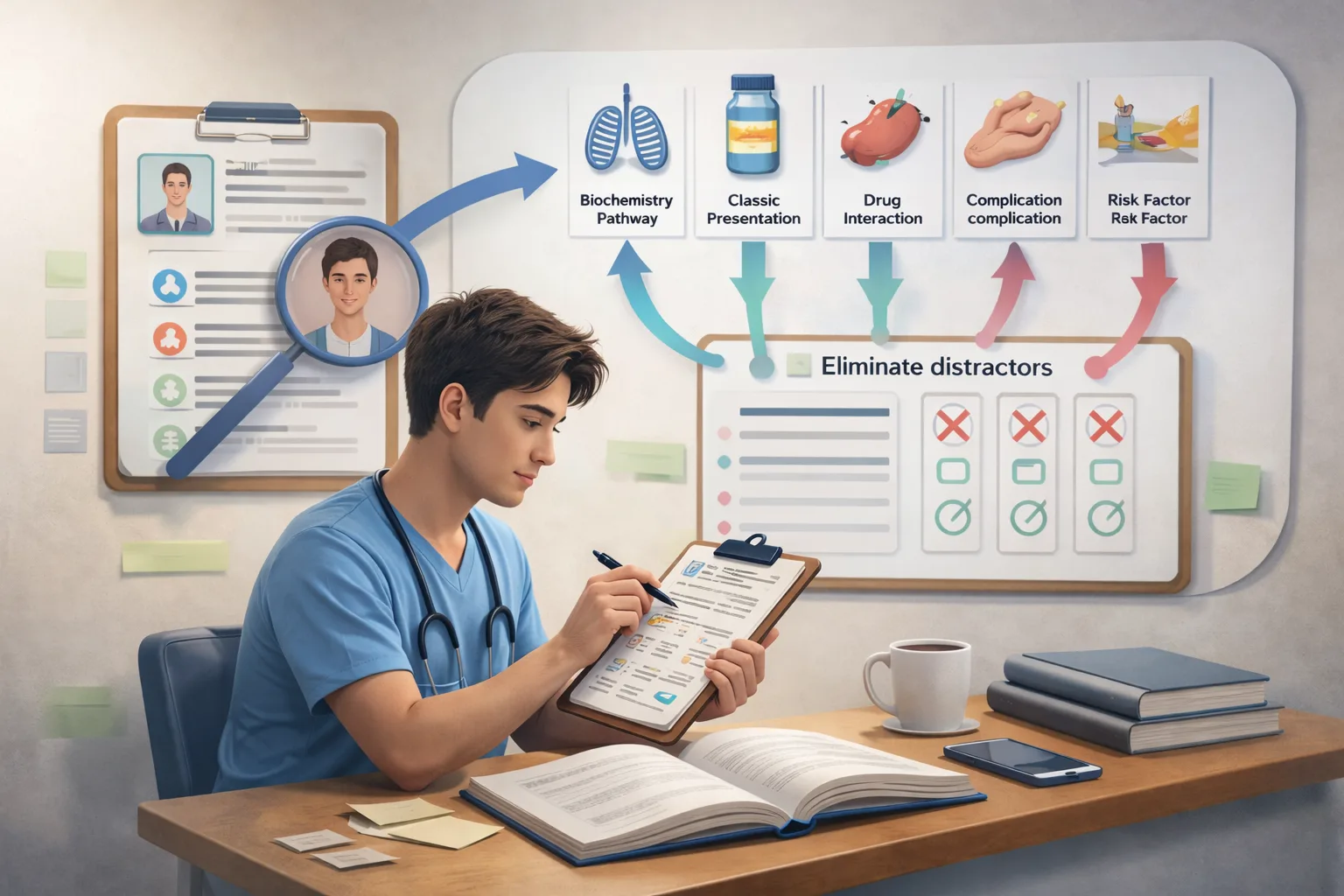
The last 2 weeks are not the time for passive explanation reading. They are the time to extract the exam rule hidden inside each missed question. The MDSteps Reasoning Method gives you a repeatable structure: identify the exam task, find the Pivot Clue, expose the Distractor Trap, classify the miss pattern, convert the miss into a Takeaway Rule, and route yourself to the next study action. This method is useful because Step 1 often tests whether you can recognize what kind of thinking the stem requires.
Start by identifying the exam task. Step 1 questions may ask for diagnosis, mechanism, pathophysiology, pharmacology, microbiology, genetics, biostatistics, or interpretation of an experiment. Students lose points when they answer the disease they recognize instead of the task being asked. For example, a vignette may clearly describe nephrotic syndrome, but the question may ask for the mechanism of edema. The correct move is not to name the disease. It is to link protein loss to reduced plasma oncotic pressure and compensatory sodium retention.
Next, find the Pivot Clue. This is the detail that decides between 2 plausible answers. In Step 1, pivot clues are often age, timing, exposure, immune status, inheritance pattern, lab direction, histology, or drug mechanism. A student may know that both Graves disease and toxic multinodular goiter can cause hyperthyroidism. The pivot may be ophthalmopathy, diffuse uptake, or older age with nodular enlargement. Without naming the pivot, the student is guessing from familiarity.
Then expose the Distractor Trap. A distractor is not random. It is designed to attract a student who recognizes part of the stem but misses the controlling detail. If you chose an answer because it sounded associated with the disease, write down why it was tempting. Then write why the stem did not support it. This step is essential because many students repeat the same trap across organ systems. They overvalue buzzwords, ignore chronology, answer a related complication instead of the mechanism, or choose the most dramatic diagnosis rather than the best-supported one.
What is the question asking?
Which clue changes the answer?
Why was the wrong answer tempting?
What will you do next time?
Finally, convert the miss into a Takeaway Rule. A weak rule says, “Review nephrotic syndrome.” A useful rule says, “If the question asks why edema occurs in nephrotic syndrome, answer the Starling force mechanism, not the disease label.” A weak rule says, “Study immunology.” A useful rule says, “If recurrent Neisseria infections appear, think terminal complement deficiency before broad immunodeficiency.” The rule must be short enough to remember during a timed block.
MDSteps can support this workflow by functioning as a reasoning diagnostic layer rather than another passive question source. Its value in a 2-week rescue window is the ability to organize misses by patterns such as Pivot Clue failure, Distractor Trap selection, and Takeaway Rule generation. For a Step 1 student, that can make review faster because the next study action is based on why the question was missed, not only what topic appeared in the explanation. For more Step 1-focused practice, see MDSteps Step 1.
Prioritize High-Yield Step 1 Patterns That Move Scores Fast
In 2 weeks, you need to study patterns with high transfer value.
In 2 weeks, you need to study patterns with high transfer value. A high-transfer pattern appears across many questions and organ systems. Acid-base interpretation, autonomic pharmacology, bacterial toxin mechanisms, immunodeficiency patterns, inheritance clues, respiratory physiology, renal compensation, enzyme deficiencies, oncogenes, tumor suppressors, and endocrine feedback loops are examples. These topics do not matter because they are famous. They matter because they can be tested in many formats.
Use your miss log to separate high-transfer deficits from isolated trivia. Missing one rare storage disease fact may not deserve a 3-hour repair session. Missing the same lysosomal storage pattern across multiple questions does. Missing one obscure drug adverse effect may not be urgent. Missing the difference between competitive antagonists, noncompetitive antagonists, partial agonists, and enzyme inhibitors is urgent because pharmacology graphs can appear in many forms. The final 14 days reward triage.
A strong content repair session should be narrow, active, and question-linked. Do not write “cardiology” on your plan. Write “murmur timing plus pressure-volume loop changes,” “post-MI complication timeline,” or “RAAS response to renal artery stenosis.” Do not write “microbiology.” Write “gram-positive cocci differentiation by catalase, coagulase, optochin, bile solubility, and clinical setting.” Each topic should end with 5 to 10 closed-book prompts. If you cannot answer them, you did not finish the repair.
For Step 1, mechanisms are often more important than labels. A vignette may describe a disease you recognize, but the answer may require the molecular defect, histologic finding, receptor pathway, or physiologic consequence. When reviewing, ask 3 questions: What diagnosis is being described? What mechanism explains the key finding? What answer choice would be tempting if I stopped at the diagnosis? This keeps your review aligned with board-style logic.
| High-yield repair target | Common vignette clue | Tempting wrong move | Takeaway Rule |
|---|---|---|---|
| Acid-base disorders | pH, PaCO2, HCO3 direction | Pick a diagnosis before identifying primary disorder | Find primary change first, then compensation |
| Autonomic pharmacology | Heart rate, pupil, bladder, bronchial tone | Memorize drug names without receptor effect | Translate receptor into organ response |
| Immunodeficiency | Organism pattern and age | Choose broad immune weakness | Match infection type to immune defect |
| Genetics | Pedigree, sex, generation skipping | Guess inheritance from disease name | Use pedigree logic before memorized association |
| Endocrine feedback | Hormone pair moves together or opposite | Answer gland location without feedback analysis | Classify primary versus secondary first |
During the final 2 weeks, avoid low-yield perfectionism. You do not need to rewrite every pathway. You need to repair the exact point where the question becomes answerable. For a glycogen storage disease question, that may be fasting hypoglycemia with lactic acidosis. For a renal tubular acidosis question, it may be urine pH and potassium direction. For a biostatistics question, it may be whether the stem asks for incidence, prevalence, attributable risk, or number needed to treat. Precision beats volume.
Fix the Final-Two Answer Trap Before Test Day
The final-two trap is one of the most common reasons a Step 1 score does not improve in the last 2 weeks.
The final-two trap is one of the most common reasons a Step 1 score does not improve in the last 2 weeks. The student knows enough to eliminate several choices, but the last decision is made by intuition, anxiety, or familiarity. The wrong answer is usually related to the case. It may be a true statement, a common association, or a complication of the disease. The problem is that it is not the answer to the task asked by the stem.
To fix this, use a 3-step final-two protocol. First, restate the task in 5 words or fewer. Examples include “mechanism of edema,” “organism causing pneumonia,” “drug adverse effect,” or “inheritance pattern.” Second, identify the one clue that supports each remaining answer. Third, eliminate the answer that requires adding information not present in the stem. This last step is critical. NBME-style questions often punish assumptions.
Consider a patient with chronic cough, weight loss, apical cavitary lesion, and acid-fast bacilli. If the question asks which immune pathway controls the organism, the answer is not simply “macrophages” because that sounds associated with tuberculosis. The reasoning must proceed through Th1 activation, interferon-gamma, macrophage activation, and granuloma maintenance. If another answer choice mentions neutrophils, it may feel plausible because neutrophils fight bacteria. The pivot is intracellular pathogen control, not generic bacterial defense.
Another common final-two trap occurs in physiology. A student recognizes heart failure and chooses a compensatory mechanism without checking whether the question asks for acute change, chronic adaptation, or drug response. If the stem gives decreased renal perfusion, the pivot may be renin release and angiotensin II-mediated efferent arteriole constriction. If the stem gives ACE inhibitor therapy, the pivot changes. The same disease context can produce different answers depending on the task.
Final-two proof test
- What exactly is the stem asking?
- Which single clue proves answer A?
- Which single clue proves answer B?
- Which answer requires an assumption not stated in the stem?
- What Takeaway Rule prevents this same trap next time?
When reviewing, do not only write why the correct answer was correct. Write why your chosen wrong answer was attractive. This is where score improvement lives. If your wrong answer was a true fact but not the answer to the question, label the miss as task mismatch. If your wrong answer matched an early clue but ignored a later detail, label it as Pivot Clue failure. If your wrong answer came from a memorized association that did not fit the full stem, label it as association overreach.
During timed blocks, you should not spend excessive time debating every final-two question. Use the protocol quickly. If no answer is proven, choose the one supported by the most specific clue and move on. The goal is not perfect certainty. The goal is a consistent decision rule that prevents avoidable switching, overthinking, and distractor selection.
Review NBMEs Like a Diagnostic Test, Not a Score Report
An NBME self-assessment is useful because it approximates the style and constraints of Step 1.
An NBME self-assessment is useful because it approximates the style and constraints of Step 1. In a 2-week window, however, the score alone is not enough. The value comes from diagnosing why you missed questions and whether the miss pattern is changing. A student who improves from 60% to 64% by fixing timing errors is different from a student who remains at 60% because of persistent recall gaps. The next study action should differ.
After each NBME or self-assessment block, divide missed questions into 3 categories. Category 1 includes questions you should have answered correctly with your current knowledge. These are the highest-yield misses because they are preventable. Category 2 includes questions that exposed a core content gap in a high-yield area. These require targeted repair. Category 3 includes obscure details or low-frequency topics. These should be noted but not allowed to dominate the final 2 weeks.
For Category 1, your review should focus on reasoning behavior. Did you miss the timeline? Did you answer the wrong task? Did you ignore a lab direction? Did you change from correct to incorrect? Did you choose a diagnosis when the question asked for mechanism? These errors often improve quickly because they do not require learning a new chapter. They require a better test-day rule.
For Category 2, use short repair loops. A repair loop includes a 20-minute focused review, 5 closed-book prompts, and 5 to 10 related questions if available. Keep the loop small. If you missed a question on restrictive lung disease, do not review all pulmonology. Repair lung volumes, compliance, DLCO patterns, and the specific disease comparison that caused the miss. If you missed a question on nephritic syndrome, repair complement patterns, presentation, and histology rather than the entire renal chapter.
For Category 3, protect yourself from panic. Every NBME contains details that feel unfamiliar. The wrong response is to abandon your plan and chase isolated facts. Ask whether the concept is likely to transfer to many questions. If not, create a brief note and move on. The final 14 days should be dominated by repeatable patterns, not emotional reactions.
NBME offers Comprehensive Basic Science Self-Assessments for students preparing for Step 1, and these tools can help gauge readiness when interpreted properly. The key is to use them as diagnostic instruments. Track whether your Reasoning Profile is improving. Are fewer misses due to final-two traps? Are recall misses shrinking in high-yield systems? Is timing stable across blocks? These trends matter more than any single question reaction.
A practical rule is this: never finish an NBME review without writing your top 5 repeat errors. Examples might include “missed endocrine feedback direction,” “overcalled rare diagnosis,” “ignored age as pivot,” “confused mechanism with complication,” and “did not calculate compensation.” These 5 errors become the next 48 hours of study. This keeps the plan responsive without becoming chaotic.
Know When to Delay, When to Proceed, and How to Reduce Risk
A 2-week improvement plan should be honest about readiness.
A 2-week improvement plan should be honest about readiness. Some students can meaningfully improve in 14 days because their misses are mostly preventable reasoning errors. Others need more time because their baseline recall is too unstable. The goal is not to create false confidence. The goal is to reduce risk and make a defensible decision.
Proceeding is more reasonable when your recent self-assessment results are consistently near or above your school’s advised safety range, your missed questions are concentrated in fixable patterns, and your timing is stable. It is also more reasonable when your weakest areas are specific and repairable, such as renal acid-base, autonomic pharmacology, or immunodeficiency patterns. These can improve faster than broad deficits across multiple systems.
Delaying should be considered when multiple recent assessments remain clearly below a safe passing range, when you cannot retrieve foundational facts under timed conditions, or when performance varies dramatically from block to block. It should also be considered when anxiety, sleep disruption, or burnout is causing repeated timing collapse. Step 1 is pass/fail, but failing still carries consequences. A delay can be the correct academic decision if it converts unstable readiness into consistent performance.
Use a decision framework rather than emotion. Ask: What do my last 2 objective data points show? Are misses decreasing for the same reasons, or are they random? Can I explain why my last score improved or dropped? Do I have enough days to repair the dominant miss pattern? If the answer is unclear, speak with your school advisor or academic support office. They may have internal policies, score thresholds, and historical data that should guide your decision.
Risk reduction also includes test-day execution. In the last 2 weeks, practice the same pacing routine you will use on exam day. For example, check time after every 10 questions, mark only questions that have a clear reason for revisit, and avoid changing answers unless you identify a concrete misread. Many students lose points because they treat marked questions as emotional threats rather than decision points. A mark should mean “return if time allows,” not “panic later.”
MDSteps can be useful here because its analytics and exam-readiness dashboard are designed to separate content gaps from reasoning patterns. A student who sees that most misses come from Distractor Trap selection needs a different final-week plan than a student whose misses come from microbiology recall. This kind of classification can help make the final decision less emotional and more evidence-based.
Rapid-Review Checklist for the Final 48 Hours
The final 48 hours should not be a desperate attempt to learn new medicine.
The final 48 hours should not be a desperate attempt to learn new medicine. They should consolidate the rules and patterns that prevent avoidable misses. Your aim is to enter the exam with a small number of reliable moves. A bloated final review document creates anxiety. A concise exam sheet creates control.
Start with your Takeaway Rules. Read each one and ask whether it changes behavior. “Study biochemistry” is not a rule. “When a child has fasting hypoglycemia, hepatomegaly, lactic acidosis, and hyperuricemia, think glucose-6-phosphatase deficiency” is a rule. “Review renal” is not a rule. “In metabolic acidosis, check whether respiratory compensation is appropriate before diagnosing a mixed disorder” is a rule. The rule must be specific enough to guide a future answer choice.
Next, review formulas and interpretation patterns that commonly fail under stress. This includes sensitivity, specificity, positive predictive value, negative predictive value, odds ratio, relative risk, attributable risk, number needed to treat, Hardy-Weinberg basics, acid-base compensation, renal clearance concepts, and pharmacokinetic relationships. Do not only look at formulas. Practice identifying which formula the stem is asking for. Many biostatistics misses happen because students calculate the wrong quantity correctly.
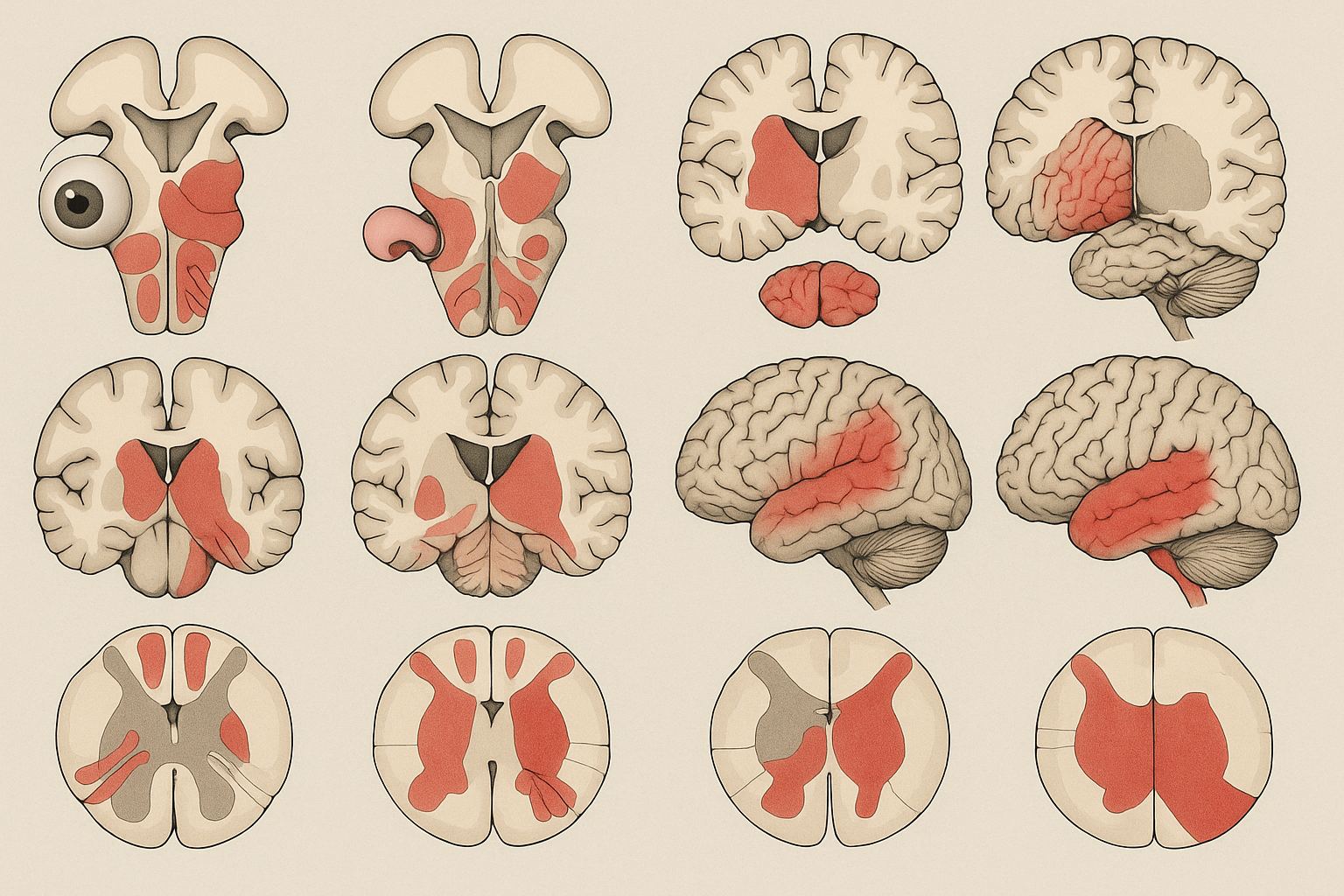
Then review your highest-yield visual patterns. This may include pressure-volume loops, spirometry curves, cardiac action potentials, nephron transporter locations, brachial plexus lesions, spinal cord tracts, lysosomal storage histology, and hematology smear findings. For each visual, ask what clue would distinguish the nearest distractor. Visual recognition without contrast is fragile.
Final 48-hour checklist
- Review your top 25 Takeaway Rules.
- Redo closed-book prompts from your last 3 days of misses.
- Practice one timed mixed block only if it will not damage sleep or confidence.
- Review formulas by task, not by memorized equation alone.
- Finalize test-day pacing and break strategy.
- Do not start a new resource.
- Sleep, food, identification, permit, route, and arrival time are part of readiness.
On the day before the exam, stop heavy studying early enough to sleep. If you review, use short active prompts and rule lists. Avoid long explanation reading because it creates the illusion that everything is equally important. Your final task is to preserve retrieval speed and emotional control.
The most important principle is this: in 2 weeks, you improve Step 1 performance by removing repeatable errors. You do not need a perfect memory. You need a disciplined system for deciding what the stem is asking, identifying the Pivot Clue, avoiding the Distractor Trap, and applying a Takeaway Rule under time pressure. That is how a short runway becomes a focused rescue plan.
Daniel R. Moreno, MD
Educational content for USMLE preparation. This article does not replace school-specific academic advising or official USMLE guidance.
References
- United States Medical Licensing Examination. Step 1 Content Outline and Specifications.
- United States Medical Licensing Examination. Examination Results and Scoring.
- National Board of Medical Examiners. Taking an NBME Self-Assessment.
- National Board of Medical Examiners. Comprehensive Basic Science Self-Assessment.
- Washington University in St. Louis Center for Teaching and Learning. Using Retrieval Practice to Increase Student Learning.
- Pastötter B, Bäuml KHT. Retrieval practice enhances new learning: the forward effect of testing. Front Psychol. 2014.
UWorld explains the medicine. MDSteps explains the decision.
Traditional review often tells you the correct answer. MDSteps helps isolate the decision error: the missed pivot clue, the tempting distractor, the timing mistake, or the weak rule that failed under pressure.
Full access includes Step 1, Step 2 CK, Step 3, CCS cases, analytics, auto-flashcards, and study planning.