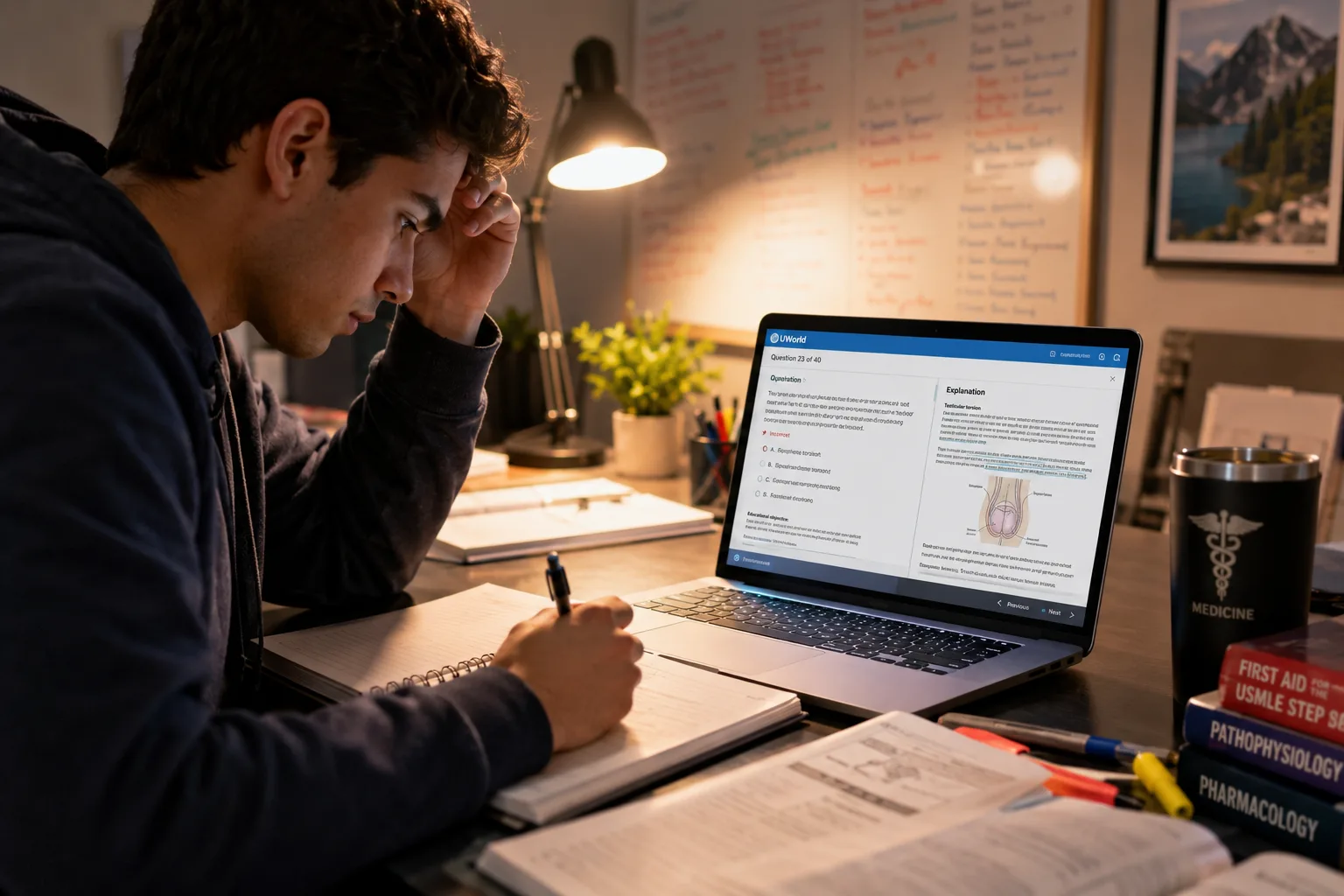
Students often interpret a repeated missed question as proof that they “do not know the topic.” That conclusion is sometimes correct, but it is incomplete. On USMLE-style exams, a repeated miss may reflect a content gap, a weak illness script, poor question-stem triage, premature closure, inadequate memory retrieval, or failure to recognize how the same concept appears in different clinical clothing. The right QBank should help separate these causes rather than simply display another red mark. The USMLE tests application of knowledge, concepts, principles, and patient-centered skills. That means a student who can recite a fact may still miss a question when the fact is embedded in a long vignette, disguised by distractors, or paired with a similar diagnosis. For Step 1, the repeated miss often occurs when the student knows a pathway but cannot connect mechanism to presentation. For Step 2 CK, it often appears when management hinges on timing, severity, contraindications, or next best step. For Step 3, repeated errors frequently involve sequencing, clinical judgment, and follow-through across time. A high-quality QBank must therefore do more than ask whether the answer was correct. It should help the learner answer three questions: why did I choose my answer, why is the correct answer better, and what cue should change my decision next time? Without that loop, students accumulate completed questions without changing the mental model that produced the error. The highest-yield approach is to treat each missed question as a specimen. The question is not just a test item. It is evidence of how your mind handled uncertainty. Did you miss the age, time course, vital sign abnormality, medication exposure, lab pattern, or wording of the actual task? Did you know the diagnosis but answer the wrong management step? Did you eliminate the correct option because it looked unfamiliar? These distinctions matter because each requires a different repair. The fact, mechanism, guideline, or association was not available during recall. The concept was known, but the vignette cues were not linked to it under pressure. The student reached the topic but chose the wrong branch in the decision pathway. Students who keep missing the same questions usually need a QBank that has three qualities. First, the explanations must clarify why the incorrect options are wrong, not merely why the correct option is true. Second, the platform must preserve misses and convert them into a structured review schedule. Third, analytics must show whether the student is improving by discipline, organ system, task type, and timing. Raw percent correct is too blunt to guide remediation. The MDSteps Platform was designed around that remediation problem. Its Adaptive QBank contains more than 16000 questions and can convert missed items into automatic flashcard decks exportable to Anki. That matters because repeated errors require retrieval, not passive rereading. When a missed concept returns through questions, cards, and analytics, the student gets multiple chances to rebuild the cue-to-answer pathway.Why repeated misses are a diagnostic signal
Knowledge gap
Recognition gap
Reasoning gap
The best question bank for students with persistent misses is not necessarily the one with the most obscure facts. It is the one that creates deliberate practice. Deliberate practice means the student receives targeted tasks, immediate feedback, precise correction, and repeated attempts at the weak skill. In USMLE preparation, this skill may be diagnosis, mechanism, management, ethics, biostatistics, or endurance across a timed block. A strong QBank explanation should have a predictable structure. It should identify the tested concept, name the key vignette clues, explain the correct answer, contrast the distractors, and end with a concise takeaway. Students who miss the same idea repeatedly often reread explanations without converting them into an action. The explanation must make that action obvious. For example, “nephritic syndrome causes hematuria and red blood cell casts” is useful, but “edema plus hypertension plus cola-colored urine after infection should trigger nephritic syndrome before nephrotic syndrome” is better for exam behavior. The platform also needs a miss-review system. A missed question reviewed once is rarely enough. The testing effect shows that retrieval practice improves later retention more than passive review. Spaced practice also improves durable learning. In practical terms, the student should see the concept again tomorrow, later in the week, and again after enough time has passed to make recall effortful. If the QBank does not automate this cycle, the student must build it manually with an error log and flashcards. Analytics are equally important. A student may believe “I am bad at cardiology,” but the real pattern may be narrower: murmurs are fine, heart failure drugs are fine, but acute coronary syndrome next-step management is weak. Another student may think pharmacology is the issue, when the true error is reading the task too quickly and answering mechanism when the question asks adverse effect. Good analytics reveal these hidden patterns. A QBank should also let students tag their own error type. Built-in categories are helpful, but personal tags are often more revealing. Useful tags include “missed clue,” “changed from correct,” “forgot association,” “wrong next step,” “anchored early,” “did not know,” and “timing.” After two weeks, the tag distribution tells the student what to fix. If most errors are “did not know,” content review is appropriate. If most are “missed clue,” more questions and better stem annotation are needed. If most are “wrong next step,” algorithms and management sequencing should become the priority. The practical answer is that a QBank is best when it changes behavior. It should make the student slower at the right moment, faster at recognizing familiar patterns, and more disciplined when eliminating distractors. A platform that only reports a score is incomplete. A platform that converts misses into a study plan is far more valuable.What makes a QBank effective for repeated errors
QBank feature Why it matters Repeated-miss use case Detailed distractor explanations Trains discrimination between similar answers. Useful for anemia, shock, renal syndromes, rashes, and next-best-step traps. Adaptive question selection Targets weak areas without wasting review time. Returns to concepts the student misses across systems and disciplines. Spaced review tools Turns errors into durable memory. Prevents the common pattern of understanding today and missing again next week. Performance dashboard Separates true weakness from perceived weakness. Shows whether errors cluster by topic, timing, or question type. Timed blocks Builds exam pacing and cognitive stamina. Identifies whether mistakes rise late in a block or under time pressure.
Students often ask which USMLE question bank is “best” as though the answer is universal. In reality, the best choice depends on the student’s error pattern, timeline, and stage of training. A first-pass learner who is still building foundations needs explanations that teach. A dedicated-period student needs exam-like timed blocks, analytics, and efficient review. A student who keeps missing the same questions needs a system that makes errors impossible to ignore. When comparing options, start with the nature of the explanations. Some banks are excellent for teaching broad concepts. Others are better for exam realism. Some are concise, while others are extensive. Long explanations can be useful when the student lacks context, but they can also become a trap if every review session turns into passive reading. The goal is not to admire the explanation. The goal is to extract the rule that will change the next answer. Next, evaluate question style. USMLE items often test application rather than isolated recall. A useful QBank should include multi-step reasoning, relevant distractors, and enough clinical detail to train prioritization. However, unnecessarily obscure questions can distort studying. A student with repeated misses should avoid interpreting every low-yield wrong answer as a mandate to memorize rare minutiae. The priority is to fix recurring high-yield mechanisms and management decisions first. Third, assess how the platform handles misses. Can you create blocks only from incorrect questions? Can you filter by organ system and discipline? Can the system show whether a concept was missed repeatedly across different stems? Can it create flashcards automatically? Can it separate performance on unused questions from recycled questions? These features matter because repeated misses are often invisible when all questions are averaged together. Official practice materials remain important because they best reflect the exam sponsor’s style. NBME self-assessments help students estimate readiness and identify broad weaknesses. They should not replace daily QBank work, but they should calibrate it. If a commercial QBank says you are improving but NBME-style performance is flat, the issue may be transfer. You may understand the explanation format of one platform but fail to apply the concept in a new NBME stem. For students who keep repeating the same mistakes, a hybrid strategy is usually strongest. Use a daily QBank for volume, feedback, and targeted repair. Use NBME-style self-assessments at planned intervals to test whether the repair transfers. Use flashcards only for facts or decision rules that must be retrieved quickly. Use a dashboard or spreadsheet to track whether the same miss disappears, persists, or evolves into a new type of error. The MDSteps analytics and exam readiness dashboard can support this process by showing how misses cluster and whether performance is becoming more reliable. That is especially useful for students who feel they are “working hard” but cannot tell whether work is producing exam-relevant gains. Get full MDSteps access with NBME-style questions, reasoning-first explanations, analytics, flashcards, and CCS cases for one simple monthly price.How to compare popular QBank options without chasing hype
Student profile Primary need QBank priority Avoid this mistake Pre-dedicated Step 1 learner Build mechanism-based foundations. Clear teaching explanations and system filters. Doing random timed blocks before basic frameworks exist. Dedicated Step 1 student Convert knowledge into application. Timed mixed blocks and missed-question recycling. Spending all day reading explanations without retrieval. Step 2 CK student Master diagnosis and management sequence. Clinical vignettes, next-step logic, guideline-aligned reasoning. Memorizing disease facts while ignoring management thresholds. Step 3 student Integrate judgment across encounters. Timed clinical reasoning and CCS-style practice when applicable. Practicing multiple-choice questions while neglecting case flow. Student with repeated misses Repair persistent error loops. Adaptive review, analytics, flashcards, and error tagging. Resetting the QBank repeatedly without changing review behavior. Compare less. Start practicing for less.
A simpler way to start practicing today.
A student who misses the same concept repeatedly needs a standard operating procedure. Without one, review becomes emotional. The student rereads, highlights, feels frustrated, and moves on. A better approach is algorithmic. Every repeated miss should pass through the same five-step process: classify, reconstruct, reduce, retrieve, and retest. Classify the miss first. Do not begin by reading the explanation. Before looking at the answer, write one sentence explaining why you chose your option. This preserves the faulty reasoning before the explanation overwrites it. Then classify the miss as knowledge, clue recognition, reasoning, test-taking, or stamina. One question can have more than one label, but one primary label should be selected. Reconstruct the item next. Identify the minimum set of clues that should have led to the correct answer. For a diagnosis question, those clues may be age, time course, exposure, vital signs, and one lab. For a management question, the decisive clues may be stability, pregnancy status, severity, prior therapy, or contraindication. Reconstructing the question prevents the student from memorizing the answer choice instead of learning the pattern. Reduce the lesson into a rule. This rule should be short enough to become a flashcard or error-log entry. A poor rule says, “Review adrenal insufficiency.” A better rule says, “Hyperpigmentation plus hypotension plus hyponatremia suggests primary adrenal insufficiency because ACTH is high.” The best rule links cue, mechanism, and action. For management questions, the rule should include the decision point: “Unstable patient first gets stabilization, not the most definitive diagnostic test.” Retrieve the concept after reduction. Retrieval should be closed-book. The student should ask, “What presentation points to this diagnosis?” or “What is the next step when this condition appears with instability?” The act of pulling the answer from memory is the learning event. Rereading the same paragraph feels fluent, but fluency can be misleading. A student may recognize an explanation and still fail to generate the answer in a new stem. Retest after time has passed. Immediate reattempts can create false reassurance because the student remembers the item. Delayed reattempts are more useful. A practical schedule is 1 day, 3 days, 7 days, and 14 days for persistent misses. If the student answers correctly twice in a row under timed conditions, the concept can move from active repair to maintenance. If it is missed again, the original error classification was probably incomplete. This method also protects morale. Repeated misses feel personal, but a classification system turns them into data. A student who sees that most repeat errors are “wrong next step” no longer needs to overhaul all content review. The targeted fix is management sequencing. A student who sees “missed clue” repeatedly needs vignette-reading discipline, not more passive videos. The algorithm narrows the intervention. The same approach works across Step 1, Step 2 CK, and Step 3. Step 1 rules often connect mechanism to presentation. Step 2 CK rules often connect stability and severity to the next action. Step 3 rules often include follow-up, monitoring, patient safety, and longitudinal judgment. The form changes, but the error-repair process stays stable.The repeated-miss algorithm
Repeated-miss repair pathway
Many students spend more time reviewing questions than doing them, yet their scores remain stagnant. The problem is not review itself. The problem is unstructured review. A student who reads every sentence of every explanation with equal intensity is treating all information as equally important. USMLE preparation requires prioritization. The goal is to extract what changes future performance. Start by reviewing every missed question and every guessed correct question. Guessed correct answers are dangerous because they inflate confidence. If the reasoning was wrong but the answer was right, the concept still needs repair. For correct questions answered confidently, review can be brief. Confirm the main teaching point and move on. This preserves energy for the questions that reveal genuine weakness. For missed questions, use a three-pass explanation method. First, read the educational objective or summary. This gives the target. Second, return to the stem and identify the clues that support that target. Third, read the distractor explanations only for options you seriously considered or should have considered. This is more efficient than reading every distractor with equal detail. However, if the question tested a classic differential, such as causes of microcytic anemia or causes of chest pain, broader distractor review is worthwhile. Students should avoid making long notes from explanations. Long notes often become unreadable and unreviewed. Instead, convert each miss into one of three outputs: a flashcard, an error-log rule, or a mini-algorithm. A flashcard is best for discrete recall. An error-log rule is best for a recurring clue pattern. A mini-algorithm is best for management sequencing. For example, “thyroid nodule evaluation” is better as an algorithm than as scattered flashcards. Timing matters. A practical review target is 60 to 90 seconds for confidently correct questions, 3 to 6 minutes for standard misses, and 8 to 12 minutes for repeated misses that require algorithm repair. Spending 20 minutes on every missed question is rarely sustainable. Spending 30 seconds on repeated errors is usually inadequate. The review time should match the educational value of the miss. Students should also learn to recognize low-yield rabbit holes. If an explanation mentions a rare association that is not necessary to answer the question, do not let it dominate the review session. The first priority is the tested concept. The second priority is the distractor you chose. The third priority is any high-yield adjacent concept. Everything else can be marked for later only if it recurs. A QBank with automatic flashcard generation from missed items can reduce friction here. MDSteps can build flashcard decks from a student’s misses and export them to Anki. This keeps the review loop connected to actual performance rather than a generic premade deck. Premade decks can be useful, but they often include cards for things the student already knows. Miss-based cards focus effort where the exam is exposing weakness.How to review QBank explanations without wasting hours
Explanation content Best output Example prompt Association or mechanism Flashcard What enzyme deficiency causes X presentation? Vignette clue pattern Error-log rule What clue distinguishes condition A from condition B? Next best step Mini-algorithm If unstable, what comes before definitive testing? Common distractor Comparison table How do the distractor and correct answer differ?
Students who keep missing the same questions should not simply “do more questions.” More volume helps only when paired with better feedback. A weekly plan should balance new questions, targeted review, spaced retrieval, and assessment. The plan should also distinguish between learning mode and performance mode. Learning mode prioritizes understanding and repair. Performance mode simulates test conditions and measures transfer. Early in preparation, most students should use more tutor-mode or untimed blocks when learning unfamiliar systems. However, students must transition to timed mixed blocks before the exam. A common mistake is staying in tutor mode because it feels safer. Another mistake is moving to random timed blocks before any core framework exists. The correct balance depends on proximity to the exam and baseline performance. For repeated misses, reserve a specific daily review block. This block should not be optional. It is where the score improves. New questions reveal weaknesses, but review repairs them. A reasonable structure is to complete one timed or tutor block, review it the same day, and then spend 20 to 40 minutes on spaced recall from prior misses. Students in dedicated study may add a second block, but they should not sacrifice review quality for volume. This plan should be adjusted for the specific exam. Step 1 students need mechanism-heavy review and integration across pathology, physiology, pharmacology, microbiology, and biochemistry. Step 2 CK students should emphasize next best step, screening, diagnosis, treatment, and risk factors. Step 3 students should add longitudinal management, prognosis, patient safety, and CCS practice. For Step 3, live vitals CCS Cases with timed orders and real physiology can be useful because they train the consequences of delayed or inappropriate actions. Self-assessments should be scheduled, not taken impulsively. Taking an NBME-style assessment too frequently can waste valuable calibration tools. Taking one too late can leave no time to repair weaknesses. A common rhythm is baseline, midpoint, and final readiness assessment, with adjustments based on timeline. After each assessment, do not review only the incorrect answers. Review patterns: missed diagnosis, missed management, careless reading, weak ethics, weak biostatistics, or fatigue. The student should also track repeated concepts by status. Use three labels: active repair, improving, and retired. Active repair means the concept was recently missed or missed more than once. Improving means the student answered a related question correctly but still needs another spaced exposure. Retired means the student has answered related items correctly under timed conditions more than once. This prevents endless review of concepts that are already fixed.A weekly study plan for students repeating the same errors
Day Primary task Repeated-miss repair Readiness signal Monday Timed mixed block Tag all misses and create rules for repeat errors. Accuracy by task type, not only total score. Tuesday Targeted weak-system block Review flashcards from Monday and prior week. Fewer misses on previously tagged topics. Wednesday Timed mixed block Reattempt selected older incorrect concepts. Stable pacing through the final 10 questions. Thursday Management or mechanism drill Build one mini-algorithm from a repeated miss. Improved discrimination between close distractors. Friday Timed mixed block Audit changed answers and guessed corrects. Fewer avoidable errors. Saturday Longer exam-style session or self-assessment Identify transfer failures from the week. Consistency across blocks. Sunday Light review and planning Retire mastered cards and schedule persistent misses. Clear plan for the next week.
The first trap is believing that the most difficult QBank is automatically the best. Difficulty has value only if it reflects the exam’s reasoning demands. If difficulty comes from obscure trivia, ambiguous wording, or unrealistic distractors, it may produce anxiety without improving exam performance. Students with repeated misses need high-yield correction, not punishment. The second trap is resetting the QBank without changing the process. A reset can be useful if a student has contaminated the question pool or needs a fresh pass. However, resetting does not erase the habits that caused the misses. If the student reviews passively, ignores guessed corrects, and never schedules retrieval, the same errors will return. A better reset includes new rules: every repeated miss gets tagged, reduced, retrieved, and retested. The third trap is using percent correct as the only metric. Percent correct is influenced by question difficulty, prior exposure, tutor mode, timing, and topic mix. A student may score 70% on repeated questions and still perform poorly on new items. Conversely, a student may score modestly on a difficult mixed block but show strong improvement in previously weak areas. The more useful metrics are unused-question performance, timed-block consistency, repeated-miss resolution, and self-assessment trend. The fourth trap is overproducing flashcards. Flashcards should solve a retrieval problem. They should not become a second textbook. A student who creates 100 cards from a 40-question block is probably copying explanations rather than extracting decision rules. Good cards are concise, answerable, and tied to a real miss. If a card cannot be answered without rereading a paragraph, it should be rewritten. The fifth trap is confusing recognition with mastery. When students redo missed questions too soon, they remember the stem and answer. This feels like improvement, but it may not transfer. To test mastery, the student needs a new question on the same concept or a delayed reattempt after the memory of the item has faded. Mastery means recognizing the concept in a new form. The sixth trap is ignoring fatigue. If repeated misses occur late in blocks, the cause may not be content. It may be cognitive endurance, pacing, hydration, sleep, or anxiety. Students should track question number and time spent. If errors rise after question 30, the intervention may include timed endurance practice and stricter pacing checkpoints. If errors occur mostly in the first few questions, the student may be rushing into the block before settling into a reading rhythm. The final trap is using too many resources. A student who keeps missing the same concept may respond by adding another book, another deck, another video series, and another QBank. This can fragment learning. The better move is to choose one primary QBank, one flashcard workflow, one error log, and scheduled self-assessments. Secondary resources should be used surgically to repair a defined weakness, not as an escape from difficult review.Common traps when choosing and using a QBank
High-yield error log template
Before choosing a QBank, the student should define the problem. “I keep missing the same questions” is a useful starting complaint, but it needs translation into action. Are the repeated misses within one organ system, across many systems, or concentrated in management questions? Are they mostly from old material, new material, or questions answered under time pressure? The best platform is the one that helps answer those questions and then makes review unavoidable. Use the following checklist as a practical decision tool. A student does not need every feature, but the more persistent the repeated errors, the more important structure becomes. For students deciding between platforms, the practical recommendation is to choose the QBank that best closes the loop between question, error, review, and retesting. A large question library is valuable, but only if the system prevents mistakes from disappearing into the archive. Students with repeated misses should prioritize adaptive review, strong explanations, spaced retrieval, and readiness analytics over superficial features. A final rule is useful: never miss the same concept twice in the same way without changing the system. The first miss identifies the weakness. The second miss proves the repair was insufficient. At that point, the student should alter the prompt, create a better card, draw a comparison table, build a mini-algorithm, or seek a targeted explanation. Repetition without redesign is the core problem. MDSteps is well suited for this use case because it pairs a large adaptive question bank with automatic study planning, an AI tutor, automatic flashcard decks from misses, Anki export, and an exam readiness dashboard. Students preparing for Step 3 can also incorporate live vitals CCS Cases when case sequencing and timed orders are part of the preparation need. These tools are most effective when used with disciplined review rather than as passive content consumption. The best outcome is not simply a higher QBank percentage. The better outcome is that repeated misses become rare, explainable, and correctable. When a student can state why an answer is right, why the distractor is wrong, and what clue controls the decision, the QBank has done its job. That is the standard students should use when selecting and using any exam-prep platform. For students who keep missing the same questions, the best choice is not just a question bank. It is a feedback system that turns errors into retrieval, analytics, and changed exam behavior.Rapid-review checklist for fixing repeated misses
QBank selection checklist
Daily review checklist
Bottom line
Medically reviewed by: Daniel R. Hoffman, MD, FACP.References