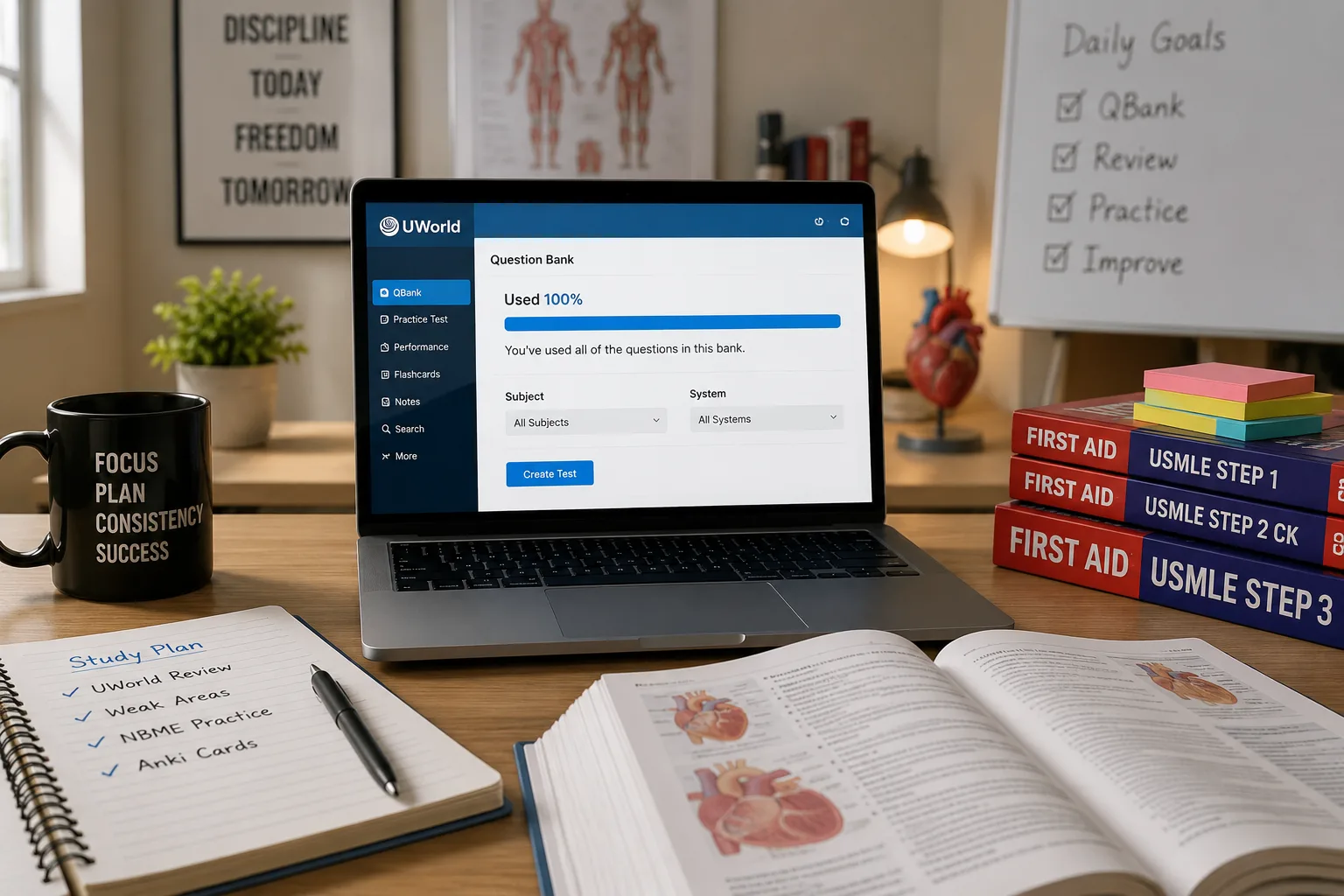
If you are asking what to do after UWorld if your score is still stuck, the first step is to stop treating completion as mastery. Finishing a question bank proves exposure. It does not prove durable recall, clinical discrimination, timing control, or readiness for the NBME style of reasoning. Many students complete UWorld and still plateau because they have reviewed explanations passively, memorized isolated facts, or repeated questions without changing how they think. A stuck score usually reflects one of four problems. First, there may be a knowledge gap, meaning the student truly does not understand the physiology, pathophysiology, pharmacology, or management principle being tested. Second, there may be a retrieval gap. The student understood the explanation yesterday but cannot retrieve the concept under timed pressure today. Third, there may be a discrimination gap. The student knows several related diseases but cannot distinguish them when the vignette is written with overlapping clues. Fourth, there may be an execution gap, such as changing answers unnecessarily, running out of time, or missing the question stem’s actual task. The solution is not automatically to buy another resource, restart every UWorld block, or watch more videos. The solution is diagnosis. You need to determine why each missed question was missed. A student who confuses nephritic and nephrotic syndromes needs a contrast table and repeated vignettes. A student who knows the content but misses “next best step” questions needs management algorithms. A student who performs well untimed but poorly timed needs block endurance and pacing drills. A student who keeps missing ethics or biostatistics needs targeted repetition, not another month of random medicine review. You do not know the tested principle well enough to explain it. You recognize the answer after reading it but cannot recall it cold. You know the topics but confuse similar presentations. You lose points through timing, question reading, or answer changes. A plateau after UWorld is also common because UWorld explanations are often more detailed than the final decision required on test day. The exam rewards the ability to identify the key clue, ignore distractors, and select the safest answer. You should still learn from the explanation, but your review must end with a short testable rule. For example, “postpartum hemorrhage with boggy uterus equals uterine atony, give uterotonics after massage” is more useful than rereading an entire obstetrics chapter. The practical goal is to convert your completed UWorld work into a targeted repair plan. That plan should include an error log, NBME-based prioritization, active recall, timed mixed blocks, and a decision rule for whether to delay or sit for the exam. The rest of this article gives you that plan. A useful error log is not a notebook full of copied explanations. It is a diagnostic tool. Each missed or guessed question should be labeled by why you lost the point. Without that label, you may spend three hours reviewing cardiomyopathy when the true problem was that you ignored the age, timing, or lab pattern in the vignette. The point of an error log is to reveal repeatable failure patterns. Use five columns: topic, tested rule, miss type, correction, and next retrieval date. The tested rule should be short. Write the rule as if you were teaching another student. The miss type should be specific. Avoid vague labels such as “dumb mistake.” Replace them with “missed qualifier,” “confused similar diagnoses,” “did not know mechanism,” “poor management sequence,” “forgot formula,” or “changed correct answer without new evidence.” The best error logs are small enough to use daily. If your log becomes a second textbook, you will stop using it. For each missed question, write one high-yield sentence. For Step 1, the sentence may connect mechanism to clinical finding. For Step 2 CK, it should often connect presentation to next best step. For Step 3, it may connect diagnosis to management, follow-up, or CCS execution. Review the log in three passes. The first pass happens immediately after the block and identifies why the miss occurred. The second pass happens 24 to 48 hours later and uses closed-book recall. Cover the answer and force yourself to state the rule. The third pass happens after several days and should be tested with new questions or flashcards. If you only reread the log, you are not training retrieval. This is where an organized platform can help. MDSteps can convert missed-question themes into automatic flashcard decks that are exportable to Anki. That matters because the missed question itself is not the final product. The final product is a retrievable rule that appears again when the exam asks the same principle in a new disguise. After UWorld, your next priority should be external calibration. UWorld performance can be useful, but it is not the same as an NBME self-assessment or Free 120 style experience. A student may improve inside UWorld because the explanation style, wording, and repeated themes become familiar. The exam, however, asks whether knowledge transfers to new stems and different distractor patterns. Take a recent NBME or official practice set under realistic conditions. Do not pause. Do not look up answers. Do not take long breaks between blocks. The purpose is not only to get a score. The purpose is to collect evidence about readiness. A single score should not define you, but a pattern across assessments matters. If your NBME scores remain flat despite finishing UWorld, the problem is probably not lack of effort. It is likely inefficient repair. Review NBME misses differently from UWorld misses. UWorld explanations often teach broadly. NBME review should teach precision. Ask, “What did this question require me to notice?” Then ask, “What wrong answer was I supposed to be tempted by?” NBME distractors often separate students who know a topic from students who can apply it. For example, a vignette may include fever and murmur, but the correct answer depends on whether the presentation fits acute valvular disease, infective endocarditis, rheumatic disease, or a benign flow murmur. Create a priority list from your NBME review. Rank weaknesses by frequency and fixability. A topic that appears often and can be repaired quickly should move to the top. Biostatistics, ethics, screening, vaccine schedules, acid-base disorders, murmurs, renal electrolyte patterns, and obstetric management sequences are common examples of areas where targeted review can improve performance. In contrast, trying to relearn all of immunology in the final week is usually inefficient. Your NBME review should also identify whether you are missing first-order or second-order reasoning. First-order misses involve direct recall, such as not knowing the enzyme, organism, or drug adverse effect. Second-order misses involve applying known information, such as choosing the next diagnostic step after recognizing the likely disease. A student with mostly first-order misses needs focused memory repair. A student with mostly second-order misses needs more mixed vignettes and algorithmic reasoning. Do not ignore correct guesses. Mark every question you answered correctly but could not explain. These are hidden weaknesses. On the actual exam, the same concept may appear with less familiar wording, and the guess may not hold. Treat uncertain correct answers as part of your repair pool. Get full MDSteps access with NBME-style questions, reasoning-first explanations, analytics, flashcards, and CCS cases for one simple monthly price. When a score is stuck, many students respond by increasing passive study. They reread First Aid, watch more lectures, or review long notes. These methods can feel productive because recognition improves. Unfortunately, recognition is not the same as recall. The exam requires you to retrieve and apply information under pressure. Retrieval practice means forcing the brain to produce an answer before seeing it. This can be done through flashcards, question blocks, blank-page recall, teaching aloud, or writing algorithms from memory. The key is effort. If you read an explanation and nod, very little has changed. If you close the book and reconstruct the mechanism, differential, or management sequence, you are training the skill the exam demands. Use the 3R method after each missed question: reduce, retrieve, and reapply. Reduce the explanation into one testable rule. Retrieve it later without looking. Reapply it to a new question or a self-made vignette. For example, after missing a question on SIADH, your reduced rule might be: euvolemic hyponatremia with concentrated urine and high urine sodium suggests SIADH after excluding adrenal and thyroid disease. Retrieval means stating that rule from memory tomorrow. Reapplication means distinguishing it from hypovolemia, heart failure, cirrhosis, and primary polydipsia. Spaced repetition is most useful when it targets misses and unstable concepts. Do not make a card for everything. Make cards for rules you failed to retrieve, facts that repeatedly disappear, and comparisons you keep confusing. A good card asks for the decision point, not a paragraph. For Step 2 CK, “What is the next step in a pregnant patient with severe-range blood pressure and seizure?” is better than “Describe preeclampsia.” Mixed timed blocks should remain in the schedule, but the review after the block should become more active. Before reading an explanation, write why you chose your answer and why you rejected the closest alternative. This exposes faulty reasoning. Many students discover they are eliminating correct answers for the wrong reason or choosing familiar diagnoses despite contradicting clues. The MDSteps Adaptive QBank can support this phase by pushing repeated exposure to weak systems and task types rather than simply giving more random questions. Used correctly, an adaptive bank should not replace thinking. It should increase the density of useful retrieval attempts. A persistent plateau after UWorld often means the student knows enough facts to be dangerous but not enough structure to choose consistently. USMLE questions reward clinical reasoning. That means identifying the patient’s problem representation, selecting the most likely diagnosis, and choosing the safest next step. For Step 1, the reasoning may focus on mechanism. For Step 2 CK, it often focuses on diagnosis and management. For Step 3, it expands into treatment sequencing, monitoring, prevention, and systems-based decisions. Start every vignette by building a one-line summary. Include age, setting, time course, key symptom, and defining abnormality. For example: “Older smoker with chronic cough, weight loss, and hypercalcemia” is not just a lung cancer stem. It suggests squamous cell carcinoma through parathyroid hormone-related peptide. A one-line summary turns a long stem into a clinical signal. Next, identify the task. Is the question asking for diagnosis, mechanism, next step, risk factor, complication, or treatment? Many students miss questions because they answer the diagnosis when the stem asks for mechanism, or they answer definitive treatment when the correct immediate step is stabilization. Before looking at options, name the task in your head. Use a consistent management sequence: stabilize, diagnose, treat, prevent recurrence, and follow up. If the patient is unstable, resuscitation comes first. If the diagnosis is uncertain but the patient is stable, the next best diagnostic test may be correct. If the diagnosis is clear and the disease is dangerous, empiric treatment may precede confirmation. This is the logic behind many emergency medicine, infectious disease, obstetric, and surgical questions. Board-style decision flow For discrimination errors, build contrast tables. Do not study asthma, COPD, bronchiectasis, and heart failure separately if you keep confusing dyspnea stems. Put them in one table with age, trigger, auscultation, imaging, pulmonary function findings, and first-line treatment. USMLE questions are written to test distinctions. Your study materials should mirror that structure. Finally, practice explaining why the wrong answers are wrong. This is not wasted time. It is how you build resistance to distractors. If you cannot state why a tempting answer is incorrect, you have not fully repaired the miss. The goal is not only to recognize the right answer. It is to become less vulnerable to the wrong one. A stuck score needs structure. The schedule should be aggressive enough to create change but narrow enough to avoid panic. Two weeks is often enough to repair common weaknesses if the student has already completed UWorld and has usable baseline knowledge. The focus should be NBME review, targeted weak-area repair, timed mixed blocks, and spaced recall. Begin with one assessment or a recent score report. Identify the top three weak systems and top two task types. A task type may be diagnosis, management, mechanism, communication, biostatistics, or interpretation of data. Each day should include one timed mixed block because you must maintain exam endurance. Each day should also include targeted repair because random blocks alone may not deliver enough exposure to weak areas. Do not fill the schedule with too many resources. One primary question source, one error log, one flashcard system, and official practice materials are enough. Resource switching often disguises anxiety as productivity. If you add a new resource, define its job. For example, use a concise video only to repair one topic, not as a new curriculum. Use a daily stop rule. At the end of each day, write the five rules most likely to earn points later. If you cannot identify those rules, your review was too passive. The next morning, retrieve those five rules before starting questions. This creates continuity across days and prevents the common pattern of relearning the same missed concept repeatedly. Protect sleep and timed conditions. A plateau is rarely fixed by staying awake until 2 AM to reread notes. Sleep supports memory consolidation, and board exams punish fatigue. Your practice blocks should occur during the same part of the day as your real exam whenever possible. Train the brain and body to perform when it matters. One of the hardest decisions after UWorld is whether to delay the exam. The answer should be based on evidence, not fear. A student who feels anxious but has stable passing or target-range NBME scores may need confidence and execution practice. A student whose assessments remain below a safe range needs more time. The distinction matters. Use multiple data points. One poor assessment can reflect fatigue, a bad day, or a weak content cluster. Repeated poor assessments under realistic conditions are more meaningful. Look at trend, consistency, and distance from your required score. For Step 1, the practical concern is passing with a safety buffer. For Step 2 CK, the target may be influenced by specialty competitiveness and application strategy. For Step 3, the concern may include passing, clinical management, and CCS readiness. Delay is reasonable when your official-style scores are not improving, your misses are broad rather than clustered, or your timing collapses across multiple blocks. Delay is also reasonable if you cannot explain why you are missing questions. That means you do not yet have a repairable diagnosis. On the other hand, sitting may be reasonable when your misses are narrow, your assessments are near or above target, and your remaining work is mostly review of known weak points. Avoid the trap of chasing perfection. No student walks into the USMLE knowing everything. The question is whether your performance is stable enough. You should expect uncertainty on test day. You should not expect to recognize every disease instantly. Readiness means you can reason safely through unfamiliar stems, not that every question feels familiar. In the final week, reduce novelty. Do not start a massive new resource. Do not overhaul your entire study system. Continue timed blocks, review high-yield errors, revisit official sample materials, and rehearse exam-day logistics. If anxiety is causing answer changes, audit your last few blocks. Count how many answer changes moved from correct to incorrect, incorrect to correct, and incorrect to incorrect. Many students discover that changing answers without new evidence costs points. If your exam includes Step 3 CCS, do not rely only on multiple-choice preparation. You must practice order timing, monitoring, patient response, and case closure. MDSteps live vitals CCS cases can help because they simulate timed orders and physiologic changes. Use that only if you are preparing for Step 3. It is not relevant to Step 1 or Step 2 CK. The final phase after UWorld should be simple, measurable, and active. Your goal is not to prove that you worked hard. Your goal is to convert missed points into future points. Every activity should answer one question: will this help me retrieve and apply a tested rule under timed conditions? For Step 1, focus on mechanisms, pathophysiology, pharmacology, microbiology, immunology, and classic clinical presentations. For Step 2 CK, focus on next best step, screening, diagnosis, management, preventive care, ethics, and common inpatient or outpatient decisions. For Step 3, include longitudinal management, prognosis, patient safety, and CCS execution. The same study principle applies across all three exams: identify the rule, retrieve the rule, and apply the rule in a new vignette. Use your last days to become more consistent, not more frantic. A clean final plan may include one timed block, one focused review session, one hour of flashcards, and one short official-style review set. That is often more valuable than ten unfocused hours of rereading. If you need a practical next step, start today with your last 40 missed or guessed questions. Sort them into the five miss types. Identify the top two recurring causes. Build a two-day repair plan around those causes. Then test whether the repair worked using new questions. Improvement comes from closing loops, not from collecting more explanations. The core answer to what to do after UWorld if your score is still stuck is this: stop measuring completion and start measuring correction. Your plateau is a signal. Read it carefully, repair it deliberately, and use official-style practice to confirm that the repair transfers. Medically reviewed by: Jonathan Reyes, MD, Board-Certified Internal Medicine Physician.Why Scores Stall After Finishing UWorld
Knowledge gap
Retrieval gap
Discrimination gap
Execution gap
Build an Error Log That Explains the Plateau
Miss type What it means Best repair method Knowledge The concept was unfamiliar or poorly understood. Brief content review, then 10 to 20 targeted questions. Retrieval You recognized the answer only after seeing the explanation. Flashcards, closed-book recall, and spaced retesting. Discrimination You confused two plausible diagnoses or treatments. Two-column comparison table and vignette contrast drills. Management You knew the diagnosis but missed the next step. Algorithm practice using stabilize, diagnose, treat logic. Execution You lost the point through pacing or question handling. Timed blocks, answer-change audit, and stem discipline. Use NBME Data to Decide What Matters Most
Compare less. Start practicing for less.
A simpler way to start practicing today.
Switch From Review Mode to Retrieval Mode
Repair Clinical Reasoning, Not Just Content
Create a Two-Week Plateau-Breaking Schedule
Time Activity Purpose Morning Timed mixed block Maintain pacing, stamina, and random retrieval. Late morning Deep review of misses and guesses Classify errors and write testable rules. Afternoon Targeted weak-system questions Increase exposure to high-yield gaps. Evening Flashcards and error-log recall Convert recent misses into durable retrieval. Every 3 to 4 days NBME or official-style review set Check transfer to exam-style reasoning. Know When to Delay and When to Test
Rapid-Review Checklist for the Final Push
Rapid-Review Checklist
References
USMLE Exam Prep
After UWorld: Fix a Stuck USMLE Score

Exam logic: prioritize weaknesses that are common, repeatedly missed, and correctable within your remaining timeline.
Full access: $27/mo
Lifetime: $299
16,000+ questions$27/month full accessCancel anytime
Monthly access. Cancel anytime. 7-day good-faith refund after baseline + 100 QBank questions or 5 CCS cases.
Lower-friction QBank
Still missing the same kinds of questions?
Read why that happens.