Running out of UWorld questions is not automatically a crisis. It is a decision point. The right move depends on why the questions are gone, what your score trend shows, and whether your misses reflect knowledge gaps, reasoning errors, or fatigue. Many students interpret an exhausted question bank as a sign that they have completed the hardest part of USMLE preparation. Others panic because their main source of daily structure has disappeared. Both reactions miss the central question. The issue is not whether the bank is empty. The issue is whether your performance has become reliable across organ systems, question styles, and testing conditions. A completed first pass can mean very different things. One student may have done questions slowly, read explanations carefully, converted errors into flashcards, and retested weak concepts with timed mixed blocks. Another student may have raced through the same number of questions while recognizing answer patterns, postponing review, and marking half the block without resolving why the wrong answers were tempting. Both students can truthfully say they finished the bank. Only one has extracted durable learning from it. Before deciding to reset, review, or add another QBank, classify your current problem into one of four categories. The first is an exposure problem. You have not seen enough presentations, mechanisms, management decisions, or distractor patterns. This is common early in Step 1 and Step 2 CK preparation, especially when students used tutor mode by system and never transitioned to mixed blocks. The second is a retention problem. You understood the explanation when you read it, but the same concept disappears one week later. The third is a reasoning problem. You know the fact but choose the wrong diagnosis, next best step, or mechanism because you overweight one clue and ignore another. The fourth is an execution problem. Your knowledge is adequate, but timing, stamina, anxiety, or careless reading lowers performance. A reset mainly helps when you need structured re-exposure and the original questions are no longer fresh enough to teach new patterns. Reviewing missed and marked questions helps when your errors are concentrated in recurring concepts. A new QBank helps when you are memorizing old stems, need more mixed practice, or want a larger sample of presentations. NBME self-assessments help when you need an exam-like readiness signal rather than more content review. The USMLE assesses application of knowledge, concepts, principles, and patient-centered skills. That means question volume is useful only when it improves transfer. A student who can recite an explanation but cannot identify the clinical pivot in a new vignette has not yet converted the question into exam readiness. For Step 1, the pivot may be a mechanism, pathophysiologic association, or experimental clue. For Step 2 CK, it may be the safest next step, the best screening decision, or the most likely diagnosis after ruling out emergencies. For Step 3, it may involve outpatient follow-up, chronic disease management, prognosis, or computer-based case sequencing. Use a three-column audit before acting. In the first column, list your most recent five mixed blocks or self-assessments. In the second, write the dominant error type for each: content, interpretation, distractor, timing, or fatigue. In the third, write the corrective action that would prevent the same error in a new question. If the third column is vague, another thousand questions may not help. Your learning loop is leaking. A reset is most useful when your first pass was early, scattered, or incomplete as a learning process. If you started months before dedicated study, used questions by organ system, and now need timed mixed practice, a reset can provide structure. It can also help if you completed many questions before learning the relevant physiology, pharmacology, pathology, or management frameworks. In that setting, the first pass was more exposure than assessment. The best reset is not a second passive pass. It should feel different from the first one. Use timed, mixed blocks unless you are deliberately repairing one weak area. Force yourself to answer before reading explanations. Do not let recognition replace reasoning. A remembered stem is still useful if you explain why each distractor is wrong and identify the rule the question is testing. A remembered answer without reasoning is low-value repetition. Resetting is also reasonable when you have a long interval between attempts or a major score gap. For example, a student who used UWorld during clerkships and then returns to Step 2 CK preparation months later may benefit from repeating the bank under exam conditions. The question is whether old items can still expose reasoning errors. If you remember most answers immediately, the reset becomes less diagnostic. It may still be useful for explanation review, but it should not be your only performance measure. Use a reset cautiously if your exam is close. A full reset can create false productivity. Completing large numbers of familiar questions may raise your percent correct while doing little to improve readiness. This is especially risky if you begin judging preparedness by repeated-item scores. A second-pass percentage often overestimates exam performance because memory of stems, answer positions, and explanation language can inflate accuracy. If you reset, protect the learning value with constraints. First, cap the number of repeated blocks per day so review stays deep. Second, mark only questions that reveal a transferable rule, not every hard item. Third, build a small error deck from misses. Fourth, schedule an NBME-style self-assessment or practice exam after several days of reset blocks to verify that gains transfer to new items. Fifth, stop repeating a topic once the error pattern is corrected. The strongest reason to reset is not that you want to see every question again. It is that you can now process questions at a higher level. On a first pass, many students ask, “What is the right answer?” On a second pass, the better question is, “What feature made the wrong answer attractive, and what clue rules it out?” That shift is what turns repeated questions into exam training. Reviewing missed and marked questions is often more efficient than resetting the entire bank. The reason is simple: your misses contain the highest concentration of personal exam risk. They show what you misunderstood, rushed, overgeneralized, or failed to recognize. A full reset treats all questions as equally important. A targeted review weights the questions that actually exposed your weaknesses. Missed questions should not be reviewed as isolated trivia. Each miss should become a rule, contrast, or trigger. A rule is a statement that can guide a future answer, such as “stabilize unstable patients before diagnostic confirmation” or “screening tests apply to asymptomatic patients, while diagnostic tests apply to symptomatic patients.” A contrast separates two similar entities, such as panic attack versus pulmonary embolism, nephritic versus nephrotic syndrome, or Crohn disease versus ulcerative colitis. A trigger is a vignette clue that should activate a diagnosis or management pathway. Marked questions deserve special handling. Students often mark items for several reasons: uncertainty, unfamiliar content, time pressure, or a lucky guess. These categories are not equivalent. A correct but marked question may be more dangerous than an incorrect question because it can hide weak reasoning. If you guessed correctly, review the item as aggressively as a miss. Ask what would have made you choose the wrong option and what clue should have anchored the correct choice. A missed-question review works best in layers. First, redo the question without looking at the answer. Second, write your reason for the answer in one sentence. Third, compare your reasoning with the explanation. Fourth, identify the exact failure point. Fifth, create a small retrieval item that tests the concept without copying the explanation. Avoid making long cards that reproduce paragraphs. Good flashcards are narrow, answerable, and linked to the error that created them. For Step 1, missed review should emphasize mechanisms. If you miss a renal physiology question, do not only memorize the disease name. Reconstruct the direction of change in volume, pressure, filtration, electrolytes, and hormones. For Step 2 CK, missed review should emphasize management sequence. Many wrong answers are plausible but premature, excessive, or unsafe. For Step 3, missed review should connect diagnosis, outpatient decision-making, prevention, and follow-up. Computer-based case preparation should be added only for Step 3, because CCS performance requires timed orders and monitoring logic rather than multiple-choice recognition alone. The MDSteps platform can be useful in this phase when students need a cleaner learning loop. Its Adaptive QBank includes more than 9000 questions, and missed concepts can be converted into automatic flashcard decks that are exportable to Anki. The value is not more volume for its own sake. The value is linking each miss to retrieval practice, analytics, and a study plan that updates as your performance changes. A practical target is to review every miss until you can answer three questions: What did I think the question was asking? What was it actually asking? What rule will I use next time? If you cannot answer those three questions, the miss has not been closed. Get full MDSteps access with NBME-style questions, reasoning-first explanations, analytics, flashcards, and CCS cases for one simple monthly price. Another QBank is most helpful when old questions have become too familiar to test you. Familiarity can feel like mastery, but it is often recognition. You remember that the patient with a certain phrase had a certain diagnosis, or that a particular lab pattern pointed to one answer. The real exam will not use your old stem. It will test whether you can identify the same principle in a new clinical wrapper. New questions are especially valuable when your self-assessment performance has plateaued despite completing UWorld. A plateau after a complete pass often means that content exposure is no longer the only problem. You may need more examples of the same concepts from different angles. A second QBank can broaden presentation patterns, force flexible retrieval, and reduce dependence on one author’s wording style. Use another QBank when your incorrects are no longer enough to fill a productive day, when second-pass scores are much higher than self-assessment scores, or when you are consistently missing questions because the vignette presentation feels unfamiliar. This is common in Step 2 CK, where the same disease may appear through emergency care, ambulatory screening, inpatient management, ethics, quality improvement, or prognosis. It is also common in Step 1 when mechanisms are tested through experiments, graphs, or unusual phrasing. The goal is not to collect endless resources. Too many banks can fragment your review. Choose one additional source and define its job. It may be used for timed mixed blocks, targeted weak systems, ethics and biostatistics, or final endurance training. Do not use it as an excuse to avoid reviewing your old mistakes. New questions should be paired with an error system, not treated as disposable drills. A second QBank is also useful for students who need an affordable extension of practice. If the main issue is cost, choose a bank that provides strong explanations, analytics, and mixed timed blocks rather than simply a large item count. Question quality matters. A good question teaches a transferable rule, contains plausible distractors, and explains why the wrong answers are wrong. A poor question rewards obscure recall without helping you think like the exam. For Step 3, the decision differs because multiple-choice practice is only part of the exam. If you are preparing for Step 3 and have already exhausted your main MCQ bank, add CCS cases rather than only adding more multiple-choice questions. CCS requires order timing, reassessment, preventive care, and physiologic consequences. MDSteps live vitals CCS Cases are designed for that type of practice, with timed orders and real physiology. This feature is most appropriate for residents preparing for Step 3, not for Step 1 or Step 2 CK students. Question banks teach. Self-assessments test readiness. Students often confuse these functions. A QBank block is useful for daily learning because explanations, tags, and repeated concepts help you build knowledge. A self-assessment is useful because it samples performance under more exam-like conditions. When your main bank is nearly complete, self-assessments become more important, not less. NBME self-assessments are designed to help examinees evaluate readiness and practice for USMLE examinations. They are not perfect predictors for every student, but they provide a standardized checkpoint. That checkpoint matters when repeated QBank performance becomes contaminated by memory. A second-pass score may look strong while a new self-assessment reveals persistent gaps in application, timing, or stamina. Use self-assessments strategically. Do not take several in a row without review. Each assessment should produce a study prescription. Review incorrects and uncertain corrects, identify weak systems, and convert repeated errors into targeted work. If the report shows weakness in cardiology, do not only reread a cardiology chapter. Do cardiology questions, rebuild the management algorithms, and drill the specific distinctions that caused misses. Timing also matters. Early in dedicated study, a baseline self-assessment can show whether your current plan is realistic. Midway, another assessment can test whether your changes are working. Near the end, a final assessment can guide whether to emphasize maintenance, weak-area repair, or test-day logistics. Avoid using self-assessments as emotional verdicts. Their purpose is calibration. When reviewing an assessment, focus on decision points. The best review question is not, “Why did I get this wrong?” It is, “At what point in the stem did the correct path become more likely than the distractor?” This trains the exact skill needed on exam day. Most USMLE questions do not ask whether you have heard of a disease. They ask whether you can use incomplete information to choose the safest, most evidence-consistent answer. Self-assessments also help protect against overstudying low-yield details. After finishing a large bank, students often start mining explanations for increasingly obscure facts. Some detail review is useful, especially for Step 1 mechanisms and pharmacology. However, if your readiness signal is weak, the solution is usually not more obscure facts. It is better recognition of common patterns, better triage of unstable patients, better next-step reasoning, and cleaner elimination of distractors. Pair self-assessments with a readiness dashboard. Track percent correct, timing, confidence, and error category. A fully developed analytics dashboard, such as the one in MDSteps, can help students see whether misses cluster by discipline, organ system, task type, or repeated cognitive error. This is more actionable than relying on a global percentage alone. Once your main bank is complete, your study plan should become more selective. The final phase is not about proving that you can keep doing questions. It is about closing the errors most likely to recur on exam day. A good two-week plan balances new questions, missed-question review, self-assessment review, spaced retrieval, and rest. Begin by ranking weaknesses. Use three inputs: recent block performance, self-assessment categories, and your own confidence. If all three point to the same weakness, it deserves immediate attention. If you feel weak in a topic but are scoring well, maintain it with brief retrieval rather than rebuilding it from scratch. If you feel confident but keep missing questions, treat that area as high risk because your confidence is poorly calibrated. Use mornings for timed mixed blocks or self-assessment review. This mimics exam decision-making and prevents the day from becoming passive. Use afternoons for targeted repair. Repair means focused question sets, short reading only where needed, and flashcards from errors. Use evenings for retrieval and light review. Avoid ending every day with dense new content, because fatigue can reduce retention and increase anxiety. Spaced repetition works best when it is linked to meaningful errors. Do not make a card for every sentence. Make cards for rules you failed to retrieve, contrasts you confused, and clues you ignored. A good card should take seconds to answer. If it requires a paragraph, split it. If it tests a fact that never affected an answer, delete it. Protect stamina. If you are within two weeks of the exam, do at least several blocks under timed conditions. Practice breaks, food, hydration, and pacing. Students often train knowledge while neglecting execution. The exam is not only a content event. It is a long performance under uncertainty. The first trap is mistaking completion for readiness. A completed bank is a milestone, not an outcome. Readiness is demonstrated by consistent performance on new, mixed, timed material and by stable self-assessment trends. If your score varies widely from block to block, the issue may be reasoning consistency rather than content volume. The second trap is rereading explanations without active retrieval. Explanations feel productive because they are clear. The danger is that clarity during reading does not guarantee recall during testing. After reading an explanation, close it and reconstruct the rule. Then answer a related question or write a flashcard. Retrieval is the step that turns recognition into memory. The third trap is overcorrecting every miss with excessive content review. If you miss a question about hypercalcemia, you do not always need to reread an entire endocrine chapter. You may need a focused contrast between primary hyperparathyroidism, malignancy, vitamin D intoxication, granulomatous disease, and familial hypocalciuric hypercalcemia. The corrective action should match the failure. The fourth trap is ignoring test-taking errors because they feel less legitimate than knowledge gaps. Misreading “next best step,” missing an unstable vital sign, failing to notice age, or overlooking pregnancy status can cost points. These are not careless in a harmless sense. They are correctable process errors. Build a pre-answer checklist: stability, age, setting, time course, key risk factor, and what the question asks. The fifth trap is adding too many resources. A new QBank can help, but three new resources can dilute attention. The best plan is usually one primary source for new questions, one error system, one self-assessment schedule, and one concise reference for targeted clarification. The more resources you add, the more carefully you must define their roles. The sixth trap is waiting too long to simulate test conditions. Students who do every block in tutor mode may know content but struggle with pacing. At some point, you must practice committing to answers without immediate feedback. This is uncomfortable because it exposes uncertainty. That discomfort is the point. The exam will not pause after each item to reassure you. The seventh trap is refusing to rest. Fatigue can imitate knowledge failure. If your later blocks are consistently worse, if you are rereading stems multiple times, or if you are missing questions you normally know, your schedule may need recovery. Sleep is not a reward for finishing. It is part of memory consolidation and performance. The final trap is using percent correct without context. A 75% on repeated questions does not mean the same thing as a 75% on new timed mixed questions. A 60% block in a weak area may be productive if it produces clear repair targets. Interpret numbers by source, freshness, timing, and review quality. Use this checklist before resetting, reviewing, or adding another QBank. The goal is to make the decision objective. Students make poor resource decisions when they are driven by anxiety, sunk cost, or the illusion that a new platform alone will fix old habits. If you are more than three weeks from the exam, a hybrid plan often works well: reset selected blocks, review incorrects, and add new questions in weak areas. If you are within two weeks, prioritize new timed mixed blocks, self-assessment review, and high-yield missed concepts. If you are within several days, avoid major resource changes. Focus on recall, logistics, sleep, and confidence calibration. The best students do not simply do more questions. They build a closed loop. Every block produces data. Every miss becomes a rule. Every repeated error gets a targeted fix. Every self-assessment updates the plan. This is how question volume becomes exam performance. For Step 1, keep the emphasis on mechanisms, core pathology, pharmacology, physiology, microbiology, immunology, and experimental reasoning. For Step 2 CK, emphasize diagnosis, management, screening, prevention, ethics, biostatistics, and clinical prioritization. For Step 3, add longitudinal care, outpatient follow-up, prognosis, systems-based practice, and CCS execution. The same resource decision can look different across exams because the testing tasks differ. Running out of a major bank can feel like losing your map. In reality, it can be the moment your preparation becomes more precise. Reset when repetition will be deliberate. Review when errors are personal and correctable. Add another QBank when you need fresh transfer practice. Use self-assessments when you need readiness data. The right answer is not universal. It is the choice that best fixes your current bottleneck.Start With the Actual Problem, Not the Empty Counter
When Resetting UWorld Makes Sense
Situation
Reset value
Main risk
Best safeguard
First pass was by system and untimed
High
Recognition without transfer
Timed mixed blocks
Explanations were poorly reviewed
Moderate to high
Repeating old habits
Error log with rules
Exam is within 1 week
Low to moderate
False confidence
Prioritize NBME review and weak areas
You remember most stems
Low
Inflated scores
Add new questions
When Reviewing Missed and Marked Questions Is Better
Compare less. Start practicing for less.
A simpler way to start practicing today.
When Another QBank Is the Smarter Move
Use another QBank when
Do not add one just because
Use Self-Assessments to Separate Learning From Readiness
Build a Two-Week Plan After the Main Bank Is Finished
Timeframe
Primary task
Secondary task
Avoid
Days 14 to 10
New mixed blocks or reset blocks
Missed-question repair
Passive rereading as the main task
Days 9 to 6
Self-assessment and deep review
Weak-system drills
Ignoring uncertain correct answers
Days 5 to 3
Targeted mixed blocks
Flashcard consolidation
Starting a large new resource
Days 2 to 1
Light recall and logistics
Sleep and pacing plan
Full-day cramming
Common Traps After the Question Bank Runs Out
Rapid-Review Checklist Before You Decide
Decision checklist
References
USMLE Exam Prep
Running Out of UWorld Questions: Reset or Switch?
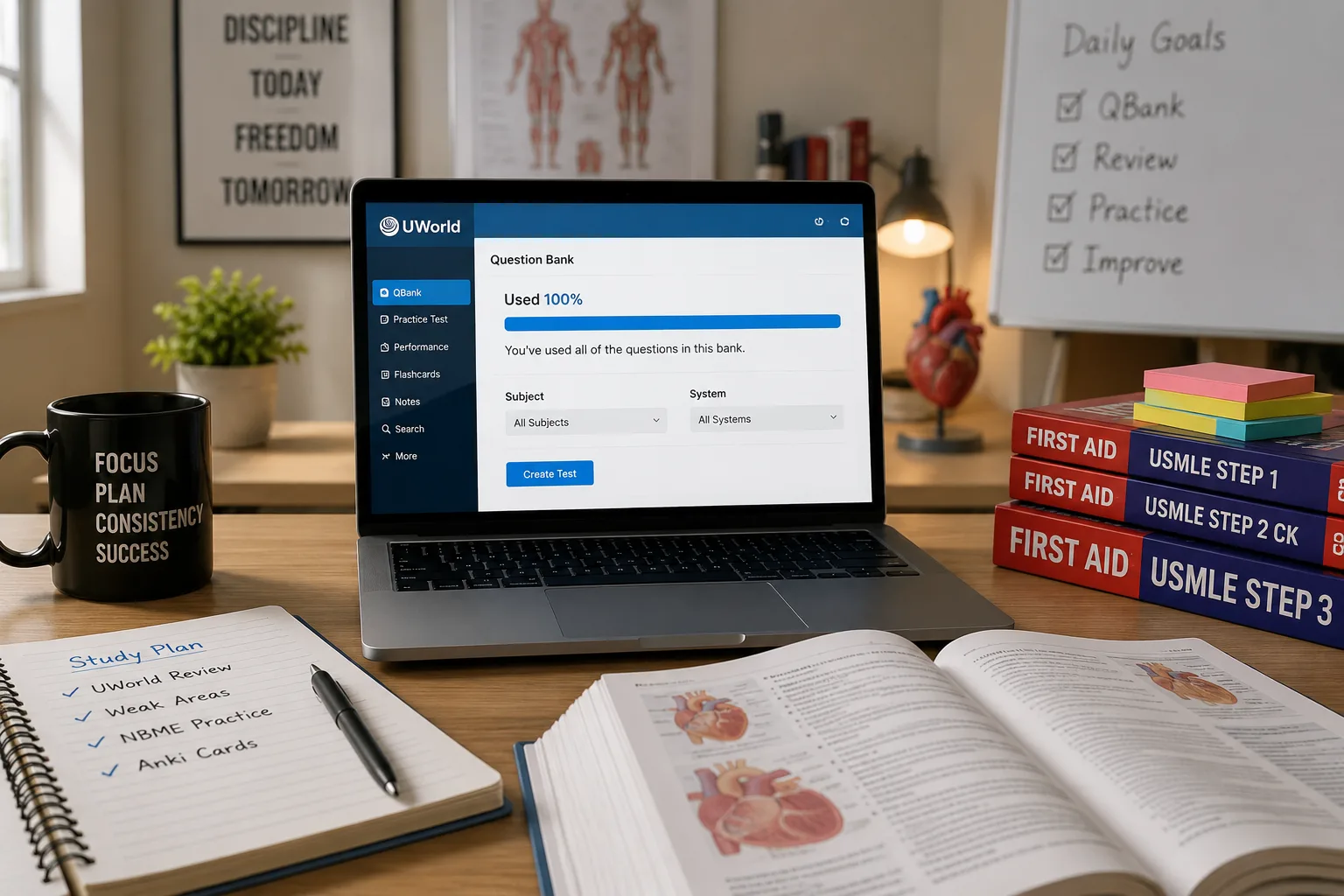
High-yield rule: do not reset a question bank because it is available. Reset it only when the second pass will produce new diagnostic information or deliberate practice.
Full access: $27/mo
Lifetime: $299
16,000+ questions$27/month full accessCancel anytime
Monthly access. Cancel anytime. 7-day good-faith refund after baseline + 100 QBank questions or 5 CCS cases.
Lower-friction QBank
Still missing the same kinds of questions?
Read why that happens.
Final exam-day principle: the goal is not to remember a question. The goal is to recognize the rule in a new vignette, under time pressure, without feedback.