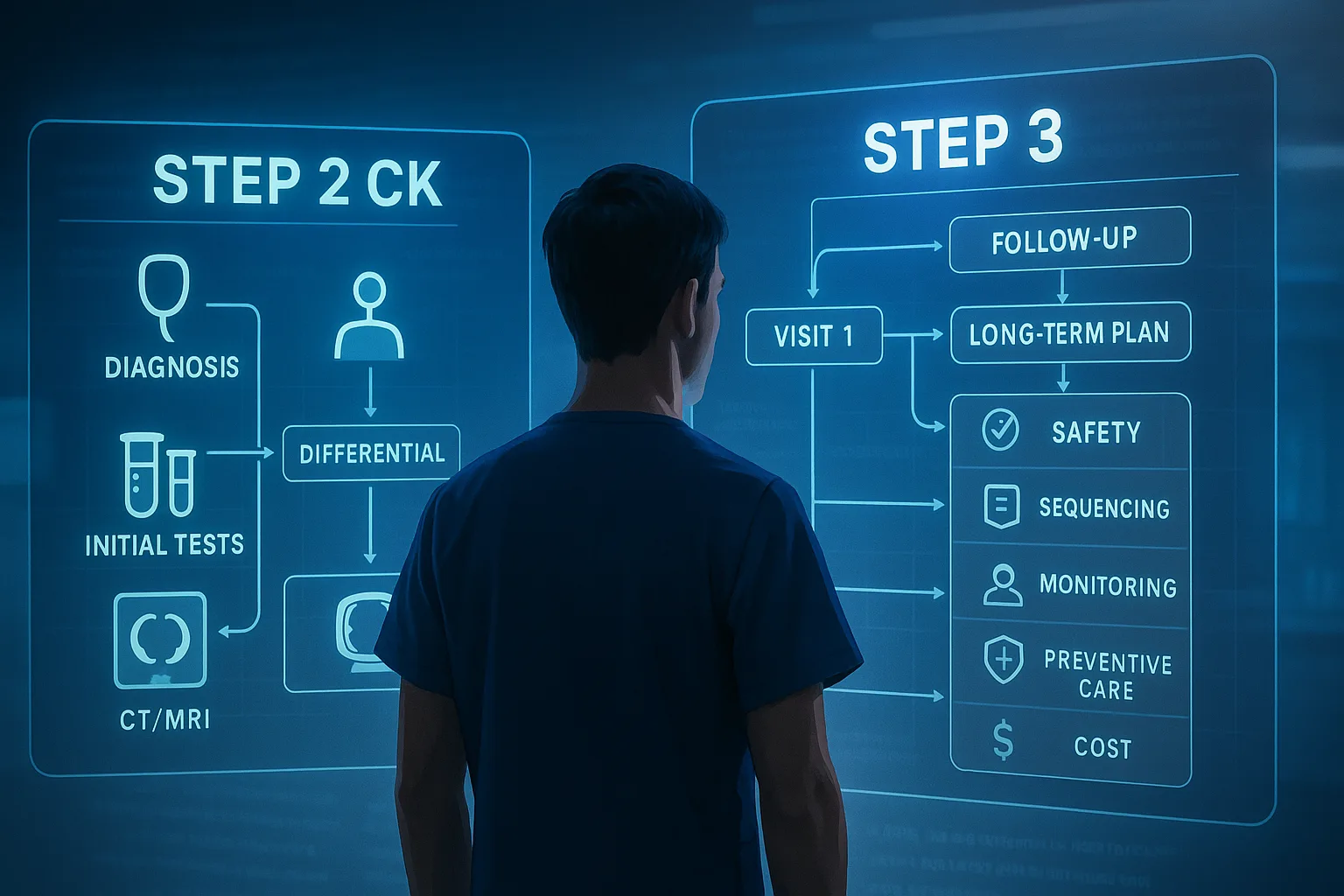
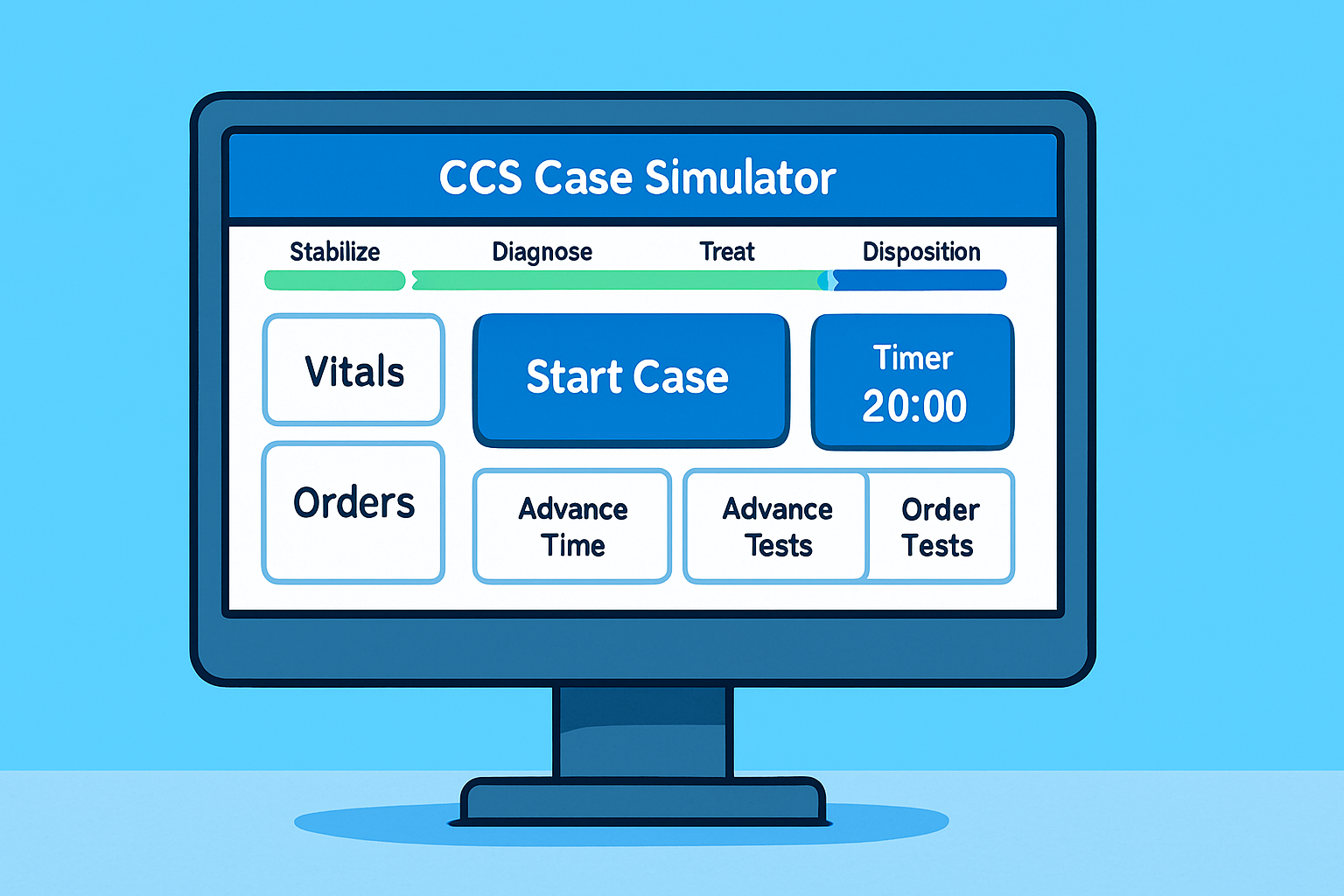
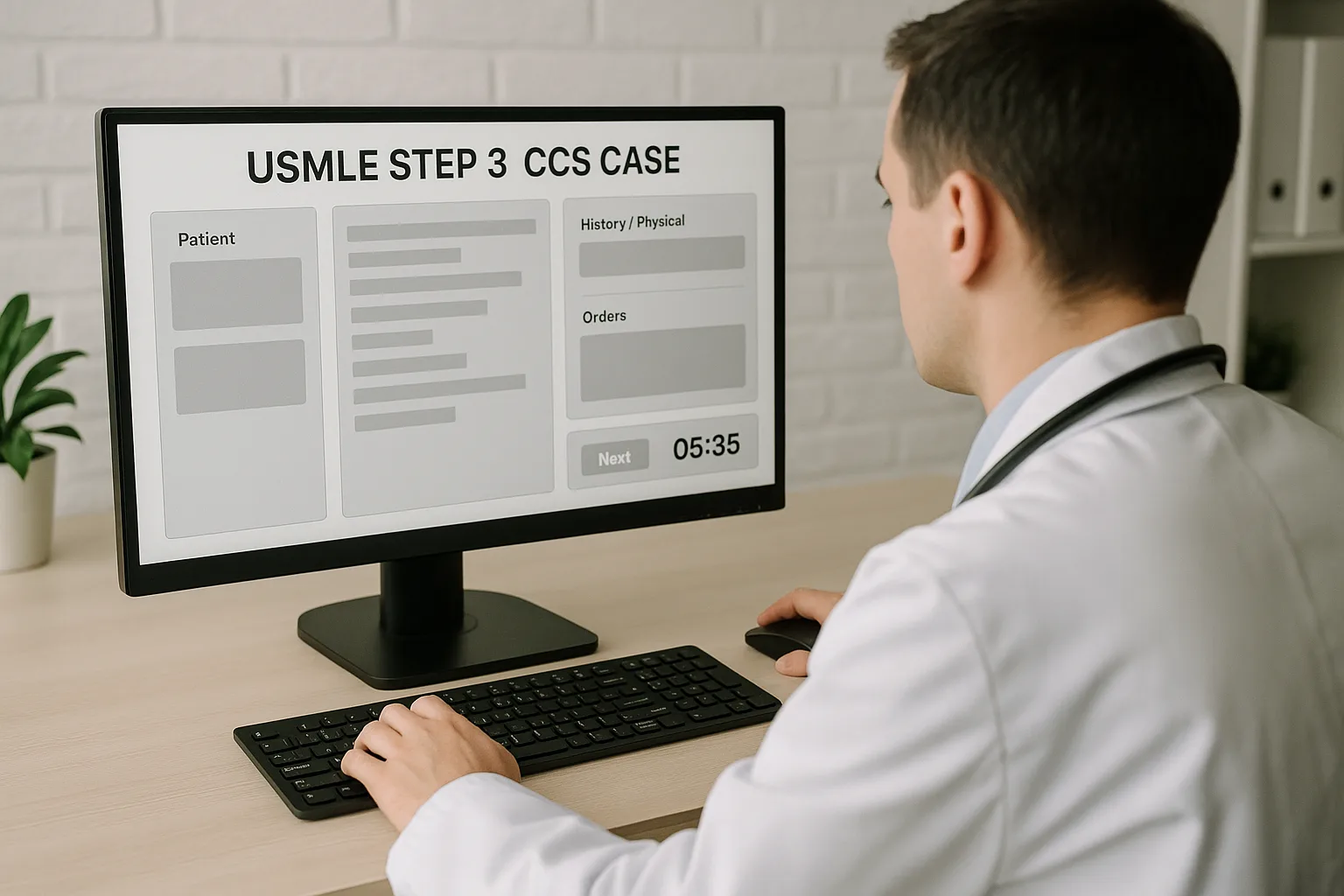
Get 16,000+ USMLE-style questions, 135 CCS cases, stem decoding, visual rationales, analytics, flashcards, and reasoning-focused review in one subscription. Cancel anytime. First month protected by our 7-day good-faith refund guarantee after 100 questions or 5 CCS cases. USMLE Step 3 is unlike any prior board exam—it evaluates independent clinical decision-making, longitudinal management, and the ability to synthesize real-time data under fatigue. For residents already stretched thin, the challenge is not intelligence but time logistics and cognitive energy. The question is not if you know the material but whether you can retrieve and apply it under conditions that mirror actual practice. This section outlines the cognitive and structural demands of Step 3 and frames how a six-week plan can integrate naturally into residency life. Step 3 contains two full-day testing blocks. Day 1 focuses on multiple-choice Foundations of Independent Practice (FIP), emphasizing biostatistics, ethics, and foundational clinical knowledge. Day 2 centers on Advanced Clinical Medicine (ACM) and the CCS interactive cases. For residents, the shift from passive recall to applied reasoning feels natural—but only if the preparation mimics clinical reasoning speed. The optimal approach is therefore hybrid: short, high-yield question bursts combined with deliberate CCS simulation practice. MDSteps’ Adaptive QBank streamlines this by sequencing >9000 questions by cognitive load and performance pattern, ensuring each brief study block delivers maximal learning per minute. Integrating QBank analytics into residency downtime lets you target weak systems efficiently. This distribution allows residents to reinforce real-world reasoning while maintaining clinical duty balance. Creating a six-week schedule that respects variable shifts requires adaptive structure rather than fixed hours. The framework below assumes 60-hour clinical weeks with unpredictable calls. The guiding principle: anchor days, not hours. Each day should have one defined academic anchor—morning QBank burst, mid-shift flashcards, or post-call CCS case. The plan divides into three phases: Foundation (Weeks 1–2), Integration (Weeks 3–4), and Simulation (Weeks 5–6). Within each phase, maintain flexibility but preserve consistency in sequence. MDSteps’ automatic study planner can populate this pattern based on duty hours entered weekly, ensuring you don’t need to micromanage timing. Residents often underestimate the benefit of distributed micro-study: a 20-minute flashcard review during sign-out can equate to an hour of tired late-night reading. Scheduling is less about duration than cognitive freshness. Protect one weekly long session—ideally a post-call afternoon—to sustain endurance training for the real exam. Practice management decisions, CCS sequencing, live vitals, and weak-area review from one dashboard. Traditional Step 3 prep wastes hours passively reading explanations. Residents need an active retrieval model: answer-analyze-apply. Each QBank block should reinforce not just content but diagnostic sequencing. MDSteps’ Adaptive QBank offers performance analytics by system and competency domain (diagnosis, management, communication), which allows precise reinforcement after clinical shifts. Treat each question as a mini-CCS scenario—document your thought process, then compare to key management steps. This deliberate cycle maintains a high retrieval frequency without exceeding the limited daily energy budget. The analytics dashboard helps spot declining accuracy patterns early—an indicator of fatigue or burnout risk rather than content gap. The Computer-based Case Simulations (CCS) are the hidden scoring multiplier of Step 3. A resident who performs adequately on MCQs can still significantly boost the overall score by mastering case flow. The CCS platform rewards decisive, guideline-driven action and time control. The following three-tier strategy maximizes performance: The goal is automation: knowing what to order without deliberation. Use a clock-advance log to train time sense—when to switch locations, reassess, or end case. During the exam, decisive management yields more points than cautious hesitation. Residency introduces unavoidable unpredictability—night floats, back-to-back calls, and variable fatigue. Passing Step 3 while working requires precise energy accounting. Use these strategies: Residents who systematize rest paradoxically outperform those who overcommit. Cognitive fatigue directly impairs retrieval accuracy. Integrating MDSteps’ fatigue-aware analytics (tracking performance variability by time of day) can identify when your recall efficiency drops below threshold—an early warning signal to rest before burnout. Progress in a compressed six-week timeline depends on feedback. MDSteps’ readiness dashboard aggregates question accuracy, CCS case scores, and flashcard retention to generate a live projected score curve. Residents can replicate this logic manually by recording accuracy percentages per week and plotting them against energy levels and sleep quality. Reflection consolidates metacognition. Every weekend, answer two questions: “Which topic consumed excess time?” and “What pattern did I miss twice?” Writing a 2-minute note enhances transfer to long-term memory and reduces repeat errors. By the final week, most residents possess the knowledge but risk cognitive overload. The goal shifts from acquisition to execution. Here’s how to protect exam-day performance: Confidence stems from controlled repetition. If you’ve followed the six-week framework and maintained ≥ 70 % accuracy on adaptive questions, you’re ready. Trust your data and habit loops more than emotion. Step 3 is as much a test of consistency as knowledge. Completing this realistic six-week plan transforms Step 3 from a logistical burden into a structured performance test that reflects residency-level competence. MDSteps’ adaptive ecosystem—QBank, CCS Cases, flashcards, and analytics—simplifies execution so you can focus on what matters: thinking like an independent clinician. References & Further Reading:Study Step 1, Step 2 CK, Step 3, and CCS for $27/month.
Understanding Step 3’s Unique Challenge During Residency
Component Exam Focus Time Allocation (6 Weeks) MCQ Practice (FIP/ACM) Clinical judgment, prioritization 55% CCS Cases Diagnostic ordering, management steps 30% Review & Analytics Identify persistent weak topics 10% Exam Simulation Stamina, pacing 5% Building a 6-Week Framework Around Residency Rotations
Phase Goal Primary Tools Study Blocks/Week Weeks 1–2 Solidify core medicine & biostatistics Adaptive QBank, flashcard reviews 5 × 1-hr blocks Weeks 3–4 Integrate CCS cases + reinforce weak areas CCS Cases Module, analytics dashboard 6 × 1-hr blocks Weeks 5–6 Simulate exam days & refine timing Full-length tests, timed CCS drills 2 long sessions/week Turn this into Step 3 + CCS practice
Practice the sequence, not just the diagnosis.
See how it works
Optimizing QBank Usage for Clinical Integration
Mastering CCS: From Templates to Real-Time Thinking
Time and Energy Management During Heavy Rotations
Tracking Progress with Analytics and Reflection
Metric Target by Week 6 Interpretation Overall QBank Accuracy ≥ 70 % Predicts solid FIP performance CCS Completion Rate ≥ 85 % Confidence in management automation Flashcard Retention ≥ 90 % Effective spacing & recall Exam-Day Strategy and Psychological Readiness
Rapid-Review Checklist: 6-Week Step 3 Residency Plan
1. USMLE Step 3 Content Outline & Specifications – usmle.org/step-3
2. Sweller J et al. “Cognitive Load Theory and Instructional Design.” Educational Psychology Review, 2019.
3. Brown P et al. Make It Stick: The Science of Successful Learning. Harvard University Press, 2014.
4. MDSteps Platform – Adaptive QBank and CCS simulation modules.
USMLE Step 3
How to Pass Step 3 During Residency: A Realistic 6-Week Plan

MDSteps Full Access
Full access: $27/mo
Lifetime: $299
135 CCS casesStep 3 QBankManagement reasoning
Monthly access. Cancel anytime. No free trial required.
CCS workflow