Why UWorld Review Takes Too Long
UWorld review becomes slow when every missed question is treated as a content chapter.
UWorld review becomes slow when every missed question is treated as a content chapter. A student misses a renal physiology question, reads the entire explanation, opens First Aid, watches a video, makes three flashcards, and writes a summary. Two hours later, the block is still unfinished. The problem is not laziness. The problem is that the review system has no triage step.
A UWorld block contains several different types of errors. Some are true knowledge gaps. Some are recognition errors. Some are caused by misreading a single phrase. Some occur because the student knew the diagnosis but chose the wrong next step. If every miss receives the same full-review treatment, the student spends too much time on questions that only needed a 90-second correction and too little time on questions that reveal a repeatable reasoning flaw.
The fastest review method begins by asking one question before reading the explanation: what failed in my decision process? This is different from asking, “What topic was this?” Topic labels are useful, but they are too broad. “Cardiology” does not explain why a student confused stable angina with acute coronary syndrome. “Endocrine” does not explain why a student recognized diabetes insipidus but missed the medication causing it. “OB” does not explain why a student chose immediate delivery instead of maternal stabilization.
For Step 1, slow review often comes from trying to relearn an entire mechanism when only one link in the chain failed. The student may know the disease name but not the enzyme, receptor, cell type, toxin, or compensatory response. For Step 2 CK, slow review often comes from reading management explanations passively instead of isolating the rule that separated two plausible actions. The exam rarely asks whether a student has seen the guideline before. It asks whether the student can identify the clinical state that makes one action correct now.
A faster workflow assigns each question to a review lane. Correct and confident questions need brief verification. Correct but lucky questions need a focused reasoning check. Incorrect questions need classification. Only a small minority need full content rebuilding. This creates speed without turning review into skimming.
| Block result | What it usually means | Fastest useful review action |
|---|---|---|
| Correct and confident | The reasoning path was probably stable. | Confirm the decisive clue, then move on. |
| Correct but guessed | The answer was not reproducible. | Find the Pivot Clue and write one Takeaway Rule. |
| Incorrect after two choices | A Distractor Trap won. | Compare the correct answer with the tempting wrong answer. |
| Incorrect with no clue | Likely content gap or unfamiliar presentation. | Do targeted content repair, then create a retrieval prompt. |
The practical goal is not to review less. It is to stop reviewing the wrong layer. A block should produce a small number of durable corrections, not a long document of copied facts. When students shorten review by skipping explanations, their scores usually do not improve. When they shorten review by diagnosing the error type first, review becomes faster and more predictive.
The 3-Pass Method for Faster Block Review
The most efficient UWorld review structure is a 3-pass method.
The most efficient UWorld review structure is a 3-pass method. It separates verification, error diagnosis, and memory repair. This prevents the common trap of reading every explanation in the same depth. The method works for timed, tutor, random, and system-based blocks, but it is most valuable once a student is close enough to the exam that time matters.
Pass 1 is the confidence audit. Before opening explanations, mark each question as one of four types: knew it, narrowed to two, guessed, or did not know. This can be done immediately after finishing the block. The key is honesty. A correct answer from elimination is not the same as a correct answer from recognition. A wrong answer after narrowing to two is not the same as a wrong answer from no knowledge. These categories determine how much time the item deserves.
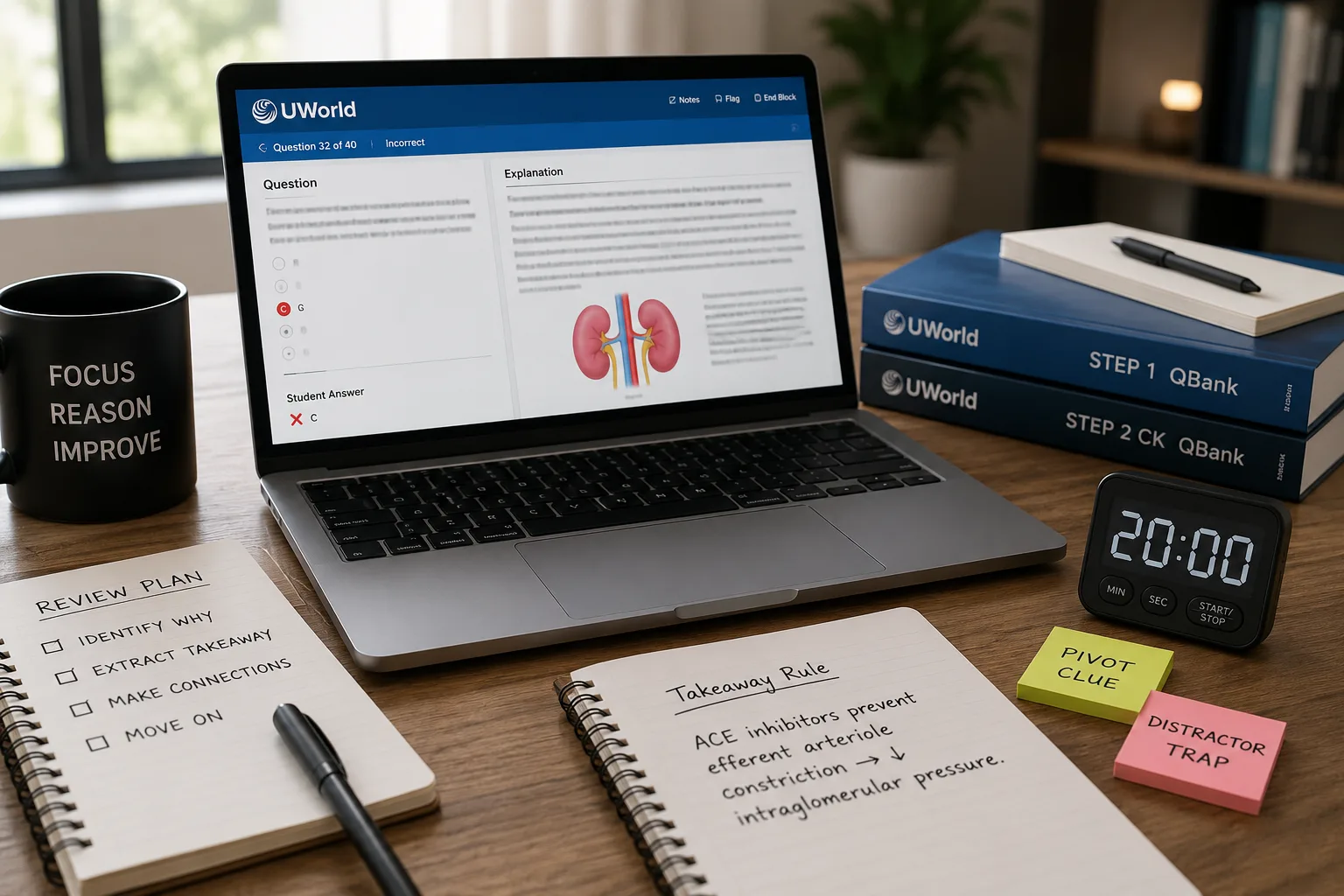
Pass 2 is the decisive-clue pass. Open the explanation and identify the shortest phrase, lab value, timeline, exam finding, or mechanism that made the correct answer correct. That phrase is the Pivot Clue. If the explanation lists several facts, do not copy all of them. Ask which one changed the answer. In a Step 1 question, the Pivot Clue may be “low complement after infection,” “branching septate hyphae,” or “increased cAMP in collecting duct cells.” In a Step 2 CK question, it may be “hemodynamically unstable,” “pregnant with severe features,” or “asymptomatic bacteriuria.”
Pass 3 is the rule pass. Convert the miss into one reusable rule. The rule should be short enough to apply under timed conditions. A weak rule says, “Review nephritic syndromes.” A useful rule says, “Low C3 after pharyngitis points to poststreptococcal glomerulonephritis, not IgA nephropathy.” A weak Step 2 rule says, “Review trauma.” A useful rule says, “Unstable trauma patients go to intervention before confirmatory imaging.”
Pass 1
Sort by confidence
Do not spend equal time on reproducible wins, lucky corrects, and true unknowns.
Pass 2
Find the Pivot Clue
Name the single clue that made the correct answer more supported than the distractor.
Pass 3
Write the Takeaway Rule
Turn the miss into a next-time decision rule, not a copied paragraph.
This method speeds review because it limits depth to the type of mistake. A correct and confident question may take 20 seconds. A lucky correct may take two minutes. A two-answer miss may take four minutes because it needs distractor comparison. A true content gap may take longer, but only after the student confirms that the issue was knowledge rather than reasoning.
The biggest error is using UWorld explanations as the primary review product. The explanation is the source. The product is the rule you extract from it. If a block produces 40 copied explanations, it has not been processed. If it produces 8 to 12 precise rules and a small list of true content repairs, it has been converted into test-day value.
Use the MDSteps Reasoning Method to Cut Review Time
The MDSteps Reasoning Method is useful because it forces review to focus on why the answer changed, not just what the disease was.
The MDSteps Reasoning Method is useful because it forces review to focus on why the answer changed, not just what the disease was. This matters for both Step 1 and Step 2 CK. Students often believe they are slow because they are thorough. More often, they are slow because they are not separating the exam task from the explanation details.
1. Identify the exam task.
Was the question asking for mechanism, diagnosis, next best step, complication, adverse effect, risk factor, or prognosis?
2. Find the Pivot Clue.
Which clue made the correct answer uniquely supported?
3. Expose the Distractor Trap.
What made the wrong answer feel attractive, and what clue ruled it out?
4. Classify the miss pattern.
Was the miss caused by content, clue neglect, premature diagnosis, management sequencing, or answer-choice overreading?
5. Convert the miss into a Takeaway Rule.
Write the next-time rule in one sentence.
6. Route the next study action.
Decide whether this needs a flashcard, a mini-content repair, a second similar question, or no further action.
For Step 1, the exam task is often hidden inside a long vignette. A patient with recurrent infections may not be testing “immunology” broadly. The task may be identifying the missing immune cell function. A question about an antibiotic may not be asking for the drug name. It may be asking for the ribosomal subunit, toxicity, or resistance mechanism. Faster review requires labeling the task first. Otherwise, the student rereads a full disease explanation even when the miss came from one mechanism link.
For Step 2 CK, the task is often a decision at a specific moment. Many students know the diagnosis but miss the question because they answer the next eventual step rather than the next best step. For example, a patient may need imaging eventually, but unstable vital signs make stabilization or immediate intervention correct first. Faster review means extracting the sequencing rule rather than rewriting the full disease management algorithm.
This is where a reasoning diagnostic platform such as MDSteps sample question breakdowns fits into the workflow. The goal is not to replace UWorld. It is to add a reasoning layer that classifies why the miss happened and turns it into a compact rule that can be reused on NBME-style questions.
A Timing System for One-Hour Block Review
A practical target is to review a 40-question block in about one hour when the block is mostly within your study range.
A practical target is to review a 40-question block in about one hour when the block is mostly within your study range. Some blocks will take longer, especially early in preparation or after a difficult random block. The point is not to force every block into the same time box. The point is to stop one block from consuming the entire day without producing proportionate learning.
Start with a timer, not because speed is the goal, but because time pressure reveals inefficient habits. Many students spend the first 30 minutes on the first five questions because they are trying to feel complete. This creates a false sense of productivity. A better structure is to allocate time by question value.
| Review lane | Approximate time | What to do | What to avoid |
|---|---|---|---|
| Correct and confident | 15 to 30 seconds | Confirm the Pivot Clue and move on. | Reading the full explanation for reassurance. |
| Correct but uncertain | 1 to 2 minutes | Write why the correct answer beats your second choice. | Calling it a win without making it reproducible. |
| Incorrect, narrowed to two | 3 to 5 minutes | Compare correct answer vs distractor and write a rule. | Reviewing the entire topic instead of the decision split. |
| Incorrect, no idea | 5 to 8 minutes | Do a focused content repair and make one retrieval prompt. | Turning one miss into a 45-minute lecture. |
In practice, review begins with the fastest lane. Clear the correct and confident questions first. This prevents the mental fatigue that comes from opening every explanation with the same intensity. Then handle the correct but uncertain questions. These matter because they represent hidden score volatility. A student who gets a question correct for the wrong reason may miss the same logic on an NBME.
The highest-value lane is the two-answer miss. This is where score gains often hide. The student had enough knowledge to reach the neighborhood of the answer but lacked the final decision rule. These questions should receive the most careful review because they are closest to being converted into points. The review product should be a contrast sentence: “I chose X because of Y, but the correct answer was Z because the stem included A.”
True unknowns require humility but not panic. If a question is completely unfamiliar, the student should make a small content repair. For Step 1, this may mean rebuilding one mechanism chain. For Step 2 CK, it may mean learning one management sequence. The repair should end with a retrieval prompt, not a long note. If the student cannot test the repair later, the repair is unlikely to hold.
Step 1 Review: Mechanism, Pathway, and Recognition Errors
Step 1 review should be faster than many students make it because most misses do not require a full content restart.
Step 1 review should be faster than many students make it because most misses do not require a full content restart. Step 1 questions often test whether the student can connect a clinical presentation to a basic science mechanism. The review goal is to find the broken link. If the student identifies the disease correctly but misses the receptor, the issue is not the whole disease. If the student recognizes the drug but misses the toxicity, the issue is the drug-specific association. If the student knows the syndrome but misses the inheritance pattern, the repair should focus on that pattern.
Use a mechanism chain for Step 1 misses: presentation → diagnosis or process → mechanism → answer choice. The missed link is the review target. For example, a patient with episodic wheezing after aspirin exposure may test leukotriene overproduction, not “asthma” broadly. A patient with chronic diarrhea after broad-spectrum antibiotics may test toxin-mediated colitis, not “antibiotics” broadly. A child with recurrent sinopulmonary infections may test impaired opsonization, not every immunodeficiency.
The tempting wrong move is to reread the entire explanation until it feels familiar. Familiarity is not mastery. A faster Step 1 review asks, “Could I answer a different question that tests the same mechanism tomorrow?” If the answer is no, write a retrieval prompt. Example: “What arachidonic acid pathway shift explains aspirin-exacerbated respiratory disease?” This is more useful than copying a paragraph about asthma.
Step 1 students should also separate memory errors from reasoning errors. A memory error means the fact was absent. A reasoning error means the fact was present but not activated by the clue. If the student knew that anti-topoisomerase I is associated with diffuse systemic sclerosis but missed it because the vignette emphasized reflux and skin thickening, the problem was clue activation. The fix is to pair the clue pattern with the antibody. If the student had never learned the antibody, the fix is a flashcard.
Step 1 fast-review prompt
“What is the smallest mechanism link I missed, and what clue in the stem should have activated it?”
This approach is especially important for students using Step 1 resources alongside UWorld. The resource stack only helps if each tool has a defined job. UWorld exposes the miss. First Aid or a video repairs the narrow content gap. Flashcards maintain recall. The Takeaway Rule makes the correction usable on an NBME-style vignette.
Step 2 CK Review: Next-Best-Step and Sequencing Errors
Step 2 CK review becomes slow when students turn every missed question into a disease review.
Step 2 CK review becomes slow when students turn every missed question into a disease review. Many Step 2 CK misses are not diagnosis misses. They are timing misses. The student knows the condition but chooses the wrong action for the patient’s current state. This is why Step 2 CK review should emphasize clinical sequencing: stabilize, diagnose, treat, prevent, follow up, and counsel.
A common pattern is choosing the best eventual test instead of the next best step. For example, imaging may be necessary, but if the patient is unstable, immediate stabilization or intervention may come first. Screening may be appropriate in a stable outpatient, but acute symptoms require diagnostic evaluation. Antibiotics may be needed, but source control may be the decisive action. Step 2 CK explanations often contain all of these details, but the review product should be the sequence rule.
For each Step 2 CK miss, classify the task as one of five decision types: emergency management, diagnostic confirmation, risk stratification, treatment selection, or prevention. This classification immediately reduces review time. A diagnostic confirmation question should not be reviewed like an emergency management question. A prevention question should not be reviewed like an acute treatment question. The stem tells the task through vital signs, timeline, pregnancy status, age, comorbidities, and severity markers.
The Distractor Trap in Step 2 CK often looks reasonable because it is medically true. The wrong answer may be something the patient needs, just not now. This is the critical distinction. In review, do not write “CT was wrong.” Write “CT was wrong before stabilization in an unstable patient.” Do not write “colonoscopy was wrong.” Write “colonoscopy is not the next step during suspected acute diverticulitis with systemic signs.” The time qualifier is the rule.
| Step 2 CK error | Tempting wrong move | Faster review rule |
|---|---|---|
| Unstable patient | Order the definitive diagnostic test. | Stabilization or immediate intervention usually precedes confirmatory testing. |
| Known diagnosis | Keep proving the diagnosis. | Once the diagnosis is established, ask what changes management now. |
| Screening vignette | Use a diagnostic algorithm for symptoms. | Screening rules apply to asymptomatic patients in the right risk group. |
| Pregnancy or pediatrics | Apply the adult nonpregnant pathway. | Check whether pregnancy, age, or fetal risk changes the next step. |
This is also why Step 2 CK students should review blocks in relation to NBME performance. If UWorld review is long but NBME scores are flat, the review loop may be too content-heavy and not decision-heavy enough. The student may know more facts but still miss the same sequencing tasks. Linking the block review to NBME plateau diagnosis helps identify whether the issue is knowledge, recognition, timing, or reasoning under pressure.
Symptom to Reasoning Problem to Fix
Fast review becomes reliable when it diagnoses recurring symptoms.
Fast review becomes reliable when it diagnoses recurring symptoms. A student should not only ask, “What did I miss today?” The better question is, “What pattern keeps producing misses?” This creates a Reasoning Profile. A Reasoning Profile is a practical summary of why questions are being lost: not enough content, missed Pivot Clues, weak discrimination between similar answers, premature closure, or poor next-step sequencing.
This table can be used after every two or three UWorld blocks. It prevents the student from adding random tasks to the study plan. The fix should match the symptom. More Anki will not fix a sequencing error. More questions will not fix a failure to write Takeaway Rules. More videos will not fix a student who already knows the content but keeps falling for Distractor Traps.
| Student symptom | Likely reasoning problem | MDSteps-style fix |
|---|---|---|
| Review takes three hours per block. | No triage system. Every question receives full explanation depth. | Sort questions by confidence, then review by lane. |
| Correct answers feel lucky. | Recognition without reproducible reasoning. | Identify the Pivot Clue and write why the distractor was weaker. |
| Frequently stuck between two choices. | Distractor Trap not being analyzed. | Write a contrast rule that separates the two answers next time. |
| NBME score stuck despite heavy UWorld use. | Review loop is topic-based, not reasoning-based. | Classify misses by Pivot Clue, Distractor Trap, and Takeaway Rule. |
| Step 2 CK management questions feel inconsistent. | Sequencing rule is missing. | Label the task: stabilize, diagnose, treat, prevent, or follow up. |
| Step 1 mechanisms disappear under pressure. | Facts are memorized but not attached to stem clues. | Pair each mechanism with the clue pattern that should trigger it. |
After classification, route the next action. Some misses need no further action beyond a rule. Some need one flashcard. Some need three similar questions. Some need a 20-minute content repair. The danger is choosing the same repair for all misses. A student who makes five flashcards for every question will quickly build a deck that is too large to maintain. A student who watches a video for every miss will run out of time. A student who only reads explanations will repeat the same errors.
MDSteps is designed around this routing problem: classify why the miss happened, build a Reasoning Profile, and convert recurring misses into targeted next actions. Used this way, review becomes shorter because the student is no longer trying to relearn medicine from every missed item. The student is repairing the exact failure that cost the point.
Rapid-Review Checklist for Faster UWorld Blocks
Use this checklist after each block. The goal is to keep review fast, diagnostic, and connected to test-day behavior.
Use this checklist after each block. The goal is to keep review fast, diagnostic, and connected to test-day behavior. The checklist is intentionally short because long systems are rarely followed when students are tired.
During the block
- Mark questions where you narrowed to two answers.
- Flag questions where your answer depended on a guess.
- Do not pause to research during timed practice.
- Notice whether you changed answers because of evidence or anxiety.
After the block
- Clear correct and confident questions quickly.
- Spend the most time on two-answer misses.
- Write one Takeaway Rule per high-value miss.
- Route true content gaps to targeted repair only.
A useful review note has three parts: the Pivot Clue, the Distractor Trap, and the Takeaway Rule. For example: “Pivot Clue: hypotension after trauma. Distractor Trap: CT abdomen is definitive but too slow. Takeaway Rule: unstable trauma patients need immediate intervention or stabilization before confirmatory imaging.” This note is short, but it contains the exam logic. A long explanation summary without the decision rule is less useful.
For Step 1, end each block with a short mechanism list. Each item should include the clue that should trigger the mechanism. For Step 2 CK, end each block with a sequencing list. Each item should include the patient state that changed the next step. This creates separate review products for separate exams while preserving one unified workflow.
Finally, review your rules, not just your questions. Before the next block, read yesterday’s Takeaway Rules for three minutes. This turns review into retrieval practice. The evidence base for retrieval practice supports testing and active recall over passive rereading, which is why the final product of a block should be something that can be tested later, not merely reread.
One-block review formula
Sort → Find the Pivot Clue → Compare the distractor → Write the Takeaway Rule → Route the next action
When this workflow is applied consistently, reviewing UWorld blocks becomes faster because each minute has a job. You are not trying to memorize the explanation. You are converting the block into a set of decisions you can reproduce on the next NBME or on test day.
References and useful links
- United States Medical Licensing Examination. USMLE Content Outline. Accessed June 14, 2026.
- United States Medical Licensing Examination. Step 1 Content Outline and Specifications. Accessed June 14, 2026.
- United States Medical Licensing Examination. Step 2 CK Content Outline and Specifications. Accessed June 14, 2026.
- National Board of Medical Examiners. Self-Assessments: Common Questions. Accessed June 14, 2026.
- Pastötter B, Bäuml KHT. Retrieval practice enhances new learning: the forward effect of testing. Front Psychol. 2014.
- Agarwal PK, Nunes LD, Blunt JR. Retrieval practice consistently benefits student learning: a systematic review. Educ Psychol Rev. 2021.
UWorld explains the medicine. MDSteps explains the decision.
Traditional review often tells you the correct answer. MDSteps helps isolate the decision error: the missed pivot clue, the tempting distractor, the timing mistake, or the weak rule that failed under pressure.
Full access includes Step 1, Step 2 CK, Step 3, CCS cases, analytics, auto-flashcards, and study planning.