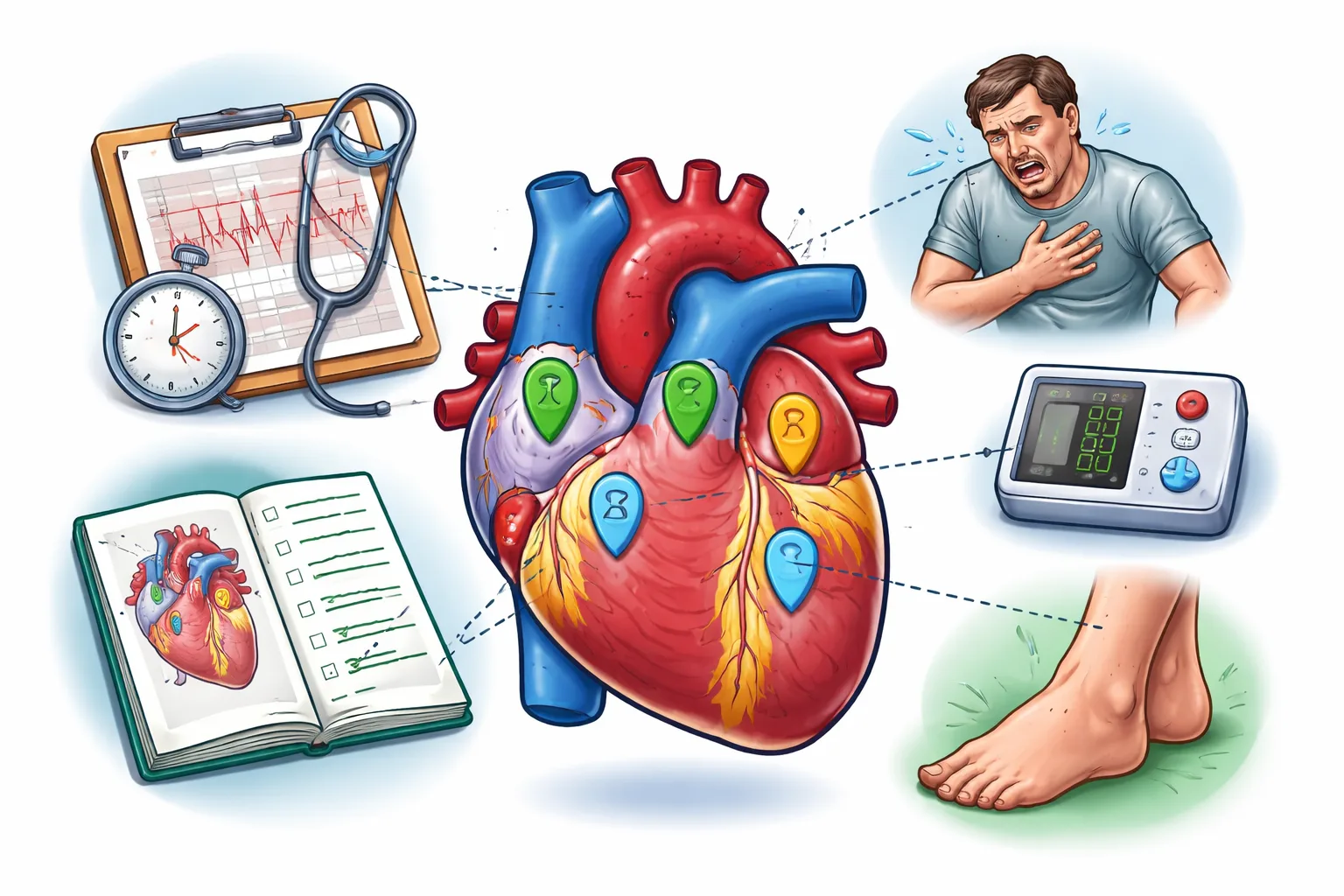
If you’ve ever paused on a stem asking which vasopressor for septic shock vs cardiogenic shock, this is the decision framework you want:
match the patient’s dominant hemodynamic problem (vasodilation vs pump failure vs mixed shock)
to the receptor profile that fixes it—without causing the classic board-style complications.
USMLE shock questions reward a simple habit: before you name a drug, name the dominant physiologic failure.
On exam day, you rarely get invasive hemodynamics—but you do get clues that map to either
low systemic vascular resistance (SVR), low cardiac output (CO), or both.
Your pressor/inotrope choice is just receptor pharmacology applied to that bucket.
USMLE tip: if the stem screams “vasodilated,” start with α support; if it screams “pump failure,” add β1 support.
Septic shock is the classic distributive picture: vasodilation (low SVR) plus capillary leak, often with a high-output phase early
and a “septic cardiomyopathy” phase later. Your initial pressor choice should
restore vascular tone while minimizing arrhythmias and excessive tachycardia—because tachycardia
increases myocardial oxygen demand and can worsen perfusion in patients already vasoplegic.
The USMLE point isn’t that dopamine never works; it’s that dopamine increases arrhythmias and performs worse in key subgroups.
If a stem offers dopamine as a nostalgic distractor, remember that large randomized data in shock populations found more arrhythmias with dopamine,
and a signal toward harm in cardiogenic shock subgroup analyses. The exam often frames this as “more tachyarrhythmias” and “worse outcomes.”
Vasopressin is not “second-line because it’s weak.” It’s second-line because it is best used as an adjunct:
a non-catecholamine way to raise SVR and reduce the catecholamine dose you need (often called “norepinephrine-sparing”).
In septic shock, endogenous vasopressin levels can become inappropriately low for the degree of vasodilation (“relative deficiency”),
which is why low-dose replacement makes physiologic sense.
Most exam stems and many real protocols use a fixed low dose rather than titration:
0.03 units/min is the classic anchor. Think “hormone replacement dose,” not “turn it up until the toes fall off.”
At that point, the question becomes: is this still pure vasodilation, or has cardiac output fallen (septic cardiomyopathy)?
If the patient is warm but profoundly hypotensive, another pressor (often epinephrine in many algorithms) may be layered.
If the patient is cold with poor perfusion, you should think “add inotropy” rather than endlessly squeezing the vasculature.
MDSteps helps you separate diagnosis, management, disposition, prevention, counseling, and timing so the next step stops feeling subjective.
Epinephrine is the drug that can look like the right answer for almost any shock stem because it has both β and α activity.
That’s also why it becomes an NBME trap: epinephrine can raise MAP, but it can also create confusing metabolic and rhythm effects
that make monitoring and interpretation harder. On boards, epinephrine is best understood as an agent you pick when you need
more inotropy plus vasoconstriction, or when first-line agents are unavailable.
A common vignette asks you to choose between “one strong drug” and “a targeted combination.”
In septic shock with myocardial dysfunction, a strategy of norepinephrine for tone plus dobutamine for forward flow
can be comparable to epinephrine alone in efficacy, but epinephrine tends to bring more tachycardia and higher lactate.
On USMLE, if the stem emphasizes low cardiac output signs (cool extremities, low urine output, echo with poor EF)
after MAP is already acceptable, the combination logic becomes more compelling than reflex epi.
Cardiogenic shock is a pump failure problem: low CO leads to hypotension and hypoperfusion. The temptation is to “fix the number” (MAP)
with pure vasoconstriction, but excessive afterload can further reduce stroke volume. The USMLE move is to balance:
restore perfusion pressure enough to maintain coronary and cerebral flow while also improving forward flow.
That’s why cardiogenic shock often involves both a vasopressor (for MAP) and an inotrope (for CO).
Dobutamine is a β1-predominant inotrope that increases contractility and (often) heart rate. It can also reduce afterload via β2,
which is helpful when the failing ventricle needs to eject against a high resistance—but risky if blood pressure is already marginal.
The USMLE pattern: dobutamine is correct when the question emphasizes ongoing hypoperfusion despite adequate MAP and volume,
or when cardiogenic shock needs a “push” to restore forward flow.
If you’re drilling shock pharmacology, pair a short “hemodynamic bucket” note with each miss and let the
platform generate flashcards from your wrong-answer logic. In MDSteps, the Adaptive QBank and missed-question
flashcard deck can turn this topic into a spaced pattern—rather than a one-time memorization pass.
Real patients (and good exam writers) love mixed shock: sepsis with new heart failure, massive MI with inflammatory vasodilation,
pancreatitis with hypovolemia plus distributive features. Mixed shock is where students either overtreat SVR (making the heart fail harder)
or overtreat CO (making blood pressure collapse). The solution is to manage two goals simultaneously:
perfusion pressure (MAP) and forward flow (CO), guided by end-organ perfusion.
This is your last-minute, exam-day pattern recognition list. Read the stem, identify the shock bucket, and select the vasoactive that fixes
the dominant problem while avoiding the predictable complication.
If you want to make this automatic, set up a “shock” tag set in your QBank reviews and track which bucket you missed most. The MDSteps analytics dashboard can make that visible fast.
Ryan K. Lee, MD (Emergency Medicine)What you’ll be able to do after reading
Build the mental model first: SVR vs CO vs “mixed” shock
Board-style hemodynamic translation
Receptor “cheat map” (why each drug behaves the way it does)
Agent
Primary effect
Exam shorthand
Norepinephrine
α1 >> β1
“Raise SVR without crazy tachy”
Epinephrine
β1/β2 → α1 (dose dependent)
“More inotropy; more lactate/tachy”
Vasopressin
V1 vasoconstriction (non-catecholamine)
“Add-on to spare norepi”
Dobutamine
β1 > β2 (inotrope; can drop SVR)
“Fix low CO when BP can tolerate it”
One-pass shock sorting algorithm (exam-friendly)
Septic shock: why norepinephrine is first-line
Mechanism-to-stem matching for norepinephrine
Dosing anchors you can recognize on questions
Why “not dopamine” is still high-yield
When to add vasopressin in sepsis (and what it’s really doing)
Board triggers to reach for vasopressin
Dose: memorize one number, understand the intent
What to do if norepi + vasopressin still isn’t enough
Clinical stems are easier when you can see the decision being tested.
Still missing questions you thought you understood?
Epinephrine: the “power tool” (useful, but messy)
When epi shows up as the correct choice
Classic “epi side-effects” the exam likes
High-yield compare: epi alone vs norepi + dobutamine
Cardiogenic shock: pressors support pressure, inotropes support flow
When norepinephrine is the “pressor” for cardiogenic shock
What not to do (common distractors)
Mini-flowchart: cardiogenic shock vasoactive sequence
Dobutamine: the inotrope you choose when “flow” is the problem
High-yield indications
Side effects & pitfalls
Exam move: decide whether you need “more pressure” or “more flow”
Finding
Suggests
Typical move
Warm, vasodilated, MAP low
Low SVR
Norepi first; add vasopressin if escalating
Cold, clammy, pulmonary edema, MAP low
Low CO + low perfusion pressure
Norepi to support MAP; then add dobutamine if needed
MAP okay but lactate high, oliguria persists
Ongoing hypoperfusion (often low flow)
Consider dobutamine after ensuring volume and ruling out obstruction
Tachyarrhythmia after vasoactive start
Excess β stimulation
Reconsider epi/dobutamine dose; correct electrolytes/ischemia
MDSteps workflow tip (optional, but clutch)
Mixed shock and the “two-number” trap: MAP vs perfusion
Signs you’re dealing with mixed physiology
A practical mixed-shock strategy (USMLE-ready)
Common NBME-style pitfalls (memorize these as “wrong-answer magnets”)
Rapid-Review Checklist: choosing the right agent in 15 seconds
Checklist
One-table summary (printable)
Scenario
Best first move
Then…
Septic shock, MAP low
Norepi
Add vasopressin if escalating
Septic shock, refractory
Norepi + vasopressin
Consider epi; recheck perfusion + source control
Cardiogenic shock, hypotensive
Norepi
Add dobutamine for low CO
Low CO, MAP acceptable
Dobutamine
Watch tachy/hypotension; treat cause
Exam-Day Essentials
References (external)
Medically reviewed by
Clinicals
Vasopressors & Shock: Norepi vs Epi vs Vasopressin vs Dobutamine (When and Why)
For clinical reasoning gaps
Both answers can sound good. Only one fits this patient right now.
Practice the patient-specific clue that makes one answer safer, faster, more appropriate, or more complete than the other.
Full access includes Step 1, Step 2 CK, Step 3, CCS cases, analytics, auto-flashcards, and study planning.
Pivot-clue review
See the exact phrase in the stem that should have changed your decision.
Distractor trap logic
Learn why the answer you almost picked felt right—and why it was wrong for this patient right now.
Miss-pattern analytics
Turn repeated mistakes into targeted blocks, flashcards, and readiness signals.
NBME trap: “normal-ish” MAP does not equal adequate perfusion. Shock is a perfusion problem first.
Practical takeaway for boards: in septic shock, pick norepinephrine first unless a question explicitly removes it from options.
Safety pearl: excessive vasoconstriction risks digital and splanchnic ischemia—boards love the “cold digits” complication.
If still warm/vasoplegic:
Add another vasopressor class (commonly epi) while reassessing source control and fluid responsiveness.
If now cold/low-output:
Consider dobutamine when perfusion is low despite acceptable MAP and volume status.
Score stuck after more questions?
Free reasoning diagnostic
Pivot clue isolatedDistractor trap explainedNext study target identified
No credit card required for the free reasoning review. Full access is $27/month after that. Cancel anytime.
Reasoning diagnostic
Still missing the same kinds of questions?
Read why that happens.
Exam phrasing to watch: “lactate rising after epinephrine started” may be a pharmacologic effect, not necessarily treatment failure.
NBME trap: “Give fluids” is not the automatic answer in cardiogenic shock—look for pulmonary edema and high JVP.
Pitfall: “BP is 92/58 so give dobutamine.”
If the patient is vasodilated, dobutamine can worsen hypotension. Start with norepi to stabilize MAP first.
Pitfall: “Lactate rose after starting epi = sepsis worsening.”
Epi can raise lactate via β2 effects. Look at perfusion, urine output, and trend after resuscitation.
Pitfall: “Add vasopressin and titrate high until MAP is normal.”
Low-dose adjunct is the board-relevant concept; high doses increase ischemic risk.
Pitfall: “Pressors fix shock even without source control.”
For sepsis, antibiotics and source control are definitive; pressors buy time.