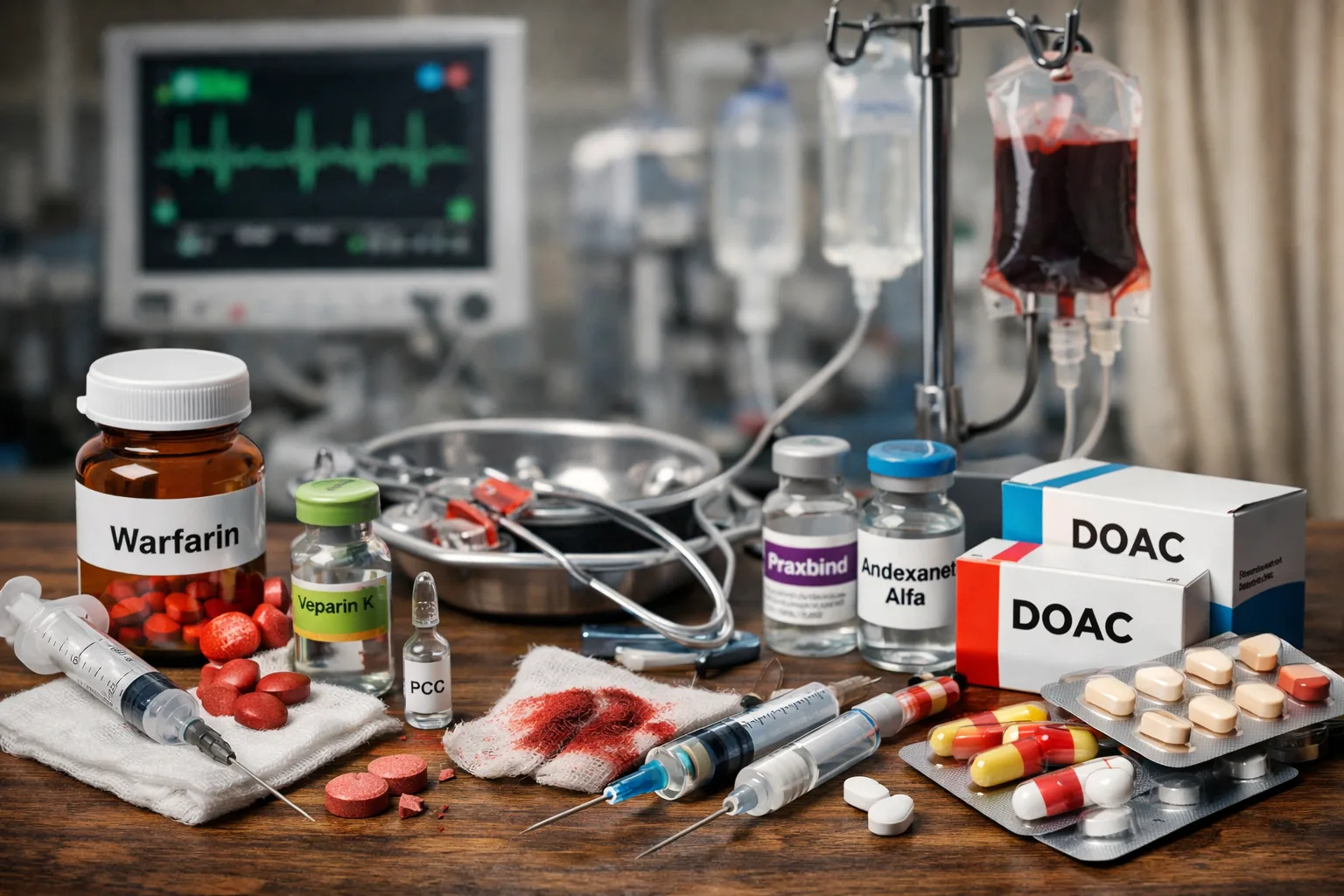
USMLE questions don’t reward memorizing drug lists. They reward recognizing which coagulation “lever” is being pulled and
how quickly you can release it. Start with two anchors:
(1) warfarin reduces synthesis of vitamin K–dependent factors (II, VII, IX, X, plus proteins C and S),
and (2) DOACs directly inhibit an activated clotting enzyme (thrombin for dabigatran; factor Xa for
apixaban/rivaroxaban/edoxaban). Everything else—bridging, INR interpretation, and reversal—flows from those anchors.
The exam trick is that the same clinical story (GI bleed, head trauma, urgent surgery) produces different “best next steps” depending on
which anticoagulant is on board, when the last dose was taken, and kidney function. You’ll rarely be asked to calculate a half‑life.
Instead, expect clues like: “last dose this morning,” “creatinine clearance is low,” or “INR is 6.8.” Translate those into one of three
decision lanes:
Keep these lanes in mind as you work through the next sections. The key is to stop thinking “drug list” and start thinking “mechanism + timing + risk.”
USMLE stems often ask you to switch anticoagulants or pick the “most appropriate long‑term therapy.”
A clean way to answer is to sort indications into “DOAC‑friendly” and “warfarin‑preferred,” then apply contraindications.
The exam also loves interaction traps. Warfarin is a pharmacology magnet: antibiotics, amiodarone,
antifungals, and many other drugs can raise INR; leafy‑green intake can lower it; and liver disease or malnutrition can
amplify effect. DOACs have fewer classic food interactions, but absorption and metabolism still matter. When a stem gives you a new medication
and an unexpected bleed, warfarin is the usual culprit unless the question is explicitly targeting a DOAC antidote.
If you want a practical study tactic: take any anticoagulation question and rewrite it twice—once as warfarin, once as a DOAC—then note how the correct answer changes.
That single exercise trains your “decision lane” thinking faster than memorizing tables.
Bridging is a favorite USMLE trap because it looks like “extra safety,” yet in many patients it increases bleeding without meaningfully reducing thrombosis.
Your goal is to identify the small group where interruption is dangerous enough that you temporarily cover them with a short‑acting parenteral anticoagulant
(typically LMWH or IV unfractionated heparin), and to avoid bridging when the underlying drug already has a short offset.
Bridging is mainly a warfarin concept. DOACs usually do not require bridging because holding them for a short, procedure‑specific window
clears the anticoagulant effect rapidly in patients with acceptable renal function.
USMLE loves to embed bridging inside “med‑surg” logistics: “He’s scheduled for colonoscopy,” “She needs urgent cholecystectomy,” “A spinal procedure is planned.”
Your job is to separate procedure timing from thrombotic urgency. If the patient’s thrombotic risk is low, the safest plan is often simply to hold and restart.
If risk is high, bridging becomes reasonable—but the stem will usually wave a flag like “recent pulmonary embolism” or “mechanical mitral valve.”
MDSteps helps you separate diagnosis, management, disposition, prevention, counseling, and timing so the next step stops feeling subjective.
Warfarin questions are often framed as an elevated INR. The high-yield move is to avoid treating the number in isolation.
Instead, decide: (1) is there major bleeding or an urgent procedure? and (2) do you need immediate factor replacement?
Vitamin K corrects the deficiency, but it’s not instant. Prothrombin complex concentrate (PCC) replaces factors quickly.
Fresh frozen plasma (FFP) exists, but modern algorithms often favor PCC for rapid reversal because it’s faster and less volume‑heavy.
Vitamin K needs the liver to synthesize new factors; it’s corrective but not instantly corrective. In a stable patient without bleeding,
that’s fine. In a crashing patient (massive GI bleed) or a patient with a brain bleed, the exam expects you to restore clotting factors right now.
That’s where PCC earns points: it supplies the factors immediately, while vitamin K prevents “rebound anticoagulation” after PCC wears off.
If you’re using MDSteps to drill this, tag any warfarin item you miss into a “INR + bleeding” deck and force yourself to write the two decisions
(severity + urgency) before looking at the explanation. That single habit usually fixes the entire warfarin reversal category within a week.
Note: exact INR cutoffs vary by protocol; USMLE tends to test the conceptual split between “no bleeding” vs “major bleeding/urgent surgery” rather than fine cut‑points.
DOAC vignettes usually provide (or imply) three details: the specific agent, the timing of the last dose, and kidney function.
The correct answer is rarely “check an INR.” Instead, you decide whether the patient can be managed with supportive care and drug clearance,
or whether they meet criteria for targeted reversal.
Two edge tools show up occasionally: activated charcoal if ingestion was very recent (think “just took the dose”),
and hemodialysis for dabigatran in certain scenarios because it has appreciable renal clearance and dialyzability.
Exam writers usually flag this by giving severe renal failure plus dabigatran and ongoing bleeding.
On Step 2, the “antidote” question is often immediately followed by a “restart” question. Don’t stop after you pick the reversal agent—ask yourself what the next move is once bleeding is controlled.
Peri‑procedure anticoagulation questions feel like a calendar math test, but you can answer most of them with patterns.
The exam is less interested in “exact hours” and more interested in whether you:
(1) appreciate the difference between short‑acting DOACs and long‑offset warfarin, and
(2) understand that procedure bleeding risk and renal function change the hold window.
A practical study move is to memorize relationships, not times: “higher bleed risk = longer hold,” “worse kidneys = longer hold,” and “warfarin = bridge only for high thrombosis risk.”
Those three rules answer most Step‑style peri‑procedure questions.
Restart questions are about clinical reasoning, not courage. The test wants you to weigh thrombotic risk if off anticoagulation
against rebleeding risk if restarted too soon. The stem often provides a bleeding site (GI vs intracranial),
hemostasis status (endoscopic control vs ongoing oozing), and the underlying indication for anticoagulation (AF vs recent PE vs mechanical valve).
If you’re building an error log, MDSteps’ automatic flashcard decks from misses work best here: create one card per “lane” and force yourself to write a one‑sentence justification before flipping to the answer.
The quickest path to mastery is not rereading guidelines—it’s rehearsing templates. Below are five classic stems that repeatedly appear on Step 1 and Step 2 CK.
Work them until your response is automatic, then mix them by swapping the anticoagulant and changing kidney function.
Stem: Elderly patient falls, CT shows intracranial hemorrhage, taking an anticoagulant. What the test wants: Stabilize, stop the drug, and choose rapid reversal based on the specific agent (warfarin → PCC + IV vitamin K; dabigatran → idarucizumab; factor Xa inhibitor → andexanet/PCC pathway). Critical-site bleeding is the key signal. Stem: Patient on warfarin, INR elevated, no bleeding. What the test wants: Hold/adjust warfarin; consider vitamin K only when the INR is extremely high or bleeding risk is significant. The “gotcha” is avoiding aggressive reversal when there is no bleeding and no urgent procedure. Stem: Needs emergent operation; on anticoagulant; last dose was recent. What the test wants: If surgery can’t wait, choose rapid reversal matched to drug; if it can wait, hold and allow clearance (especially for DOACs). Timing language (“in 2 hours,” “tomorrow morning”) is your biggest clue. Stem: Elective procedure scheduled; on warfarin or DOAC; asks about bridging. What the test wants: Warfarin may need bridging only for high thrombotic risk. DOACs are typically held for a procedure-specific window without bridging. Renal impairment extends DOAC hold time. Stem: Bleeding controlled; asks when and what to restart. What the test wants: Restart after hemostasis, balancing clot risk vs rebleed risk. The exam usually rewards a plan that acknowledges stability first and prioritizes high thrombotic risk conditions for earlier resumption.Warfarin = “slow on, slow off”
DOACs = “fast on, fast off”
Lane
What the vignette is really testing
What you do first
Bleeding now
Is it major/life‑threatening? Is there a specific antidote? Can you wait for drug clearance?
Stabilize (ABCs, transfuse if needed) → stop anticoagulant → targeted reversal when indicated
Procedure soon
Thrombotic risk if you hold? Bleeding risk of the procedure? What’s the minimal interruption time?
Hold/bridge based on risk category; choose timing based on drug kinetics + renal function
Restart question
When is it safe to resume after hemostasis? What’s the trade‑off between recurrent bleed and thrombosis?
Restart once bleeding is controlled; earlier for high thrombosis risk, later for high rebleed risk
DOAC vs warfarin on test day: choose the drug based on the patient in front of you
When DOACs are usually favored (classic exam pattern)
When warfarin is often preferred (high‑yield exceptions)
Board-style “which lab matters?” rule
Bridging made testable: who needs it, who doesn’t, and why
Core principle
Step-style risk stratification (the way exam writers think)
Thromboembolism risk if anticoag held
Examples the test likes to use
Typical peri-procedure plan
High
Mechanical mitral valve; recent stroke/TIA in AF; VTE within the past few months; severe thrombophilia (e.g., antiphospholipid syndrome)
For warfarin: stop in advance and bridge with LMWH/UFH; resume when hemostasis is secure.
For DOACs: usually no bridge; consider specialist input if “extreme risk” scenario appears.
Moderate
AF with multiple risk factors; remote VTE; bioprosthetic valve with AF
Individualize; many questions still steer you away from bridging unless the stem emphasizes recent events.
Low
AF without recent stroke; VTE > 12 months ago with no major thrombophilia
Hold anticoagulant for procedure window; no bridging.
A testable “mini‑algorithm” for bridging
Clinical stems are easier when you can see the decision being tested.
Still missing questions you thought you understood?
Warfarin reversal: turn “INR panic” into two decisions (bleeding severity + urgency)
If INR is high but no bleeding
If there is major bleeding or emergency surgery
Why “vitamin K alone” is sometimes wrong
One-page warfarin reversal flowchart (USMLE logic)
DOAC reversal: match the antidote to the drug, then decide if you truly need reversal
Drug class
Common agents
Targeted reversal options (board-relevant)
Direct thrombin inhibitor
Dabigatran
Idarucizumab for life‑threatening bleeding or urgent procedures; supportive care and time when stable.
Factor Xa inhibitors
Apixaban, rivaroxaban (and sometimes edoxaban)
Andexanet alfa for major bleeding in select settings; PCC is a common alternative in many institutional pathways.
When the test wants “supportive care and hold the drug”
When the test wants “antidote / rapid reversal”
Activated charcoal and dialysis: the “rare but testable” details
Peri‑procedure holds: the high-yield timing patterns that replace memorization
Warfarin peri‑procedure pattern
DOAC peri‑procedure pattern
A “procedure risk” shortcut that matches USMLE stems
Common “hold vs bridge” vignette conversions
Stem detail
What it means
Likely best action
Elective colonoscopy; AF; no recent stroke
Low–moderate thrombotic risk
Hold anticoagulant appropriately; no bridge
Mechanical mitral valve; elective surgery
High thrombotic risk
Stop warfarin and bridge with LMWH/UFH
Apixaban; normal renal function; minor procedure
Short offset, low bleed risk
Short hold or timed scheduling; no bridge
Dabigatran; CKD; high‑bleed surgery
Prolonged effect with renal impairment
Longer hold; consider antidote if truly urgent
Restarting anticoagulation after bleeding: the “re-bleed vs clot” trade that USMLE tests
Factors pushing earlier restart
Factors pushing later restart
Board-style “restart” phrasing and what it means
Rapid-Review Checklist (bookmark this for dedicated blocks)
Exam-Day Essentials
Practice with vignette templates: the fastest way to stop missing anticoagulation questions
How to drill this in 20 minutes
Clinicals
Warfarin Reversal vs DOAC Reversal: Bridging & Antidotes for USMLE Prep
For clinical reasoning gaps
Both answers can sound good. Only one fits this patient right now.
Practice the patient-specific clue that makes one answer safer, faster, more appropriate, or more complete than the other.
Full access includes Step 1, Step 2 CK, Step 3, CCS cases, analytics, auto-flashcards, and study planning.
Pivot-clue review
See the exact phrase in the stem that should have changed your decision.
Distractor trap logic
Learn why the answer you almost picked felt right—and why it was wrong for this patient right now.
Miss-pattern analytics
Turn repeated mistakes into targeted blocks, flashcards, and readiness signals.
NBME-style pitfall: Don’t bridge a DOAC “because it feels safer.” The question writer is often testing that you recognize the short half‑life and choose a timed hold instead.
Score stuck after more questions?
Free reasoning diagnostic
Pivot clue isolatedDistractor trap explainedNext study target identified
No credit card required for the free reasoning review. Full access is $27/month after that. Cancel anytime.
Reasoning diagnostic
Still missing the same kinds of questions?
Read why that happens.
Step 1
Is there major bleeding or urgent surgery?
Step 2
If yes: PCC + IV vitamin K + supportive care.
Step 3
If no: hold warfarin; consider oral vitamin K only when INR is very high or bleeding risk is high.
USMLE clue: If the stem explicitly names dabigatran and asks “most appropriate reversal agent,” the answer is almost always idarucizumab.
If it names apixaban or rivaroxaban and describes major bleeding, the stem is likely testing andexanet alfa or PCC-based reversal pathways.
Test-taker move: If you’re unsure, choose the answer that explicitly states bleeding control first (e.g., “confirm hemostasis”),
then safe resumption based on risk. USMLE punishes “restart immediately” answers unless the stem screams extreme thrombosis risk and controlled bleeding.
Medically reviewed by: R. Patel, MD (Internal Medicine)
References (external)